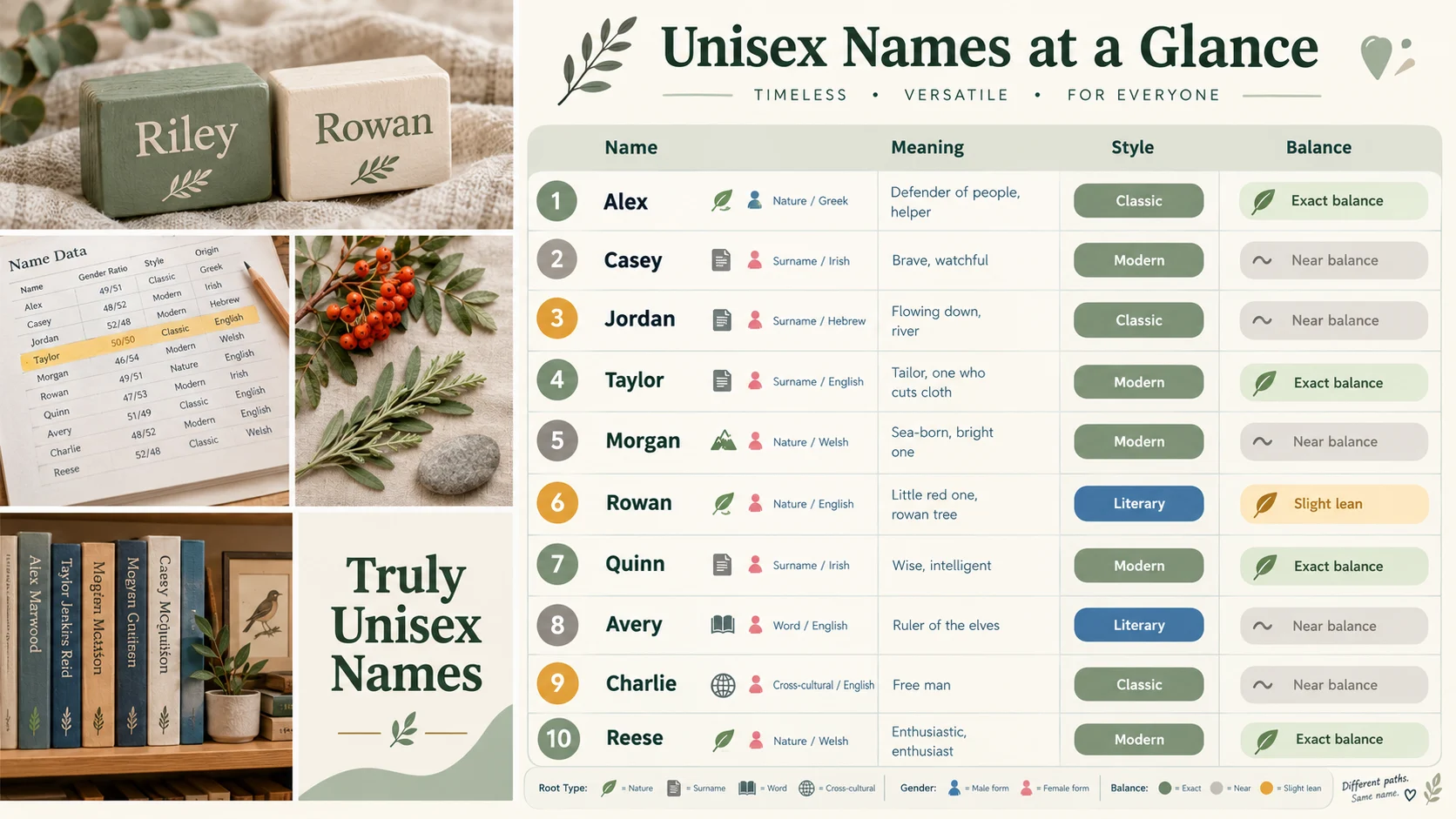
Unisex names are given names used for people of any gender, though many lean more heavily toward one sex in practice. Truly balanced unisex names, such as Charlie and Robin, are used roughly equally for boys and girls.
- The search for unisex names often starts with a simple frustration. You want a name that does not announce a gender before the person does. Maybe you are naming a child and want to leave room for whoever they become. Maybe you are writing a character and need a name that works regardless of how readers imagine them. Maybe you are choosing a name for yourself. The problem is that many so-called unisex names are not actually neutral. They lean heavily one way, and the “unisex” label is doing more wishful thinking than descriptive work. This guide cuts through that. It covers ten unisex names with genuine balance or strong neutral credentials, explains their origins, and offers practical advice for choosing one. It also explains how to check whether a name is truly unisex rather than just marketed that way. No name determines identity. But a thoughtfully chosen unisex name can offer flexibility that gendered names cannot.
10 Unisex Names Worth Considering
1. Charlie
Meaning and origin: Charlie derives from Charles, which comes from the Germanic name Karl, meaning free man. It began as a nickname and has functioned as a standalone name for decades .
Style and vibe: Warm, friendly, and unpretentious. It has a casual, approachable sound that works equally well in childhood and adulthood.
Gender balance: Charlie is one of the few names used exactly evenly between girls and boys in recent U.S. naming data, making it a genuinely balanced unisex choice .
Best for: Families who want a name that feels familiar without being generic. It suits parents who value flexibility and do not want to commit to a strongly gendered choice.
Similar names: Charley, Charli, Chuck, Charles.
Why it works today: Charlie has moved beyond its nickname origins to become a standalone name in its own right. Its perfect gender split makes it a rare example of a truly neutral option.
2. Robin
Meaning and origin: Robin comes from the diminutive of Robert, a Germanic name meaning bright fame. It also refers to the bird, which reinforced its nature association in English-speaking countries .
Style and vibe: Gentle, classic, and slightly literary. It has a soft sound that feels warm rather than sharp.
Gender balance: Robin is used more often for girls in recent U.S. data, but it has a long history of use for both genders and appears on BabyCenter’s list of names used almost equally .
Best for: Parents drawn to nature names with historical depth. It works well for characters and real people alike.
Similar names: Robyn, Rob, Robbie, Birdie.
Why it works today: Robin balances a bird association with a medieval root, giving it both charm and substance. It is familiar without being overused.
3. Kai
- Meaning and origin: Kai has multiple origins. In Hawaiian, it means sea. In Japanese, it can mean forgiveness or recovery depending on the characters used. In Scandinavian languages, it is a form of Cai or Kay. This multicultural root structure makes it unusually versatile .
Style and vibe: Short, crisp, and modern. The single syllable gives it a clean, punchy sound that feels contemporary.
Gender balance: Kai is widely used for both boys and girls, particularly in Hawaii and increasingly across the mainland United States. It is cited as a durable unisex name heading into 2026 .
Best for: Families seeking a short, globally legible name. It suits parents who want something modern without being invented.
Similar names: Kye, Kaine, Cai, Kailani.
Why it works today: Kai’s multiple origins give it cross-cultural legitimacy. It is short enough for a child and substantial enough for an adult.
4. Rowan
Meaning and origin: Rowan comes from the Irish and Scottish name for the rowan tree, which carries associations with protection and resilience in Celtic tradition .
Style and vibe: Natural, grounded, and slightly rugged. It has a two-syllable flow that feels balanced and strong.
Gender balance: Rowan is used for both genders, though it leans slightly toward boys in some data sets. Its nature association gives it neutral appeal regardless of statistics.
Best for: Families drawn to nature names with Celtic roots. It works well for parents who want something earthy without being overtly floral or delicate.
Similar names: Rowen, Rowanne, Ash, Birch.
Why it works today: Rowan fits the broader interest in nature names while avoiding the more heavily gendered options like Lily or Rose. Its Celtic origin gives it depth.
5. Sage
Meaning and origin: Sage comes from the herb, which has associations with wisdom and healing. The word itself derives from the Latin salvia, meaning to heal or save .
Style and vibe: Calm, minimalist, and slightly spiritual. It has a soft, open sound that feels modern and uncluttered.
Gender balance: Sage is used for both boys and girls, with a slight lean toward girls in recent data. Its word-name status gives it flexibility.
Best for: Parents who want a short, meaningful name with a nature connection. It suits families drawn to minimalism and calm aesthetics.
Similar names: Sable, Cedar, Fern, Basil.
Why it works today: Sage combines a clean sound with a positive meaning. It works equally well as a first name or a middle name.
6. Finley
Meaning and origin: Finley is a Scottish surname meaning fair-haired hero. It entered first-name usage in the late twentieth century and has risen steadily since .
Style and vibe: Friendly, modern, and slightly sporty. It has a light, approachable sound with a surname-name structure.
Gender balance: Finley is used more often for girls in recent U.S. data, but the split is close enough that it functions as a genuine unisex option .
Best for: Families who like surname names but want something softer than Hunter or Mason. It works well for parents seeking a modern name with history.
Similar names: Finn, Finlay, Hadley, Harper.
Why it works today: Finley offers the surname-name trend in a less aggressively masculine package. Its Scottish roots give it substance beyond trend.
7. Jules
Meaning and origin: Jules is a French form of Julian or Julia, both of which derive from the Latin Iulius, possibly connected to Jupiter. It functions as a standalone name and a nickname .
Style and vibe: Sleek, European, and slightly literary. It has a sophisticated sound that works across ages.
Gender balance: Jules appears on BabyCenter’s list of names with exactly equal registrations between genders .
Best for: Parents drawn to French names and literary associations. It works well for characters and for children who may want a name that travels internationally.
Similar names: Julian, Julia, Julie, Julien.
Why it works today: Jules is short, elegant, and genuinely balanced. It carries a European flair without being difficult to pronounce in English.
8. River
Meaning and origin: River is a nature word name referring to a flowing body of water. It entered name usage in the late twentieth century alongside other nature names .
Style and vibe: Flowing, calm, and modern. It has a natural, free-spirited quality that appeals across aesthetic preferences.
Gender balance: River is used for both boys and girls, though it leans slightly toward boys in some data. Its word-name status makes it inherently neutral.
Best for: Families drawn to nature and water imagery. It works for parents who want something modern and evocative without being abstract.
Similar names: Brooks, Brook, Lake, Ocean.
Why it works today: River captures the appeal of nature names while avoiding the floral associations that often push names toward feminine usage. It is simple and evocative.
9. Sidney
Meaning and origin: Sidney comes from an Old English surname meaning dweller by the well-watered land. It has a long history as both a surname and a given name .
Style and vibe: Classic, slightly formal, and distinguished. It has a crisp sound that feels both traditional and modern.
Gender balance: Sidney appears on BabyCenter’s list of names with exactly equal registrations . It has shifted between genders historically and now sits in a balanced position.
Best for: Families who want a classic name with surname roots. It suits parents seeking something familiar but not overused.
Similar names: Sydney, Syd, Sidney variants, Shelby.
Why it works today: Sidney’s surname origin and balanced usage make it a practical unisex choice. It works in professional contexts without feeling stiff.
10. Kiran
Meaning and origin: Kiran is a Sanskrit name meaning ray of light. It is widely used across India and has gained international recognition in recent years .
Style and vibe: Bright, warm, and cross-cultural. It has a two-syllable flow that feels both traditional and modern.
Gender balance: Kiran is used for both boys and girls in India and among diaspora communities. It is one of the best-known gender-neutral names in South Asian naming traditions.
Best for: Families with South Asian heritage or anyone drawn to names with light-related meanings. It works well for parents who want cultural specificity without difficulty of pronunciation.
Similar names: Kieran, Kirin, Kirana, Roshan.
Why it works today: Kiran combines a meaningful root with cross-cultural usability. It demonstrates that unisex naming is not a Western invention but a global practice.
Quick Comparison Table
How to Choose a Unisex Name
Check the data, not the label. Many lists call names unisex when they are used 90 percent for one gender. A reasonable threshold for genuine balance is at least 40 percent usage for each gender in recent statistics. Nameberry uses this standard to identify truly balanced names .
Decide how neutral you want to go. Some families want a name that offers flexibility without being unusual. Others want a name that actively resists gendered assumptions. Charlie and Jules sit at the balanced end. River and Rowan lean slightly but still offer flexibility.
Consider the cultural source. Unisex naming is not a single tradition. Sanskrit names like Kiran, Hebrew names like Noa, and Japanese names like Kai all function differently in their cultural contexts. Research the source before borrowing .
Think about how the name ages. A name that sounds cute on a toddler should also work on a teenager and an adult. Charlie, Sidney, and Robin all have established histories as adult names. Newer options like Sage and River are still proving their longevity.
Test the name in context. Say the name with your surname. Imagine it on a job application, a byline, and a social media profile. A name that feels neutral in one context may feel strongly gendered in another.
Accept that usage shifts. Names move between genders over time. Ashley was once primarily male. Madison was a surname. Harper shifted toward girls within a generation. A name that is unisex today may not stay that way, and that is not necessarily a problem .
For characters, prioritize distinctiveness. Fiction benefits from names that do not immediately signal gender, especially for characters whose identity is part of the story. Short names like Kit, Ash, and Robin work well because they are memorable without being overdetermined .
Query Fan-Out:
- What are the most balanced unisex names? Recent analysis identifies Charlie, Finley, Skyler, Justice, and Royal as among the most evenly split between girls and boys in U.S. usage data .
- Are unisex names becoming more popular? BabyCenter data shows growing interest in names used equally for both genders, with parents increasingly choosing options like Blake, Jules, and Sidney .
- What are unisex names from nature? River, Rowan, Sage, Wren, and Sky are nature-inspired options used for any gender .
- What unisex names work across cultures? Kai, Arya, Kiran, and Noa have roots in multiple languages and are used internationally .
- Do unisex names have to be modern? No. Names like Robin, Sidney, and Ashley have shifted between genders over centuries, showing that neutral usage is not a new phenomenon .
- What are good unisex names for a character? Short, distinctive names like Kit, Ash, Robin, and Jules work well in fiction because they avoid gendered assumptions .
- How do I know if a name is truly unisex? Check recent naming statistics. A name used at least 40 percent for each gender is often considered genuinely balanced .
FAQ
What are the most truly unisex names?
Based on recent U.S. naming data, names used most evenly between girls and boys include Charlie, Jules, Sidney, Robin, and Finley. These names have splits close to 50-50, making them genuinely balanced rather than leaning heavily one way .
Are unisex names becoming more common?
Data from BabyCenter and other naming sources suggests growing interest in names used for both genders. Parents are increasingly choosing options like Blake, Jojo, and Landry, which achieved exactly equal registrations in recent data .
What are some unisex nature names?
Nature-inspired unisex names include River, Rowan, Sage, Wren, Sky, and Cedar. These names draw on natural imagery rather than gendered traditions, making them inherently flexible .
What unisex names work across cultures?
Kai has Hawaiian, Japanese, and Scandinavian roots. Kiran is widely used in South Asia. Arya has Sanskrit origins and international recognition. Noa is used in Hebrew and other traditions. These names travel well because they have meaning in multiple languages .
Do unisex names have to be modern?
No. Names like Robin, Sidney, and Ashley have shifted between gendered usage over centuries. The practice of using a name for both genders is not new, though the current cultural interest in neutrality is more visible than in past decades .
What are good unisex names for a nonbinary person?
The best name is one that feels right to the person using it. Commonly chosen options include short, nature-based, or surname names like Ash, Kit, Robin, Sage, and Jules. There is no single correct choice, and the most important factor is personal comfort .
How can I tell if a name is actually unisex?
Check recent naming statistics from sources like the Social Security Administration or BabyCenter. If the name is used at least 40 percent for each gender, it is reasonably balanced. Names used 90 percent for one gender are not truly unisex in practice .
What are some rare unisex names?
Options include Vesper, Ciel, Romilly, Hollis, and Bellamy. These names are used for both genders but are uncommon enough to feel distinctive. Many come from word names, surnames, or literary sources .
Conclusion
- Unisex names offer something that gendered names cannot: room. Room for a child to become whoever they are without their name making assumptions. Room for a character to exist before the reader decides what to make of them. Room for a person to choose a name that fits without being boxed in. The ten names in this guide are not the only options, but they are among the most genuinely balanced, backed by data rather than wishful labeling. Charlie and Jules split perfectly. Kai crosses cultures. Kiran carries light in its Sanskrit root. Use the data when you can, trust your ear when you cannot, and remember that usage shifts over time. If you have a favorite unisex name, share it in the comments. The best conversations about names are the ones where everyone brings something different.

Scarlett Howard is a writer and name enthusiast at NicknameCorner. She creates creative and helpful guides on nicknames, names, usernames and naming ideas, helping readers find meaningful, memorable and unique names for every occasion.









14 thoughts on “Unisex Names Guide| Meanings, Origins, and How to Choose”