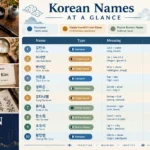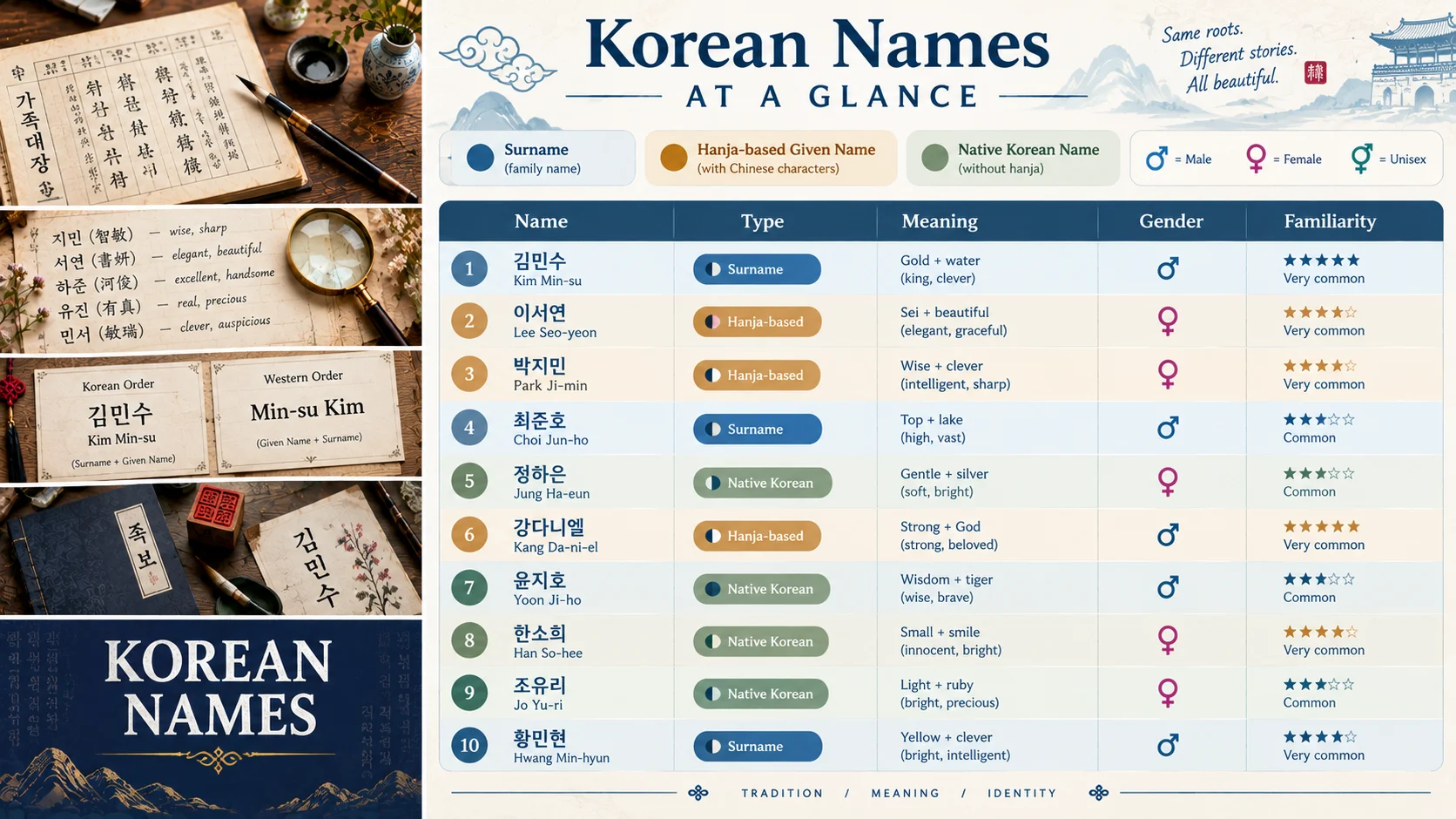
Korean names consist of a family name followed by a two-syllable given name. Family names come from a small set of Korean surnames, while given names are often formed from Sino-Korean characters chosen for their meaning, sound, and auspicious associations.
A Korean name is a small, precise package of information. It tells you a person’s family, often their generational position, and frequently a pair of carefully chosen meanings that parents hoped would shape a life. Unlike English names, where a given name might be chosen mostly for sound or family sentiment, Korean names often carry a documented hanja meaning and a structural logic that reaches back centuries. That structure is part of why searches for Korean names attract such a wide audience. Some readers are expecting a child and want a name that sounds beautiful and means something. Others are writing characters, researching genealogy, or trying to understand why so many Koreans share the surname Kim. This guide explains the machinery behind Korean names, then presents ten names across the spectrum, from long-standing classics to current chart leaders. It also covers practical points like Romanization, naming taboos, and how to choose a name that works across cultures.
10 Korean Names Worth Knowing
1. Do-yun (도윤)
- Meaning and origin: Do-yun is a male given name built from Sino-Korean characters. The specific meaning varies by hanja, but common combinations include 道 (do, meaning path or way) paired with 允 (yun, meaning allowance or truth). The name has led recent birth registration rankings, holding the top spot for male names in consecutive years .
Style and vibe: Do-yun sounds modern and balanced, with a soft opening and a clean close. It fits the current preference for names that feel contemporary but still carry classical character roots.
Best for: Parents who want a name that is currently well recognized in Korea without being an older generational marker. It pairs easily with single-syllable surnames.
Familiarity: Very high in South Korea. Among the top male names in recent birth data, with roughly 1.8 percent of registered male births in one tracking period .
Similar names: Do-hyun, Do-ha, Yun-woo, Ji-ho.
Why it works today: Do-yun represents the current mainstream of Korean naming: two syllables, hanja-based meaning, and a sound that reads smoothly in both Korean and Romanized form.
2. Seo-yun (서윤)
Meaning and origin: Seo-yun is a female given name. The syllable Seo often carries meanings related to auspiciousness or brightness depending on the hanja, while Yun can mean graceful or shining. It has ranked among the most common female names in recent years .
Style and vibe: Seo-yun is soft, flowing, and slightly formal. It avoids harsh consonants and works well in both written and spoken Korean.
Best for: A name that feels current and elegant. It suits families looking for a female name with clear hanja potential and broad familiarity.
Familiarity: Extremely high. It appears repeatedly at or near the top of female name rankings in recent birth data .
Similar names: Seo-a, Seo-yeon, Ha-yun, Ji-yu.
Why it works today: Seo-yun balances tradition and trend. It uses established Sino-Korean elements but feels fresh rather than dated.
3. Ji-woo (지우)
Meaning and origin: Ji-woo is a unisex given name. Its meaning depends entirely on the hanja selected. Common combinations include 智 (ji, wisdom) with 雨 (woo, rain) or 祐 (woo, blessing). Because multiple hanja map to the same sounds, the name can carry different meanings across families .
Style and vibe: Ji-woo is clean, modern, and gender-neutral. It has become one of the most recognizable Korean names among international audiences, partly through its use in popular culture.
Best for: Parents who want a name that does not strongly signal gender and carries a pleasant, open sound.
Familiarity: Very high. It is a frequent choice across both male and female birth registrations and appears often in media .
Similar names: Ji-ho, Ji-yu, Ji-min, Ji-an.
Why it works today: Ji-woo demonstrates the flexibility of Korean naming. The same sound can carry different meanings, and the name does not need to be pinned to a single gender.
4. Kim (김)
- Meaning and origin: Kim is the most common Korean surname. The hanja most often used is 金, meaning gold. The surname is associated with multiple clans, each with its own historical origin, and is held by more than one in five Koreans .
- Style and vibe: Kim is short, hard, and unmistakable. It has a single syllable that carries immediate recognition, both in Korea and internationally.
Best for: Understanding the baseline of Korean surnames. It is the name most likely to appear in any random sample of Korean people.
Familiarity: The highest of any Korean surname. Roughly 21 percent of the Korean population carries it .
Similar names: Lee, Park, Choi, Jung.
- Why it works today: Kim illustrates the concentration of Korean surnames. A small set of family names covers a large population, which is why clan and generation details matter so much.
5. Lee (이)
Meaning and origin: Lee is the second most common Korean surname. The hanja 李 means plum or plum tree. Like Kim, it is divided into multiple clans with distinct genealogical records .
- Style and vibe: Lee is simple and slightly softer than Kim, with a vowel ending that makes it easy to pronounce in many languages.
Best for: Anyone researching a common Korean surname or looking for a name that transitions smoothly into English-language contexts.
Familiarity: Extremely high. About 14.7 percent of the population carries the surname .
Similar names: Rhee, Yi, Ri, Leigh, all Romanization variants of the same surname .
Why it works today: Lee shows how Romanization shapes perception. The same surname can appear as Lee, Rhee, Yi, or Ri depending on family preference and historical convention.
6. Park (박)
Meaning and origin: Park is the third most common Korean surname. The hanja 朴 means gourd. The surname is traditionally associated with the founder of the Park clan, and it appears in historical records from the Silla period .
Style and vibe: Park is short, crisp, and globally recognizable, partly through the prominence of Korean public figures abroad.
Best for: A surname that is common, historically deep, and easy to spell in English.
Familiarity: Very high. Roughly 8.4 percent of the population carries it .
Similar names: Pak, Bak, all Romanization variants.
- Why it works today: Park is a case study in how a single-syllable surname can become a global identifier while remaining rooted in a specific clan history.
7. Ji-hye (지혜)
Meaning and origin: Ji-hye is a female given name meaning wisdom. The syllable ji often corresponds to 智 (wisdom), and hye often corresponds to 慧 (wisdom or intelligence). The name is a direct, transparent statement of a valued quality .
Style and vibe: Ji-hye is classic, clear, and slightly formal. It has been used across generations and does not feel tied to a single decade.
Best for: Parents who want a name with an unambiguous meaning that is easy to explain. It suits families who value traditional virtues.
Familiarity: High. It is a well-established female name that appears across age groups.
Similar names: Ji-hyun, Ji-eun, Hye-jin, Seo-hyeon.
Why it works today: Ji-hye proves that a name can be both old and legible. Its meaning is clear even to people who do not read hanja, because the combination is so commonly associated with wisdom.
8. Ha-jun (하준)
Meaning and origin: Ha-jun is a male given name. The syllable ha can carry meanings related to summer or greatness, while jun often corresponds to 俊 (talented or handsome) or 準 (standard or level). It has ranked among the top male names in recent birth data .
Style and vibe: Ha-jun is bright and energetic, with an open first syllable and a confident close.
Best for: Parents seeking a name that feels modern and lively. It works well for a child and an adult alike.
Familiarity: High. It has appeared consistently in the top tier of male name rankings .
Similar names: Ha-yun, Ha-eun, Jun-seo, Seo-jun.
Why it works today: Ha-jun reflects the current preference for names that combine a soft opening with a hanja-based meaning that signals talent or potential.
9. Min-ji (민지)
Meaning and origin: Min-ji is a female given name. The syllable min can mean clever or intelligent, and ji often means wisdom. Together the name is commonly interpreted as intelligent and clever . It has been a steady presence in Korean naming across multiple decades.
Style and vibe: Min-ji is friendly, approachable, and slightly traditional without feeling old-fashioned.
Best for: A name that feels familiar and warm. It is easy to pronounce and carries a clear, positive meaning.
Familiarity: High. It is widely recognized across generations and appears frequently in media and public life.
Similar names: Min-ji, Min-ji, Min-seo, Ji-min, Min-a.
Why it works today: Min-ji endures because it balances clarity and warmth. It does not chase trends, and its meaning is easy to understand.
10. Ga-ram (가람)
Meaning and origin: Ga-ram is a native Korean name meaning river. It does not use hanja and instead draws directly from the Korean language. The name has gained attention as part of a broader interest in pure Korean names .
Style and vibe: Ga-ram is soft, natural, and slightly poetic. It has a flowing sound that matches its meaning.
Best for: Families who want a name rooted in Korean language rather than Sino-Korean characters. It suits a nature-connected or artistic sensibility.
Familiarity: Moderate. It is recognizable but not as statistically dominant as the top chart names. It has appeared in recent discussions of rising female names .
Similar names: Da-som, Ra-on, Ha-ram, Na-moo.
Why it works today: Ga-ram represents a genuine shift in Korean naming. Native Korean names offer an alternative to hanja-based choices, and their meanings are immediate and accessible.
Quick Comparison Table
| Name | Type | Meaning / Root | Gender | Style | Familiarity |
|---|---|---|---|---|---|
| Do-yun | Given | Path and truth (hanja-dependent) | Male | Modern, balanced | Very high |
| Seo-yun | Given | Auspicious and graceful | Female | Soft, elegant | Very high |
| Ji-woo | Given | Wisdom and rain/blessing (hanja-dependent) | Unisex | Clean, neutral | Very high |
| Kim | Surname | Gold | — | Short, hard | Highest |
| Lee | Surname | Plum tree | — | Simple, soft | Extremely high |
| Park | Surname | Gourd | — | Crisp, global | Very high |
| Ji-hye | Given | Wisdom | Female | Classic, clear | High |
| Ha-jun | Given | Summer/great and talented | Male | Bright, modern | High |
| Min-ji | Given | Clever and wise | Female | Warm, steady | High |
| Ga-ram | Given | River (native Korean) | Unisex | Soft, natural | Moderate |
How to Choose a Korean Name
Decide on hanja or native Korean. Hanja-based names offer layered meanings and a connection to classical tradition. Native Korean names like Ga-ram or Na-moo are immediate and do not require character selection. Neither is better, but they serve different goals.
Check the generation name if applicable. Some families still use a generation syllable shared by cousins. If your family follows this practice, confirm the correct character before finalizing the given name .
Consider Romanization early. The same Korean name can appear in multiple English spellings. Lee can be Rhee or Yi. Ji-woo can be Jee-woo or Ji-u. Choose a spelling that is easy for your intended audience and consistent across documents.
Avoid names that clash with a surname. A single-syllable surname like Kim or Park pairs well with a two-syllable given name. Check the full name aloud for unintended rhymes or awkward repetitions.
Respect naming taboos. Korean tradition includes naming taboos related to ancestors and exalted figures. While these are less strictly observed today, some families still avoid characters used by recent ancestors .
Think about international use. A name that is common in Korea may be unfamiliar abroad. Many Koreans adopt an additional English name for international contexts, but the legal name remains the same . If the child will grow up in a multilingual environment, test how the name sounds in each language.
Query Fan-Out:
- What is the most common Korean surname? Kim is the most common Korean surname, followed by Lee and Park. Together these three names are held by a large portion of the Korean population .
- How are Korean names structured? A Korean name places the family name first, followed by a given name that is usually two syllables long. The given name may include a generation syllable shared with siblings .
- What does the name Ji-woo mean? Ji-woo is a unisex given name whose meaning depends on the hanja chosen. Common interpretations include wisdom and abundance or wisdom and rain, though the exact meaning varies by family .
- Do Korean women change their names when they marry? No. Korean women legally retain their birth surname after marriage, and children typically take the father‘s surname .
- What are popular Korean baby names right now? Recent birth registration data places Do-yun, I-jun, and Si-u among the top male names, while Seo-yun, Seo-a, and I-seo lead female names .
- Can Korean names have one syllable? Yes, single-syllable given names exist but are uncommon. Most given names use two syllables .
- What is a generation name in Korean naming? A generation name is a syllable shared by siblings or cousins of the same generation, traditionally recorded in a family genealogy .
FAQ
What is the most common Korean surname?
Kim is the most common, held by more than 21 percent of the Korean population. Lee is second at roughly 14.7 percent, and Park is third at about 8.4 percent. Together these three surnames cover nearly half of all Koreans .
How are Korean names written in English?
Korean names are Romanized using systems such as the Revised Romanization of Korean. The family name comes first in Korean order, but many people reverse the order in English-speaking contexts. Spelling variants are common, so Lee, Rhee, and Yi may refer to the same surname .
Do Korean names have meanings?
Yes. Most given names are built from hanja, and each character carries a meaning. The same hangul sound can map to different hanja, so two people with the same name may have different meanings. Native Korean names also carry direct meanings without hanja .
What is a generation name in Korean naming?
A generation name is a syllable shared by siblings or cousins of the same generation. It appears in the given name alongside an individual syllable. The practice is traditional and less common today, but some families still follow it .
- Can Korean names be unisex?
- Yes. Names like Ji-woo and Ga-ram are used across genders. Research on gender-neutral names in Korea has noted an increase in their use, and Korean naming has a relatively high prevalence of gender-neutral options compared to some Western contexts .
- Do Korean women change their surname after marriage?
- No. Korean women legally keep their birth surname after marriage. Children typically take the father‘s surname, but the mother’s surname is not erased .
What are popular Korean baby names right now?
Recent birth registration data places Do-yun, I-jun, and Si-u at the top for male names, while Seo-yun, Seo-a, and I-seo lead female names. Rankings shift yearly, but these names have held top positions in recent tracking periods .
- What is a naming taboo in Korean culture?
- A naming taboo is a traditional restriction on using characters from the names of exalted persons or ancestors. Historically, this applied to kings and clan elders. Today it is less strictly enforced, but some families still avoid reusing a recent ancestor‘s name character .
Conclusion
- Korean names reward a closer look. The family name comes first, the given name carries two syllables, and underneath the hangul there is often a pair of hanja chosen for meaning and sound. Surnames are few but deeply rooted in clan history. Given names range from chart leaders like Do-yun and Seo-yun to native Korean choices like Ga-ram that skip hanja entirely. Understanding that structure turns a list of Korean names into something more useful: a set of decisions about meaning, family, sound, and the kind of life a name is meant to accompany. Use this guide as a starting point, check the hanja if meaning matters to you, and test the Romanized spelling before you commit. If you have a Korean name in your family or a favorite from this list, share it in the comments.

Scarlett Howard is a writer and name enthusiast at NicknameCorner. She creates creative and helpful guides on nicknames, names, usernames and naming ideas, helping readers find meaningful, memorable and unique names for every occasion.