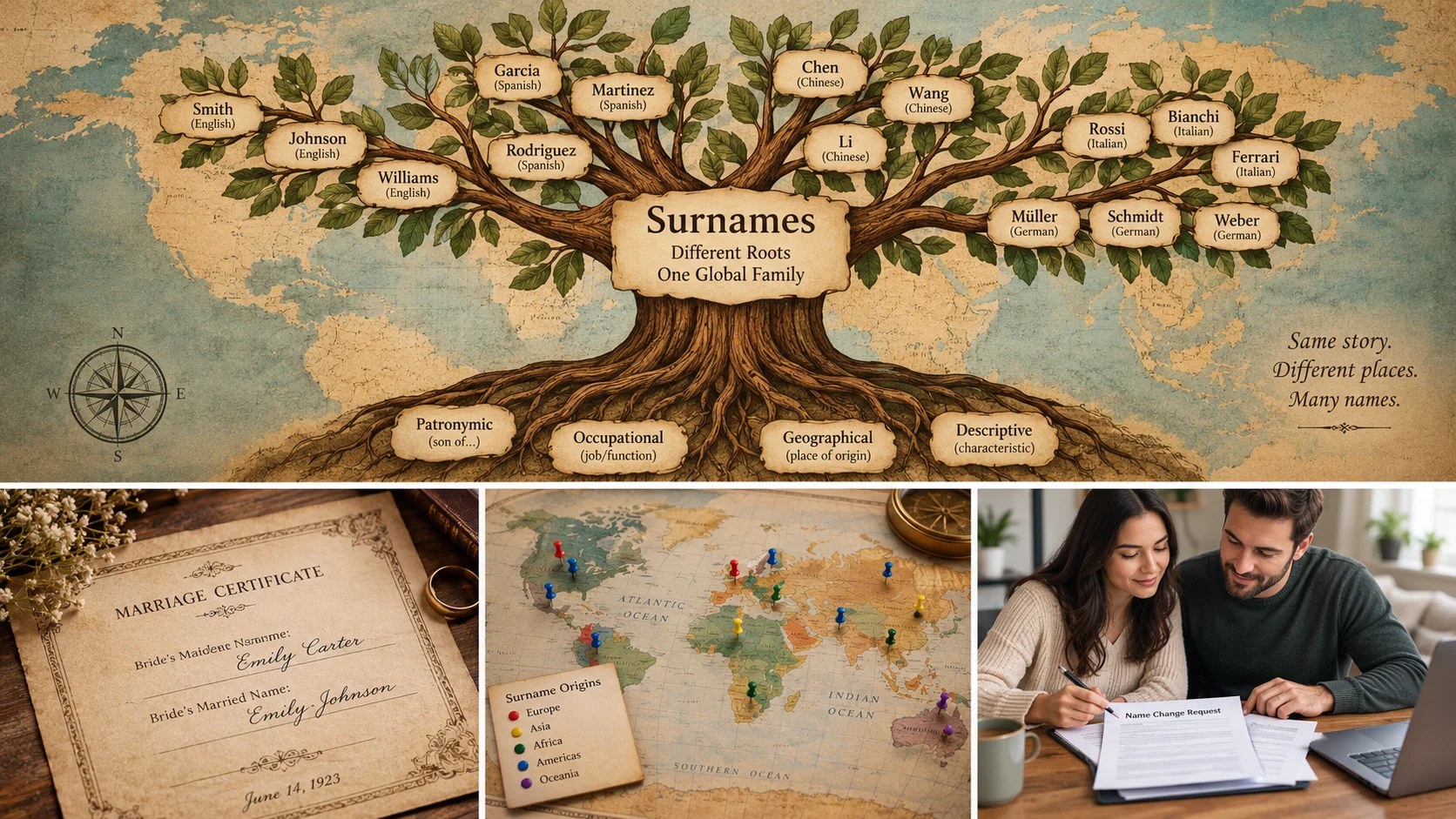
A maiden name is the surname a woman carries before marriage. The maiden name meaning points to her family of origin and heritage. This article covers 210 surnames across place names, patronymics, occupations, nature, and cultural traditions worldwide.
A maiden name is more than a word on a form; it is a link to family history, culture, and identity. Understanding the maiden name meaning helps you trace ancestry, choose how to combine names after marriage, or simply appreciate where a surname comes from. This guide explains the term and lists 210 surnames across 14 meaningful categories.
1. What Is the Maiden Name Meaning in Family History?
The maiden name meaning in genealogy is the bridge to a woman’s birth family. Before marriage records listed a husband, her maiden name identified her parents, siblings, and ancestral line. These 15 surnames are classic examples often found in family trees.
- Roberts — Common Welsh patronymic meaning “son of Robert.”
- Miller — Occupational name for one who grinds grain.
- Taylor — English occupational name for a tailor.
- Fischer — German occupational name for a fisherman.
- Novak — Czech and Slavic name meaning “new person” or newcomer.
- Rossi — Italian patronymic meaning “red-haired.”
- Bianchi — Italian descriptive name meaning “white.”
- Kowalski — Polish surname often tied to a place or smith.
- Dubois — French topographic name meaning “of the wood.”
- Larsen — Scandinavian patronymic meaning “son of Lars.”
- Hernandez — Spanish patronymic meaning “son of Hernando.”
- Murphy — Irish surname meaning “sea warrior.”
- Campbell — Scottish nickname meaning “crooked mouth.”
- Andersson — Swedish patronymic meaning “son of Anders.”
- Yamamoto — Japanese topographic name meaning “base of the mountain.”
2. Maiden Name Meaning in Patronymic Traditions
Patronymic surnames derive from a father’s given name. The maiden name meaning here records a specific male ancestor, often with a suffix or prefix indicating “son of.” These 15 names show how patronymics vary across languages.
- Johnson — English, “son of John.”
- O’Brien — Irish, “descendant of Brian.”
- MacLeod — Scottish, “son of Leòd.”
- Ivanov — Russian, “son of Ivan.”
- Jansen — Dutch, “son of Jan.”
- Petersen — Danish and Norwegian, “son of Peter.”
- Fernandes — Portuguese, “son of Fernando.”
- Gonzalez — Spanish, “son of Gonzalo.”
- Haddad — Arabic, “son of the blacksmith” (also occupational).
- Cohen — Hebrew, traditionally “priest” (not strictly patronymic but lineage-based).
- Nguyen — Vietnamese, originally a dynasty surname with patrilineal use.
- Kim — Korean, clan-based surname with patrilineal descent.
- Fitzgerald — Anglo-Norman, “son of Gerald.”
- Ap Rhys — Welsh patronymic form meaning “son of Rhys.”
- Bin Laden — Arabic patronymic structure meaning “son of Laden.”
3. Maiden Name Meaning Through Place Names
Topographic and habitational surnames record where a family lived. The maiden name meaning in this category points to a landscape feature, village, or region. These 15 names are clear geographic identifiers.
- Hill — English, someone who lived on or near a hill.
- Brooks — English, someone who lived by a stream.
- Wood — English, someone who lived in or near a wood.
- Foster — English, from a place meaning “forest” or “wood.”
- Marsh — English, someone who lived near marshland.
- Churchill — English, from a place name meaning “church on a hill.”
- Lancaster — English, from the city of Lancaster.
- York — English, from the city of York.
- Paris — French, from the city of Paris.
- Frank — German, from Franconia or the Frankish people.
- Berger — German and French, “shepherd” or “from the hills.”
- Costa — Portuguese and Italian, “coast” or “slope.”
- Rivers — English, someone who lived by a river.
- Green — English, someone who lived near a village green.
- Bush — English, someone who lived near a thicket.
4. Occupational Maiden Name Meaning and Trade Surnames
Occupational surnames reveal the work a family was known for. The maiden name meaning here connects to a trade, tool, or role in the community. These 15 names are among the most recognizable occupational surnames.
- Smith — English, metalworker.
- Baker — English, baker of bread.
- Cooper — English, barrel maker.
- Fletcher — English, arrow maker.
- Thatcher — English, roof thatcher.
- Weaver — English, cloth weaver.
- Carpenter — English, woodworker.
- Mason — English, stoneworker.
- Porter — English, door or gate keeper.
- Chandler — English, candle maker or dealer.
- Schmidt — German, smith.
- Muller — German, miller.
- Bauer — German, farmer.
- Lefebvre — French, smith.
- Ferrari — Italian, smith or ironworker.
5. Descriptive Maiden Name Meaning and Nicknames
Nickname surnames described appearance, personality, or a distinguishing trait. The maiden name meaning here reflects how a family was perceived by neighbors. These 15 names illustrate common descriptive patterns.
- Brown — English, brown-haired or brown-skinned.
- White — English, fair-haired or pale.
- Black — English, dark-haired or dark-complexioned.
- Short — English, of short stature.
- Long — English, tall or long-limbed.
- Strong — English, physically strong.
- Swift — English, fast or quick.
- Wise — English, wise or learned.
- Fox — English, cunning or fox-like.
- Wolf — German and English, wolf-like or fierce.
- Armstrong — English, strong arm.
- Fairchild — English, fair-haired child.
- Goodman — English, good man or householder.
- Kennedy — Irish, “helmeted head” or “ugly head.”
- Calvo — Spanish and Italian, bald.
6. Nature-Based Maiden Name Meaning and Earth Surnames
Nature surnames come from animals, plants, and natural features. The maiden name meaning here ties a family to the living world. These 15 names show how nature shaped surname choices.
- Bird — English, from the bird.
- Crow — English, from the crow.
- Finch — English, from the finch.
- Swan — English, from the swan.
- Peacock — English, from the peacock.
- Rose — English, from the flower.
- Lily — English, from the lily.
- Violet — English, from the flower.
- Ash — English, from the ash tree.
- Oak — English, from the oak tree.
- Birch — English, from the birch tree.
- Wolf — German, from the wolf.
- Baer — German, bear.
- Fuchs — German, fox.
- Vogel — German, bird.
7. Maiden Name Meaning Across Cultures: European Surnames
European surnames vary widely by language and region. The maiden name meaning in this section highlights fixed family names from across the continent. These 15 names represent major European naming traditions.
- Garcia — Spanish, one of the most common surnames in Spain.
- Martinez — Spanish patronymic, “son of Martin.”
- Lopez — Spanish patronymic, “son of Lope.”
- Sanchez — Spanish patronymic, “son of Sancho.”
- Perez — Spanish patronymic, “son of Pedro.”
- Russo — Italian, red-haired or from the south.
- Esposito — Italian, “exposed” or foundling.
- Romano — Italian, from Rome.
- Bernard — French and English, from the given name Bernard.
- Moreau — French, dark-skinned or Moorish.
- Laurent — French, from the given name Laurent.
- Schneider — German, tailor.
- Fischer — German, fisherman.
- Weber — German, weaver.
- Wagner — German, wagon maker.
8. Maiden Name Meaning in Hispanic and Iberian Traditions
Spanish and Portuguese surnames often combine patronymic, topographic, and descriptive elements. The maiden name meaning here frequently involves family lineage or a place. These 15 names are common across Latin America and Iberia.
- Rodriguez — Spanish, “son of Rodrigo.”
- Gutierrez — Spanish, “son of Gutierre.”
- Torres — Spanish, “towers.”
- Ramos — Spanish, “branches.”
- Flores — Spanish, “flowers.”
- Rivera — Spanish, “riverbank.”
- Gomez — Spanish, “son of Gomo.”
- Diaz — Spanish, “son of Diego.”
- Silva — Portuguese, “forest” or “woodland.”
- Santos — Portuguese and Spanish, “saints.”
- Oliveira — Portuguese, “olive tree.”
- Pereira — Portuguese, “pear tree.”
- Costa — Portuguese, “coast.”
- Almeida — Portuguese, from a place name meaning “the table” or plateau.
- Nunes — Portuguese, “son of Nuno.”
9. Maiden Name Meaning in Asian Surnames
Asian surnames carry deep cultural and historical meaning. The maiden name meaning here often connects to clan, region, or ancestral lineage. These 15 names represent major Asian naming systems.
- Wang — Chinese, “king” or “monarch.”
- Li — Chinese, “plum” or “reason.”
- Zhang — Chinese, “to open” or “archer.”
- Liu — Chinese, “willow” or a place name.
- Chen — Chinese, “to exhibit” or an ancient state.
- Yang — Chinese, “poplar” or “sun.”
- Sato — Japanese, “help” or “village.”
- Suzuki — Japanese, “bell tree” or “small bell.”
- Takahashi — Japanese, “high bridge.”
- Tanaka — Japanese, “middle of the rice field.”
- Watanabe — Japanese, “cross over” or “ferry.”
- Kim — Korean, “gold” or “metal.”
- Lee — Korean, “plum tree” or “logic.”
- Park — Korean, “gourd” or “calabash.”
- Nguyen — Vietnamese, a major dynastic surname.
10. Maiden Name Meaning in African Surnames
African surnames reflect ethnic groups, languages, and colonial histories across the continent. The maiden name meaning here varies from clan names to descriptive terms. These 15 names represent diverse African naming traditions.
- Mensah — Akan (Ghana), “third-born child.”
- Owusu — Akan, “strong” or “powerful.”
- Okafor — Igbo (Nigeria), “born on a market day” or “first son.”
- Okonkwo — Igbo, “born on a great market day.”
- Adeyemi — Yoruba (Nigeria), “the crown suits me.”
- Balogun — Yoruba, “war commander.”
- Diallo — Fula and Wolof (West Africa), a common clan name.
- Traore — Mandé (West Africa), a clan name.
- Keita — Mandé, a royal lineage name.
- Nkosi — Zulu and Xhosa (South Africa), “king” or “chief.”
- Dlamini — Swazi and Zulu, a royal clan name.
- Moyo — Shona and Ndebele (Zimbabwe), “heart.”
- Ndlovu — Zulu and Ndebele, “elephant.”
- Abebe — Amharic (Ethiopia), “flower” or “blossom.”
- Tesfaye — Amharic, “my hope.”
11. Unique Maiden Name Meaning and Rare Surnames
Some surnames are rare, regional, or nearly extinct. The maiden name meaning here often survives in specific communities or archival records. These 15 names offer unusual options for readers seeking something distinctive.
- Featherstonehaugh — English, a rare Northumberland place name.
- Pepin — French, from the given name Pepin.
- Quimby — English, from a place name meaning “queen’s manor.”
- Zabala — Basque, from a place name.
- Xanthos — Greek, “yellow” or “blond.”
- Yarrow — English, from the plant.
- Vane — English, from a place name or “banner.”
- Ulrich — German, “rich heritage.”
- Tolliver — English, occupational name for a toll collector.
- Sayer — English, “sawyer” or “speaker.”
- Raven — English, from the bird.
- Pike — English, from the fish or a pointed tool.
- Nightingale — English, from the bird.
- Meriwether — English, “merry weather” or “pleasant.”
- Lovelace — English, “without reproach” or a nickname.
12. Maiden Name Meaning and Surnames from the British Isles
The British Isles produced a rich mix of English, Scottish, Welsh, and Irish surnames. The maiden name meaning here often combines patronymics, place names, and nicknames. These 15 names are widely recognized examples.
- Smith — English, metalworker.
- Jones — Welsh, “son of John.”
- Williams — Welsh, “son of William.”
- Davies — Welsh, “son of David.”
- Evans — Welsh, “son of Evan.”
- Thomas — Welsh and English, from the given name Thomas.
- Roberts — Welsh and English, “son of Robert.”
- Hughes — Welsh, “son of Hugh.”
- Lewis — Welsh, “son of Lewis.”
- Morgan — Welsh, “sea-born” or “bright sea.”
- Rees — Welsh, “son of Rhys.”
- Griffiths — Welsh, “son of Gruffydd.”
- O’Connor — Irish, “descendant of Conchobar.”
- Kelly — Irish, “warrior” or “bright-headed.”
- MacDonald — Scottish, “son of Donald.”
13. Maiden Name Meaning in Modern Name Combinations
Many people now blend a maiden name with a partner’s surname or keep it professionally. The maiden name meaning in modern usage is about identity and choice. These 15 compound or hyphenated examples show how maiden names live on.
- Smith-Jones — Blended English surnames.
- Garcia-Lopez — Combined Hispanic patronymics.
- Lee-Park — Combined Korean surnames.
- Nguyen-Tran — Combined Vietnamese surnames.
- Patel-Shah — Combined Indian surnames.
- Kim-Lee — Combined Korean surnames.
- Rossi-Ferrari — Combined Italian surnames.
- Muller-Schmidt — Combined German surnames.
- Dubois-Laurent — Combined French surnames.
- Silva-Costa — Combined Portuguese surnames.
- Murphy-Kelly — Combined Irish surnames.
- Campbell-MacLeod — Combined Scottish surnames.
- Roberts-Williams — Combined Welsh surnames.
- Hernandez-Rodriguez — Combined Spanish surnames.
- Yamamoto-Tanaka — Combined Japanese surnames.
14. Maiden Name Meaning for Genealogy Research
For family historians, the maiden name meaning is a key that unlocks earlier generations. Before civil registration, a woman’s maiden name may appear only in marriage or baptism records. These 15 surnames are common starting points for research.
- Moore — English, “moor” or “dark-skinned.”
- Clark — English, clerk or scholar.
- Hall — English, someone who lived at a hall.
- Allen — English and Scottish, from the given name Alan.
- Young — English, “young” or “junior.”
- Wright — English, craftsman or builder.
- King — English, from the title or a nickname.
- Scott — English and Scottish, “from Scotland.”
- Green — English, village green.
- Baker — English, baker.
- Adams — English, “son of Adam.”
- Nelson — English, “son of Neil.”
- Hill — English, hill.
- Campbell — Scottish, “crooked mouth.”
- Mitchell — English, “son of Michael.”
FAQs
What is a maiden name exactly?
A maiden name is the surname a woman uses before marriage. It identifies her family of origin and appears on birth and marriage records. The term traditionally refers to a woman’s surname prior to taking a spouse’s name .
Is a maiden name the same as a birth name?
Not always. A birth name is the name given at birth. A maiden name specifically refers to the surname before marriage. Someone who changed their name before marrying may prefer the broader term “birth name” .
What does “née” mean on official documents?
“Née” is French for “born.” It appears before a married woman’s maiden name, for example, “Jane Smith, née Jones.” It indicates the surname she carried before marriage .
Can a man have a maiden name?
Traditionally, no. The term is specific to women. For men or anyone who changes their surname upon marriage, “birth name” or “previous surname” is more accurate.
Why do some people keep their maiden name after marriage?
Reasons include professional identity, personal preference, cultural tradition, or feminist principles. Many people also hyphenate or use both names in different contexts .
How do I find someone’s maiden name for genealogy?
Search marriage records, birth certificates of children, death records, and obituaries. Census records and newspaper archives can also list a woman under her maiden name before marriage.
What is the most common maiden name meaning pattern?
Patronymic (father’s name) and occupational surnames are among the most common across cultures. Place names and descriptive nicknames are also widespread .
Can I use a maiden name as a first name?
Yes. Many surnames work well as given names. Examples include Taylor, Morgan, and Quinn. Check the name’s meaning and sound with the full name before deciding.
Conclusion
Understanding the maiden name meaning opens a window into family history, cultural identity, and personal choice.
Whether you are researching ancestors, deciding whether to keep or combine a surname, or simply curious about where a name comes from, the categories in this guide offer a starting point. The 210 names here show that a maiden name can point to a place, a trade, a parent, or a trait. Use them to explore your own heritage or appreciate the stories surnames carry.

Benjamin Clarke is a writer and nickname enthusiast at NicknameCorner.com, where he helps readers discover creative, meaningful, funny and unique nicknames for people, pets, usernames and special occasions. His content focuses on practical ideas, clear explanations and nickname inspiration that makes choosing the perfect name easier.



26 thoughts on “Maiden Name Meaning| 210 Surnames & Origins Explained”