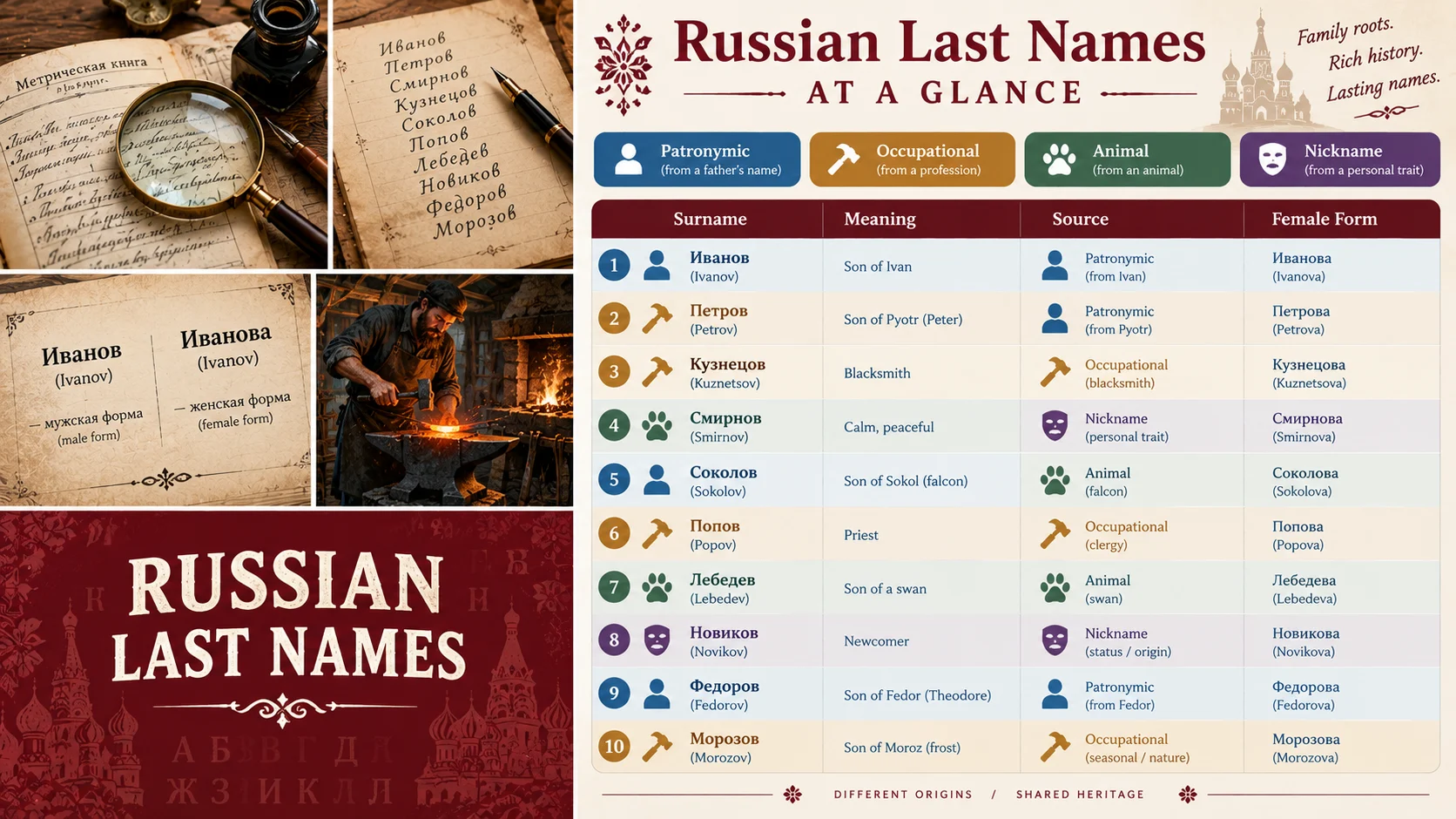
Russian last names are family names typically ending in -ov, -ev, or -in, often derived from a father’s given name, occupation, or a nickname. Most have distinct male and female forms, with females adding -a or changing -sky to -skaya.
A Russian last name is more than a label. It is a compressed record of ancestry, occupation, or a characteristic someone’s forebear carried centuries ago. The surname Smirnov tells you an ancestor was considered quiet. Kuznetsov points to a blacksmith in the family line. Ivanov simply means “son of Ivan,” a name so common it became the Russian equivalent of John Smith. Understanding Russian last names means learning how to read these small histories, and also how to navigate the grammatical rules that make Russian naming distinctive. Whether you are researching family heritage, writing characters, or simply curious about why so many Russian surnames end in -ov, this guide explains the patterns clearly. It covers ten representative surnames, the structure behind them, and practical advice for interpreting and using Russian last names accurately.
10 Russian Last Names Worth Understanding
1. Smirnov (Смирнов)
Meaning and origin: Smirnov derives from the Russian word smirny, meaning quiet, peaceful, or meek. It likely originated as a nickname for a calm child or a person of gentle disposition, and later became a hereditary surname .
Style and vibe: Smirnov is the most common surname in Russia, carried by roughly 1.8 percent of the population according to some estimates. It has a soft, rounded sound in Russian and a familiar, unassuming quality .
Female form: Smirnova.
Best for: Anyone researching the most statistically typical Russian surname. It is the Russian surname equivalent of Smith or Jones in English-speaking countries.
Similar names: Smirnyagin, Tikhonov, Krotov (from krotky, meek).
Why it matters: Smirnov illustrates how a personality trait observed generations ago can become the single most widespread family name in a country.
2. Ivanov (Иванов)
Meaning and origin: Ivanov means “son of Ivan.” The name Ivan, itself a form of John, was extraordinarily common among Russian peasants for centuries, which explains why the patronymic-derived surname became so widespread .
Style and vibe: Ivanov is the quintessential Russian surname in cultural imagination. The phrase “Ivanov, Petrov, Sidorov” functions like “Tom, Dick, and Harry” in English, representing the average Russian .
Female form: Ivanova.
Best for: Cultural reference or fictional characters meant to feel archetypally Russian. It is instantly recognizable and carries no ambiguity.
Similar names: Ivankov, Ivashin, Ivlev.
Why it matters: Ivanov demonstrates the patronymic principle at the heart of Russian naming. Before surnames were fixed, a person was identified by their father’s name, and that identifier eventually became hereditary.
3. Kuznetsov (Кузнецов)
Meaning and origin: Kuznetsov comes from kuznets, the Russian word for blacksmith. Blacksmiths held essential roles in pre-industrial communities, and the surname reflects the trade’s importance .
Style and vibe: Kuznetsov has a solid, occupational weight. It sounds practical and grounded, much like the profession it commemorates.
Female form: Kuznetsova.
Best for: Families with a craft or trade heritage, or anyone interested in occupational surnames. It pairs naturally with given names of any length.
Similar names: Kovalyov (also from a word for blacksmith), Plotnikov (carpenter), Rybakov (fisherman).
Why it matters: Occupational surnames offer a direct link to the daily labor of ancestors. Kuznetsov is one of the clearest examples of a name that tells you exactly what someone in the family line did for a living.
4. Popov (Попов)
Meaning and origin: Popov derives from pop, the Russian word for priest. It originally meant “son of the priest” or belonged to someone who worked for a priest .
Style and vibe: Popov is short, direct, and slightly unexpected to non-Russian ears. It carries an ecclesiastical association that is more historical than religious in modern usage.
Female form: Popova.
Best for: Those exploring surnames tied to religious or community roles. It is also a common surname, so it appears frequently in records and literature.
Similar names: Popkov, Protoiereyev (from a term for archpriest).
Why it matters: Popov reflects the social structure of pre-revolutionary Russia, where the church played a central role in community life and surnames often recorded a family’s relationship to it.
5. Volkov (Волков)
Meaning and origin: Volkov derives from volk, meaning wolf. Animal surnames were common in Russia, often arising from nicknames that described a trait associated with the animal, or from a person’s occupation as a hunter or trapper .
Style and vibe: Volkov has a sharp, strong sound. The wolf association gives it a certain edge, and it is popular in fiction for characters who need a surname with bite.
Female form: Volkova.
Best for: Characters or individuals drawn to nature-based names with a forceful quality. It is one of the most recognizable Russian animal surnames.
Similar names: Volchkov (from volchok, little wolf), Medvedev (bear), Sobolev (sable).
Why it matters: Volkov shows how Russian surnames absorbed the natural world. The wolf held cultural significance in Slavic folklore, and the name preserves that connection.
6. Medvedev (Медведев)
Meaning and origin: Medvedev comes from medved, the Russian word for bear. Bears were central to Slavic folklore and held symbolic weight, though the surname likely originated as a nickname or occupational reference .
Style and vibe: Medvedev is longer and more flowing than Volkov, with a warm, heavy sound that matches its meaning.
Female form: Medvedeva.
Best for: Anyone drawn to animal names with a gentler, more folkloric association. The bear carries connotations of strength and forest life rather than aggression.
Similar names: Medvedkov, Mishin (from misha, a diminutive for bear).
Why it matters: Medvedev connects to the deep folk traditions of Slavic culture, where the bear was both feared and respected. The surname makes that cultural memory visible.
7. Novikov (Новиков)
Meaning and origin: Novikov derives from novik, an old Russian word meaning newcomer or someone new to a community. It was used to distinguish a person who had recently arrived in a village .
Style and vibe: Novikov is crisp and straightforward. It has a modern sound despite its old roots, and it carries the practical logic of community organization.
Female form: Novikova.
Best for: Those interested in surnames that describe social circumstances rather than personal traits. It is a clear example of a name recording a life event.
Similar names: Novozhilov (new settler), Novoseltsev (new resident).
Why it matters: Novikov shows that Russian surnames could record not just who someone was but where they came from or when they arrived. It is a small piece of social history embedded in a name.
8. Sokolov (Соколов)
Meaning and origin: Sokolov derives from sokol, meaning falcon. Bird surnames are especially common in Russian, reflecting both the prevalence of birds and the cultural value placed on certain species for hunting or symbolism .
Style and vibe: Sokolov has a sleek, elegant sound. The falcon association gives it a sense of speed and precision.
Female form: Sokolova.
Best for: Names with a noble or hunting connection. The falcon was traditionally associated with aristocracy and skill.
Similar names: Orlov (eagle), Golubev (pigeon), Vorobyov (sparrow), Zhuravlev (crane).
Why it matters: Sokolov is one of many bird-derived surnames that reveal how closely Russian naming practices observed and named the natural world. The falcon stands out for its cultural prestige.
9. Romanov (Романов)
Meaning and origin: Romanov means “son of Roman.” The name became historically significant as the surname of the dynasty that ruled Russia from 1613 until 1917. The family’s ancestry traces back to a man named Roman, a great-grandson of Andrei Kobyla .
Style and vibe: Romanov carries immediate historical weight. It is a name associated with tsars, palaces, and the end of imperial Russia.
Female form: Romanova.
Best for: Historical contexts, fictional characters with aristocratic or dramatic backstories, or anyone exploring the connection between surnames and power.
Similar names: Romanovsky (a variant with aristocratic connotations), Romanishin.
Why it matters: Romanov demonstrates how a patronymic surname, ordinary in origin, can become globally recognized through historical circumstances. It is a reminder that any surname can rise to significance.
10. Putin (Путин)
Meaning and origin: The origin of Putin is not definitively established. One theory connects it to the Russian word put, meaning road or path, suggesting an ancestor associated with travel or a roadside location. Another possibility involves a nickname for a person tightly bound in clothing, from puty .
Style and vibe: Putin is short, sharp, and unmistakably contemporary due to its most famous bearer. Linguistically, it belongs to the -in category of surnames, which are common and often patronymic or nickname-derived.
Female form: Putina.
Best for: Understanding the -in suffix category, or for discussions of how modern political figures shape surname recognition.
Similar names: Putilin, Putyatin.
Why it matters: Putin illustrates that surname origins are not always certain. Many Russian surnames have multiple plausible explanations, and scholarly consensus is not always available.
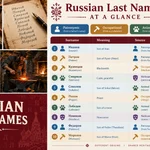
Quick Comparison Table
| Russian Last Name | Meaning | Source Category | Female Form | Familiarity |
|---|---|---|---|---|
| Smirnov | Quiet, peaceful | Nickname/trait | Smirnova | Extremely common |
| Ivanov | Son of Ivan | Patronymic | Ivanova | Archetypal |
| Kuznetsov | Blacksmith | Occupation | Kuznetsova | Very common |
| Popov | Priest’s son | Religious role | Popova | Common |
| Volkov | Wolf | Animal | Volkova | Recognizable |
| Medvedev | Bear | Animal | Medvedeva | Recognizable |
| Novikov | Newcomer | Social circumstance | Novikova | Common |
| Sokolov | Falcon | Bird | Sokolova | Common |
| Romanov | Son of Roman | Patronymic/dynastic | Romanova | Historically famous |
| Putin | Uncertain (road/bound) | Nickname/uncertain | Putina | Globally known |
How Russian Last Names Work
The suffix system. Most Russian surnames end in -ov, -ev, or -in. These suffixes originally indicated belonging: Ivanov meant “of Ivan” or “son of Ivan.” The choice between -ov and -ev depends on the final sound of the root word, while -in is used when the root ends in a vowel or feminine form .
Gender marking. Russian surnames are grammatically gendered. Male forms typically end in a consonant (-ov, -ev, -in), while female forms add -a (Ivanova, Smirnova). Surnames ending in -sky change to -skaya for women. Surnames ending in -ko or -ich do not change .
The -off spelling. Many Russian surnames appear in English with -off rather than -ov. This is not a different name but a historical transliteration. French was the preferred foreign language of Russian nobility, and -off reflects French phonetic rendering. Descendants of White émigrés who fled after 1917 often retained this spelling, while later emigrants typically use -ov .
Patronymics versus surnames. Russian naming uses three parts: given name, patronymic (derived from the father’s name), and surname. The patronymic ends in -ovich or -evich for men and -ovna or -evna for women. A full name like Ivan Petrovich Smirnov means Ivan, son of Pyotr, of the Smirnov family. The patronymic is not the surname, though both derive from similar principles .
Historical timeline. Surnames appeared among Russian nobles in the 16th century, but many peasants did not have official hereditary surnames until after serfdom was abolished in 1861 and the process was completed in the early Soviet period. This means the age of a Russian surname varies enormously by social class and region .
Query Fan-Out:
- What is the most common Russian last name? Smirnov is often cited as the most common surname in Russia, followed by Ivanov, Kuznetsov, and Popov .
- Why do Russian last names end in -ov or -ev? These suffixes indicate belonging or descent, originally meaning “son of” or “of the family of” a particular ancestor .
- How do Russian last names change for women? Most female surnames add -a to the male form, so Ivanov becomes Ivanova, and -sky becomes -skaya .
- What does the -off ending mean? The -off spelling is a historical French transliteration of -ov, often preserved by descendants of White émigrés who left Russia after 1917 .
- What Russian last names mean blacksmith? Kuznetsov and Kovalyov both derive from words for blacksmith, reflecting the importance of the trade .
- Are Russian last names always gendered? Most are, but surnames ending in -ko or -ich are gender-neutral and do not change form .
- What are common Russian animal surnames? Volkov (wolf), Medvedev (bear), Orlov (eagle), Sokolov (falcon), and Kozlov (goat) are among the most recognizable .
FAQ
What is the most common Russian last name?
Smirnov is generally identified as the most common surname in Russia, followed by Ivanov. Some sources note that Smirnovs make up roughly 1.8 percent of the population, while Ivanovs account for about 1.3 percent .
Why do Russian last names end in -ov?
The -ov suffix originally indicated belonging or descent, functioning like “of” or “son of.” Ivanov meant “of Ivan.” Over time, these identifiers became fixed hereditary surnames passed down through generations .
How do Russian last names change for females?
Most female Russian surnames add -a to the male form. Ivanov becomes Ivanova, Smirnov becomes Smirnova. Surnames ending in -sky become -skaya. Surnames ending in -ko or -ich remain unchanged regardless of gender .
What does the -off ending mean in Russian names?
The -off ending is a historical French transliteration of -ov. It is common among descendants of Russians who emigrated after the 1917 revolution. The spelling reflects the transliteration conventions of their host countries rather than a different surname origin .
What Russian last names mean blacksmith?
Kuznetsov and Kovalyov both derive from words for blacksmith. Kuznetsov comes from kuznets, while Kovalyov comes from koval, a regional or older term for the same trade .
Are Russian last names always gendered?
Most are, but not all. Surnames ending in -ko, -ich, or -yk do not change based on gender. These endings are more common in Ukrainian and Belarusian naming traditions but appear frequently in Russia as well .
What do Russian animal surnames mean?
Animal surnames often originated as nicknames describing a person’s traits or occupation. Volkov (wolf) might have described someone fierce or a hunter. Medvedev (bear) could indicate strength or a connection to forest work. Sokolov (falcon) might suggest speed or a hunting association .
How can I tell if a Russian surname is noble?
Most Russian surnames do not inherently indicate nobility. However, certain suffixes like -sky were more common among nobility and clergy, and some families have documented noble ancestry through historical records. A surname alone is not sufficient evidence of noble status.
Conclusion
Russian last names offer a compact education in history, language, and social structure. The suffix that once meant “son of Ivan” became a permanent family identifier. The word for blacksmith became a surname carried by millions. The grammatical gender rules that seem complicated at first follow a clear logic once you see the pattern. Whether you are tracing your own family line, writing characters with Russian heritage, or simply satisfying a curiosity about why so many names end in -ov, understanding Russian last names opens a window into how naming practices record the lives of ordinary people across centuries. Use this guide as a starting point. Check primary records for your own family research. And if you have a Russian last name in your family or a favorite from this list, share it in the comments.

Scarlett Howard is a writer and name enthusiast at NicknameCorner. She creates creative and helpful guides on nicknames, names, usernames and naming ideas, helping readers find meaningful, memorable and unique names for every occasion.