Greek names are given names originating from the Greek language, including ancient mythological names, biblical names, and modern Greek naming traditions. They often carry compound meanings from Greek roots and remain common across English-speaking countries through names like Sophia, Alexander, and Chloe.
Greek names carry a particular kind of weight. They are the words of philosophers and poets, of Orthodox saints and mythological figures, of families who have passed names down through generations on islands and in mountain villages. When you choose a Greek name, you are not simply picking a pleasant sound. You are reaching into a tradition that stretches back thousands of years, where names were often compound phrases with meanings that any ancient Greek speaker would have understood instantly.
Yet Greek names are not relics. They live in the modern world through names like Sophia, Alexander, and Chloe, which appear on playgrounds and in classrooms far from the Aegean. They also survive in the villages of Crete and the diaspora communities of Melbourne and Chicago, where a child might be named after a grandmother and celebrate a saint’s day alongside a birthday. This guide explores Greek names from several angles: the familiar, the mythological, the biblical, and the quietly traditional. It offers meanings, origins, and practical considerations for anyone choosing a Greek name for a child, a character, or simply out of curiosity.
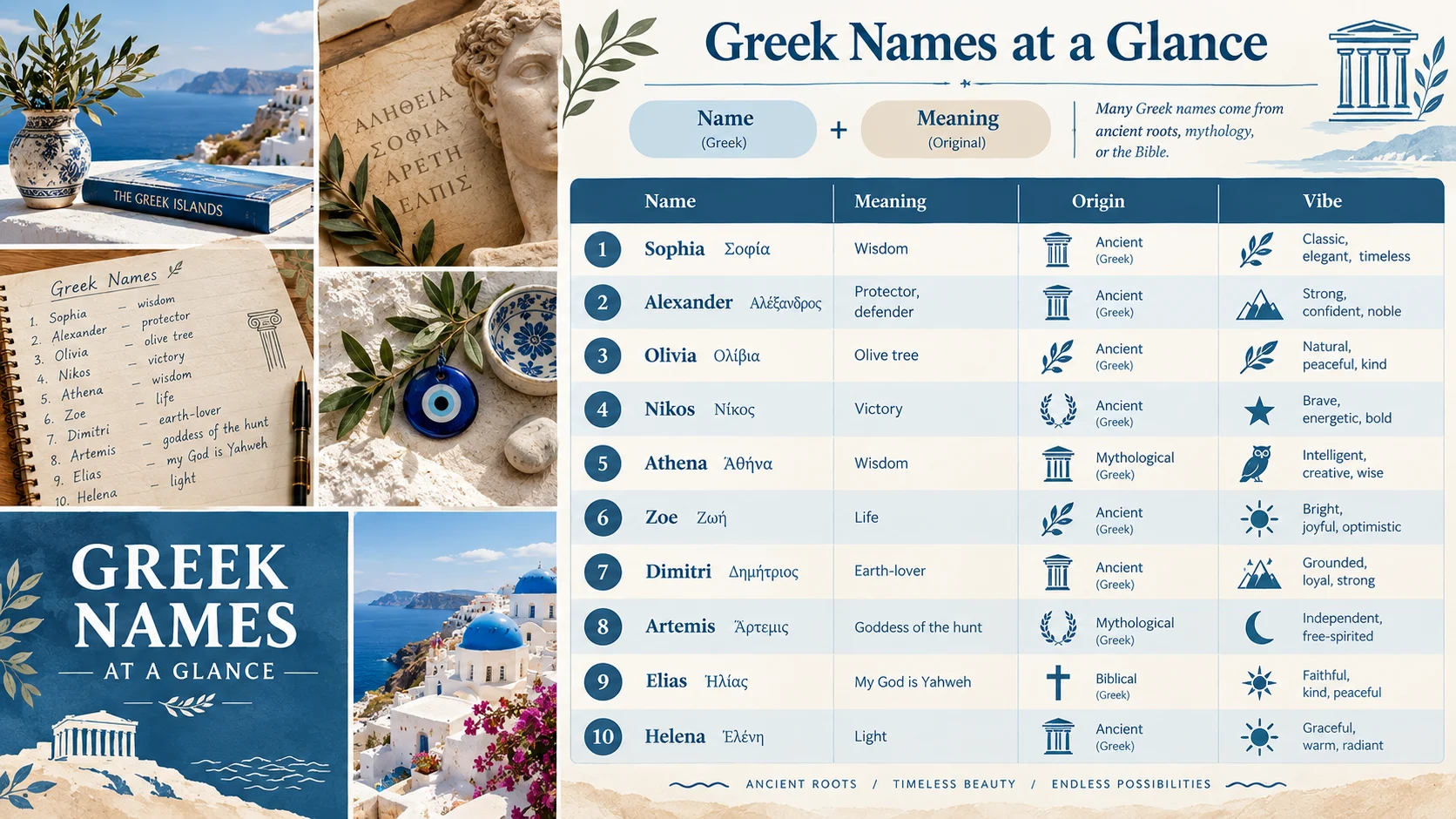
10 Greek Names Worth Considering
1. Sophia
Meaning and origin: Sophia comes directly from the Greek word sophia, meaning wisdom. It was used in the Byzantine world and later spread through Christian Europe, partly through devotion to Saint Sophia and the famous Hagia Sophia in Constantinople. The name has never truly left use, though its popularity in English-speaking countries surged in the late twentieth and early twenty-first centuries.
Style and vibe: Sophia is elegant, internationally recognized, and carries an unmistakable air of intelligence. It is soft but substantial, and it works across languages with minimal adjustment.
Best for: Families who want a name that is both beautiful and meaningful, and who value cross-cultural recognition. It suits parents looking for something classic without feeling old-fashioned.
Similar names: Sofia, Sophie, Sonia, Sylvia, Athena.
Why it works today: Sophia balances accessibility with depth. It is common enough to be familiar but not so common that it feels generic, and its meaning gives it a quiet dignity that appeals across generations.
2. Alexander
Meaning and origin: Alexander is the Latinized form of the Greek Alexandros, composed of alexo (to defend) and aner (man), meaning “defender of men.” It was borne by Alexander the Great and later by numerous saints, kings, and popes. The name has been continuously used for over two millennia across Europe and beyond.
Style and vibe: Alexander is strong, traditional, and endlessly familiar. It has a formal, weighty quality but softens through nicknames like Alex, Xander, or Lex.
Best for: Parents who want a name with historical gravitas and flexible nickname options. It pairs well with both short and long surnames.
Similar names: Alexandros, Alexios, Alexis, Andreas, Nicholas.
Why it works today: Alexander remains one of the most durable names in the Western world. Its meaning is clear, its history is undeniable, and its nickname potential keeps it wearable across every life stage.
3. Eleni
Meaning and origin: Eleni is the modern Greek form of Helen, which likely derives from the Greek word helene, meaning torch or shining light. In Greek Orthodox tradition, Saint Helen (Eleni) was the mother of Constantine the Great and is credited with discovering the True Cross. The name is among the most common in Greece today .
Style and vibe: Eleni is melodic and distinctly Greek. It has a warm, rolling sound and feels simultaneously ancient and contemporary. The nickname Lena or Ellie makes it approachable.
Best for: Families with Greek heritage or anyone drawn to a name that sounds beautiful in both Greek and English contexts. It suits parents who want something recognizable but not overused outside Greece.
Similar names: Helena, Elena, Helen, Eliana, Iliana.
Why it works today: Eleni offers the familiarity of Helen with a distinctly Mediterranean flavor. It travels well, and its association with light gives it a positive, luminous quality.
4. Nikolaos
Meaning and origin: Nikolaos is the original Greek form of Nicholas, composed of nike (victory) and laos (people), meaning “victory of the people.” Saint Nicholas, the fourth-century bishop of Myra, is the historical figure behind the Santa Claus tradition. The name remains extremely common in Greece and among Orthodox communities.
Style and vibe: Nikolaos is formal and traditional, with a strong, rhythmic sound. It carries a sense of heritage and religious history, and it shortens naturally to Nikos, Nick, or Niko.
Best for: Families who value tradition and want a name with deep Christian associations. It works well for parents who prefer a formal given name with an easy everyday nickname.
Similar names: Nikos, Nicholas, Nikolas, Nikos, Nicolae.
Why it works today: Nikolaos connects the ancient world, the Byzantine church, and the modern Greek diaspora. Its nickname forms make it practical, while the full name carries unmistakable weight.
5. Chloe
Meaning and origin: Chloe comes from the Greek word chloe, meaning green shoot or blooming. It appears in the New Testament as the name of a woman in Corinth and was used in ancient Greece as an epithet for Demeter, the goddess of agriculture. The name entered English usage in the seventeenth century and has grown steadily in popularity since the 1990s.
Style and vibe: Chloe is short, fresh, and modern-sounding despite its ancient roots. It has a light, breezy quality that appeals across age groups.
Best for: Parents who want a name that feels contemporary but has genuine historical depth. It works well for families seeking something short and easy to spell.
Similar names: Zoe, Cleo, Clio, Phoebe, Iris.
Why it works today: Chloe is proof that ancient names can feel entirely modern. Its botanical meaning gives it a connection to nature, and its brevity makes it practical in a world of long surnames.
6. Persephone
Meaning and origin: Persephone is the name of the Greek goddess of spring and queen of the underworld, daughter of Demeter and Zeus. The etymology is uncertain; some scholars connect it to phero (to bear) and phonos (slaughter), though this is debated. The name has been used in English-speaking countries only recently and remains uncommon.
Style and vibe: Persephone is dramatic, literary, and unmistakably mythological. It has a long, flowing sound and carries associations with both beauty and darkness.
Best for: Parents who love mythology and want a name with a story behind it. It suits families who prefer distinctive names and do not mind occasional pronunciation questions.
Similar names: Penelope, Calliope, Ariadne, Demeter, Hecate.
Why it works today: Persephone offers a rare combination of softness and power. As mythological names continue to interest modern parents, it stands out for its rich narrative and striking sound .
7. Andreas
Meaning and origin: Andreas is the Greek form of Andrew, derived from aner (man) and meaning manly or courageous. It was the name of one of the twelve apostles and has been used continuously in Greek-speaking communities. In Greece, the name is often shortened to Andreas or Andy.
Style and vibe: Andreas is solid, masculine, and international. It sounds more distinctly Greek than Andrew but remains familiar to English speakers.
Best for: Families with Greek heritage who want a name that honors tradition while remaining accessible. It pairs well with both Greek and non-Greek surnames.
Similar names: Andrew, Andre, Andros, Alexios, Dimitrios.
Why it works today: Andreas bridges cultures. It is recognizably Greek without being difficult, and its biblical pedigree gives it a quiet authority.
8. Anastasia
Meaning and origin: Anastasia derives from the Greek word anastasis, meaning resurrection. It was a common name among early Christians and has been borne by saints, princesses, and the youngest daughter of the last Russian tsar. The name remains popular in Greece, Russia, and Eastern Europe and has gained followers in English-speaking countries.
Style and vibe: Anastasia is regal, romantic, and slightly elaborate. It has a fairy-tale quality and shortens to Stasia, Ana, or Stacey.
Best for: Parents who love long, elegant names with religious meaning and historical resonance. It works well for families who appreciate Slavic and Greek cultural connections.
Similar names: Anastasios, Athanasia, Natalia, Katerina, Elena.
Why it works today: Anastasia offers grandeur without obscurity. It is recognizable, meaningful, and flexible enough to suit a child, a professional, and anyone in between.
9. Iris
Meaning and origin: Iris is the name of the Greek goddess of the rainbow and messenger of the gods, derived from the Greek word for rainbow. It was used in ancient Greece and later in English-speaking countries, though never at the top of popularity charts. The name also refers to the iris flower.
Style and vibe: Iris is short, vivid, and unmistakably associated with color and light. It has a clean, modern feel despite its ancient origins.
Best for: Parents who want a short name with mythological connections and a natural, botanical quality. It suits families who prefer names that are easy to spell and pronounce.
Similar names: Iris is related to Iris, but similar Greek options include Chloe, Phoebe, and Daphne. Nature names with Greek roots include Daphne and Rhodanthe.
Why it works today: Iris combines brevity, beauty, and meaning. Its rainbow association gives it a joyful quality, and its mythological roots provide depth without heaviness.
10. Dimitrios
Meaning and origin: Dimitrios is the Greek form of Demetrius, derived from Demeter, the goddess of agriculture and harvest. It was borne by Saint Demetrius of Thessaloniki, a popular Orthodox martyr, and remains one of the most common male names in Greece.
Style and vibe: Dimitrios is formal, religious, and deeply Greek. It carries a sense of tradition and community, and it shortens to Dimitri, Demi, or Jim.
Best for: Families who value Orthodox tradition and want a name with strong cultural roots. It works well for parents who prefer formal names with familiar nicknames.
Similar names: Demetrius, Dimitri, Demi, Demetrios, Dimitris.
Why it works today: Dimitrios anchors a child in a specific heritage. Its connection to the earth and harvest gives it a grounding quality, and its nickname options make it adaptable.
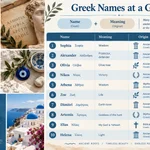
Quick Comparison Table
| Name | Meaning | Style | Best For | Vibe |
|---|---|---|---|---|
| Sophia | Wisdom | Classic-international | Cross-cultural families | Elegant, intelligent |
| Alexander | Defender of men | Classic-historical | Tradition seekers | Strong, familiar |
| Eleni | Torch, light | Modern-Greek | Greek heritage | Warm, melodic |
| Nikolaos | Victory of people | Traditional-formal | Orthodox families | Weighty, rhythmic |
| Chloe | Blooming | Modern-ancient | Minimalists | Fresh, breezy |
| Persephone | Uncertain (mythological) | Mythological-dramatic | Mythology lovers | Striking, literary |
| Andreas | Manly | International-Greek | Cross-cultural families | Solid, accessible |
| Anastasia | Resurrection | Regal-elaborate | Lovers of long names | Romantic, grand |
| Iris | Rainbow | Short-mythological | Nature lovers | Vivid, clean |
| Dimitrios | Of Demeter | Traditional-formal | Orthodox families | Grounded, communal |
How to Choose the Perfect Greek Name
Decide between ancient and modern. Greek names span a wide spectrum. Ancient names like Persephone and Alexander carry mythological and historical weight. Modern Greek names like Eleni and Dimitrios reflect contemporary Greek naming traditions. Neither is better, but they project different energies.
Consider the nickname factor. Many Greek names are long and formal, with natural short forms. Nikolaos becomes Nikos. Anastasia becomes Ana or Stasia. Decide whether you want a name that offers flexibility or one that stands alone.
Check pronunciation in your context. Names like Eleni and Dimitrios are straightforward in Greek but may require a quick correction outside Greek-speaking communities. If ease of pronunciation matters to you, names like Sophia, Alexander, and Chloe have broader familiarity.
Think about name days. In Greek tradition, many people celebrate the feast day of the saint they are named after. If this tradition matters to your family, research which saint’s day corresponds to your chosen name.
Respect the culture. Greek names carry specific cultural and religious associations. If you are not Greek, use them with awareness and respect. Many are shared across Christian traditions, but some, like Persephone, are more specifically tied to ancient religion.
Test the full name. Say the first name with your surname. Check the rhythm and the initials. A short Greek name like Iris pairs differently with a long surname than a formal name like Anastasia. Both can work, but the sound should feel intentional.
Query Fan-Out:
- What are the most popular Greek names? In Greece, Maria, Eleni, and Aikaterini lead for women, while in the US, Sophia, Alexander, and Chloe rank highly .
- What Greek names mean wisdom? Sophia derives directly from the Greek word for wisdom. Athena, the goddess of wisdom, also carries this association.
- What are rare Greek mythological names? Options include Calliope, Persephone, and Ariadne for girls, plus Atlas and Orion for boys .
- Do Greek names have meanings? Yes, most Greek names are compound words with transparent meanings, such as Alexander (defending men) or Sophia (wisdom).
- What are Greek girl names ending in A? Most Greek female names end in -a or -i, including Eleni, Sophia, Anastasia, and Katerina .
- What is a name day in Greek culture? Name days are celebrations tied to the saint a person is named after, often observed with more tradition than birthdays in Greece.
- What Greek names work well in English? Sophia, Chloe, Zoe, Alexander, Nicholas, and Katherine have long histories of use in English-speaking countries .
FAQ
What are the most common Greek names?
In Greece, Maria is the most common female name, followed by Eleni, Aikaterini, Ioanna, and Vasiliki. For males, common names include Georgios, Dimitrios, Konstantinos, and Nikolaos .
What Greek names mean light?
Eleni (from Helen) means torch or shining light. Phoebe means bright or radiant. Lucia, though Latin in origin, shares the light meaning and is used in Greek contexts.
Are Greek names still popular?
Yes. Names like Sophia, Alexander, and Chloe remain common in English-speaking countries. In Greece, traditional names persist strongly, often passed down through families .
What is a good Greek name for a girl?
Sophia, Eleni, Chloe, and Anastasia are all well-established choices. For something less common, consider Iris, Daphne, or Persephone. The best choice depends on your preferred style and cultural connection.
What Greek names work in English?
Sophia, Alexander, Chloe, Zoe, Nicholas, Katherine, and Irene have long histories of use in English-speaking countries and require little adjustment in pronunciation or spelling .
Do Greek names have religious meaning?
Many do. Nikolaos, Dimitrios, Anastasia, and Andreas all have strong Orthodox Christian associations through saints and martyrs. Ancient names like Persephone and Athena carry pagan religious meanings from Greek mythology.
What is the difference between Greek and Latinized Greek names?
Greek forms often retain original endings, such as -os for males and -i for females. Latinized forms adapt these to English conventions. Nikolaos becomes Nicholas, Dimitrios becomes Demetrius, and Eleni becomes Helen.
Can non-Greek families use Greek names?
Yes. Many Greek names have become common across Christian and English-speaking cultures. Families without Greek heritage often choose names like Sophia or Alexander. For distinctly Greek names, awareness of cultural context is respectful but not a barrier.
Conclusion
Greek names are not a single category. They are a living tradition that stretches from the Bronze Age to the modern diaspora, from the epics of Homer to the baptismal fonts of Orthodox churches. The ten names in this guide barely scratch the surface, but they show the range: the international elegance of Sophia, the mythological drama of Persephone, the quiet tradition of Dimitrios, and the modern simplicity of Iris.
Choosing a Greek name is an act of connection. It links a child to a language, a history, and a culture, whether that culture is ancestral or simply admired. Use this guide as a starting point. Say the names aloud. Consider the nicknames and the meanings. Think about the person who will carry the name for a lifetime. If you have a favorite Greek name that is not on this list, share it in the comments. The best name conversations are the ones where everyone brings something different to the table.

Scarlett Howard is a writer and name enthusiast at NicknameCorner. She creates creative and helpful guides on nicknames, names, usernames and naming ideas, helping readers find meaningful, memorable and unique names for every occasion.