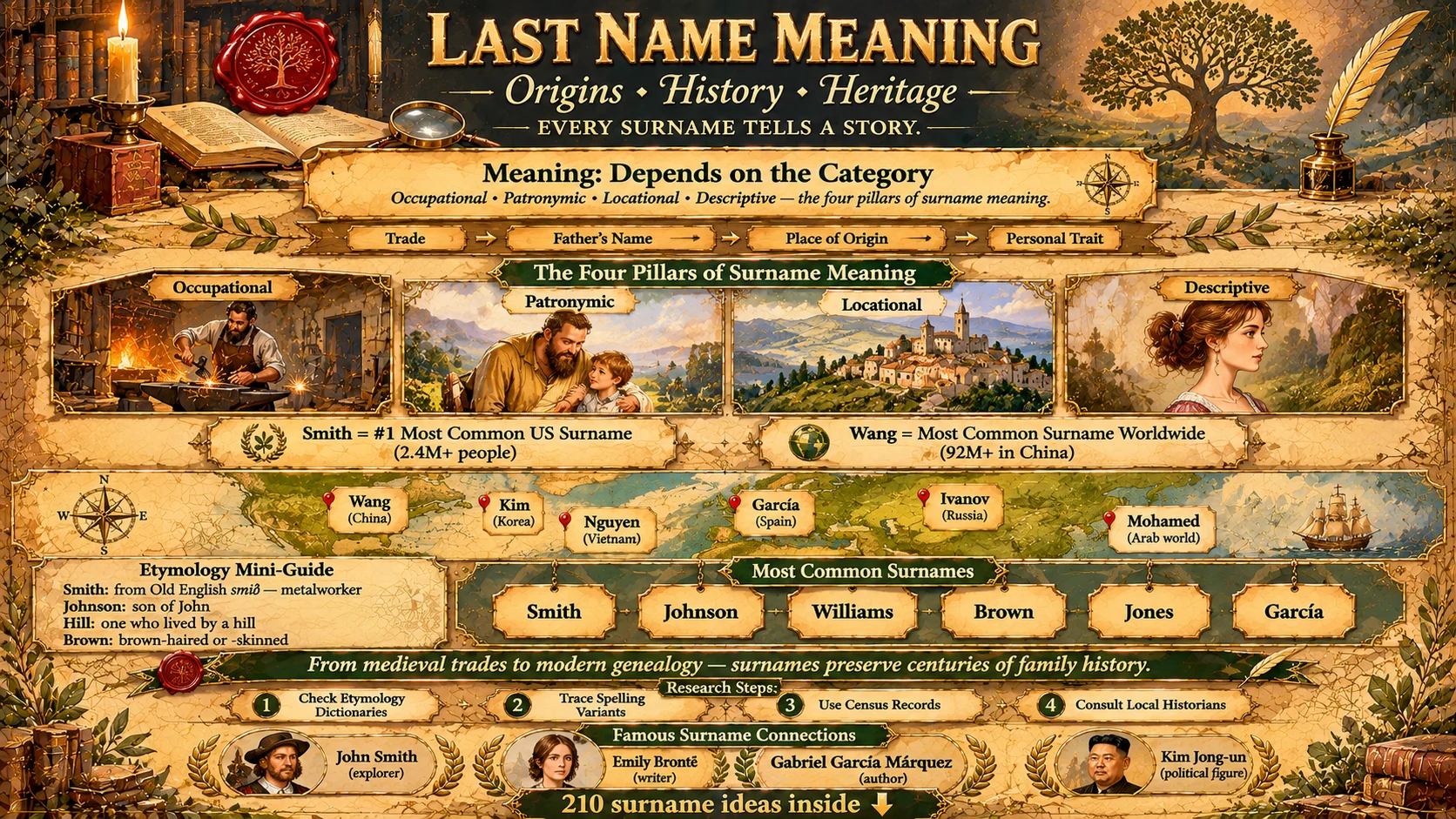
The last name meaning depends on its category: occupational names like Smith describe a job, patronymic names like Johnson mean “son of John,” place names like Hill describe a location, and descriptive names like Brown note a physical trait . Most surnames fall into one of these four types.
1. The Core Last Name Meaning and the Four Main Categories
Understanding last name meaning starts with the four classical categories that scholars use to classify surnames. Occupational, patronymic, locational, and descriptive names form the foundation of most family names worldwide . These foundational surnames illustrate each type clearly.
- Smith — Occupational: a metalworker or blacksmith .
- Johnson — Patronymic: “son of John” .
- Hill — Locational: someone who lived by a hill .
- Brown — Descriptive: someone with brown hair or skin .
- Miller — Occupational: a grain mill worker .
- Wilson — Patronymic: “son of Will” .
- Green — Locational: someone who lived near the village green .
- Taylor — Occupational: a tailor .
- Davies — Patronymic: “son of David” .
- White — Descriptive: someone with white hair or fair skin .
- Baker — Occupational: a baker .
- Anderson — Patronymic: “son of Andrew” .
- Wood — Locational: someone who lived near a forest .
- Short — Descriptive: someone of short stature .
- Clark — Occupational: a clerk or scribe.
2. Occupational Last Name Meaning: Surnames from Trades
Occupational surnames are among the oldest and most common, describing the work an ancestor did. The last name meaning in this category reveals medieval trades and the essential roles that kept communities functioning . These surnames honor the craftspeople of the past.
- Smith — A metalworker, the most common occupational surname globally .
- Miller — A grain mill operator .
- Taylor — A clothing tailor .
- Baker — A bread baker .
- Cooper — A barrel maker .
- Fletcher — An arrow maker.
- Thatcher — A roof thatcher.
- Wright — A carpenter or craftsman .
- Walker — Someone who cleaned and thickened wool .
- Fisher — A fisherman .
- Butler — A wine steward or household official .
- Carter — A cart driver.
- Mason — A stoneworker.
- Shepherd — A sheep herder.
- Cook — A cook or chef .
3. Patronymic Last Name Meaning: Surnames from Fathers
Patronymic surnames derive from a father’s given name, often with a prefix or suffix meaning “son of.” The last name meaning here connects directly to ancestry and lineage, making these names a direct link to a family’s patriarchal history . These surnames show the pattern across cultures.
- Johnson — “Son of John” .
- Williams — “Son of William” .
- Jones — “Son of John” (Welsh form) .
- Davis — “Son of David” .
- Wilson — “Son of Will” .
- Anderson — “Son of Andrew” .
- Thomas — From the given name Thomas .
- Roberts — “Son of Robert” .
- Thompson — “Son of Thomas” .
- Harris — “Son of Harry” .
- Richardson — “Son of Richard” .
- Watson — “Son of Walter” .
- Peterson — “Son of Peter” .
- Henderson — “Son of Hendrick” .
- Patterson — “Son of Patrick” .
4. Locational Last Name Meaning: Surnames from Places
Locational surnames describe where an ancestor lived or came from, whether a specific town, a landscape feature, or a general direction. The last name meaning in these names paints a picture of the physical world of medieval life . These surnames range from precise villages to broad landscape terms.
- Hill — Someone who lived by a hill .
- Green — Near the village green .
- Wood — Near or in a forest .
- Brooks — Near a brook or stream .
- Lee — Near a meadow or field .
- West — Someone from the west .
- Morton — A settlement near a moor.
- Sutton — A southern settlement .
- Leicester — From the city of Leicester .
- Hayes — Near an enclosure or hedge .
- Barnes — Near or in a barn .
- Castillo — Near a castle .
- Medina — From the city .
- Jordan — From the River Jordan .
- Hamilton — From the crooked hill .
5. Descriptive Last Name Meaning: Surnames from Characteristics
Descriptive surnames were nicknames based on a person’s appearance, personality, or distinguishing feature. The last name meaning here captures how communities identified individuals before surnames became fixed . These names often reflect physical traits or character.
- Brown — Brown hair or skin .
- White — White hair or fair complexion .
- Short — Short in stature .
- Thin — Slim build .
- Long — Tall or long-limbed .
- Gray — Gray hair .
- Russell — “Little red one” .
- Moreno — Dark-haired or dark-skinned .
- Reed — Red complexion .
- Kelly — “Bright-headed” or red-haired .
- Fox — Cunning like a fox .
- Goodfellow — A friendly companion .
- Armstrong — Strong arms.
- Swift — Fast or nimble.
- Wise — Wise or learned.
6. Last Name Meaning from Global Cultures: Common Surnames Worldwide
The last name meaning varies dramatically across cultures, reflecting different naming traditions and histories. These surnames represent the most common family names in different regions of the world, from Asia to Africa to the Americas .
- Wang — Chinese: “king,” the world’s most common surname .
- Li — Chinese: “plum” or “reason” .
- Kim — Korean: “gold” .
- Devi — Indian: “goddess” .
- Ivanov — Russian: “son of Ivan” .
- García — Spanish: possibly from Basque “bear” .
- Müller — German: “miller” .
- Mohamed — Arabic: from the Prophet’s name .
- Nguyen — Vietnamese: from a dynasty name .
- Ali — Arabic: “high” or “lofty” .
- Silva — Portuguese: “forest” .
- Ferreira — Portuguese: “ironworker” .
- Murphy — Irish: “sea warrior” .
- Jones — Welsh: “son of John” .
- Park — Korean: “gourd” or a clan name .
7. Last Name Meaning for English and British Surnames
English and British surnames offer a rich cross-section of all four categories. The last name meaning in this tradition often reveals medieval occupations, Norman influences, and local landscapes . These surnames are among the most recognizable in the English-speaking world.
- Smith — Metalworker .
- Jones — “God is gracious” .
- Taylor — Tailor .
- Brown — Brown-haired or -skinned .
- Williams — “Son of William” .
- Davies — “Son of David” .
- Evans — “Son of Evan” .
- Thomas — From the given name .
- Johnson — “Son of John” .
- Roberts — “Son of Robert” .
- Walker — Wool fuller .
- Wright — Carpenter .
- Robinson — “Son of Robin” .
- Thompson — “Son of Thomas” .
- Edwards — “Son of Edward” .
8. Last Name Meaning from Occupations in the Modern World
Many occupational surnames survive even though the jobs themselves have faded. The last name meaning in these names offers a window into pre-industrial economies and the specialized skills that once defined communities . These surnames honor trades both common and obscure.
- Smith — Blacksmith .
- Miller — Grain miller .
- Baker — Bread maker .
- Taylor — Tailor .
- Cooper — Barrel maker .
- Thatcher — Roof thatcher.
- Mason — Stoneworker.
- Carpenter — Woodworker.
- Weaver — Cloth maker.
- Potter — Ceramic maker.
- Brewer — Beer maker.
- Chandler — Candle maker.
- Tanner — Leather maker .
- Webster — Cloth weaver .
- Baxter — Baker (female form) .
9. Last Name Meaning from Nature and Landscape
Nature-based surnames connect families to the physical environment their ancestors inhabited. The last name meaning here draws from trees, rivers, hills, and other natural features that served as landmarks in medieval communities . These names paint a picture of the natural world.
- Hill — A hill .
- Wood — A forest .
- Brooks — A stream .
- Green — A village green .
- Lee — A meadow .
- Moor — A moor or heath.
- Rivers — A river.
- Lake — A lake .
- Stone — A stone or rocky place.
- Field — An open field.
- Forest — A forest.
- Banks — A riverbank.
- Marsh — A marshland.
- Ash — An ash tree.
- Holm — An island or holly tree.
10. Last Name Meaning from Nicknames and Personal Traits
Nickname surnames are among the most colorful, capturing how a person was known in their community. The last name meaning in this category can be humorous, affectionate, or pointed, revealing personality and reputation . These surnames are often the most memorable.
- Fox — Cunning .
- Goodfellow — Friendly .
- Longbones — Tall and thin .
- Mantel — Perhaps a cloak-wearer .
- Short — Short in stature .
- Swift — Fast.
- Wise — Wise or learned.
- Strong — Physically strong.
- Armstrong — Strong arms.
- Fairchild — Fair-haired or fair-natured.
- Goodman — A good man or householder.
- Young — The younger of two people.
- Blythe — Cheerful.
- Merry — Joyful.
- Sharp — Keen or clever.
11. Last Name Meaning from Patronymics Across Languages
Patronymic surnames exist in nearly every culture, though the form varies. The last name meaning in each language follows its own grammatical rules, from the Slavic *-ov* to the Spanish *-ez* to the Arabic bin . These surnames show the global reach of “son of” naming.
- Johnson — English: “son of John” .
- Ivanov — Russian: “son of Ivan” .
- Rodriguez — Spanish: “son of Rodrigo” .
- Martinez — Spanish: “son of Martin” .
- Hernandez — Spanish: “son of Hernando” .
- Lopez — Spanish: “son of Lope” .
- Gonzalez — Spanish: “son of Gonzalo” .
- MacDonald — Scottish: “son of Donald”.
- O’Brien — Irish: “descendant of Brian”.
- Fitzgerald — Irish: “son of Gerald” (Norman).
- Johansson — Swedish: “son of Johan”.
- Andersen — Danish: “son of Anders”.
- Peters — German/Dutch: “son of Peter”.
- Ben-David — Hebrew: “son of David”.
- Al-Farsi — Arabic: “the Persian” (a tribal/regional identifier).
12. Last Name Meaning from Place Names and Geography
Place-based surnames can be specific or broad, from a named village to a general compass direction. The last name meaning in these names often tells you exactly where an ancestor’s family originated or settled . These surnames range from precise to expansive.
- Sutton — Southern settlement .
- Leicester — From Leicester .
- West — From the west .
- East — From the east.
- North — From the north.
- South — From the south.
- Mendoza — From Mendoza, Spain .
- Castillo — Near a castle .
- Medina — From the city .
- Jordan — From the River Jordan .
- Hamilton — From the crooked hill .
- Graham — From the gravelly homestead .
- Ross — From a promontory .
- Murray — From Moray, Scotland.
- Browning — From a settlement of Brown’s people.
13. Last Name Meaning from Rare and Uncommon Surnames
Some surnames are so rare that they offer a unique window into a single family line. The last name meaning in these uncommon names often preserves archaic words, lost places, or singular nicknames . These surnames are rarely encountered but rich in history.
- Last — Possibly “smallest” or “nimble” .
- Maddrell — From a medieval personal name .
- Minett — From the medieval name Minna, “love” .
- Morgenstern — German: “morning star” .
- Okorie — Igbo: “born on Orie” day .
- Picot — Old French: “pointed object” .
- Poirier — French: “pear tree” .
- Quek — Chinese: from Guo, “outer city” .
- Rutter — “Robber” (medieval nickname) .
- Beadle — A court official .
- Franklin — A landowner .
- Haywood — From a hedged wood .
- Knapp — “Hilltop” .
- Laund — A grassy clearing .
- Lynch — “Hill” or “boundary” .
14. Making Sense of Last Name Meaning: How to Research Your Surname
The last name meaning is not always obvious, and many surnames have multiple possible origins. These practical steps help you trace your own family name with confidence, whether you are exploring genealogy or simply curious about your heritage.
- Check etymology dictionaries — Use resources like Behind the Name for surnames .
- Look at regional distribution — Surnames often cluster in specific counties or countries .
- Consider multiple origins — Many names have more than one possible meaning .
- Trace spelling variations — Names evolved through illiteracy and dialect .
- Use census records — National archives can show where a name was concentrated.
- Search historical records — Birth, marriage, and death records reveal family origins.
- Look for occupational clues — Surnames ending in *-er* or -wright often indicate trades .
- Check for patronymic patterns — Suffixes like -son, *-ez*, and *-ov* mean “son of” .
- Consider locational roots — Names matching towns or landscape features are likely place-based .
- Look for descriptive nicknames — Color and size names often describe ancestors .
- Join a surname society — Many common names have dedicated research groups.
- Use DNA testing — Genetic genealogy can connect you to surname origins.
- Consult local historians — Regional experts know local naming patterns.
- Be patient with variants — Spelling was not standardized until recently .
- Record what you find — Document each step for future family researchers.
FAQs
What does a last name meaning typically reveal?
A surname usually reveals one of four things: an ancestor’s occupation (Smith, Taylor), a father’s name (Johnson, Rodriguez), a place of origin (Hill, Sutton), or a personal characteristic (Brown, Short) .
What is the most common last name in the world?
Wang is the most common surname globally, shared by over 92 million people in China and more worldwide. It means “king” in Mandarin and became widespread after royal families adopted it for protection during the Qin dynasty .
What is the most common last name in the United States?
Smith ranks #1 in the US with over 2.4 million people. It is an occupational surname for a metalworker and is also the most common surname in the UK, Canada, Australia, and New Zealand .
How can I find the meaning of my own last name?
Start with a reputable surname dictionary like Behind the Name or Oxford Reference. Then check census records and regional distribution maps. Many surnames have multiple origins, so consider all possibilities before settling on one meaning .
What are patronymic surnames?
Patronymic surnames derive from a father’s given name. Examples include Johnson (“son of John”), Rodriguez (“son of Rodrigo”), and Ivanov (“son of Ivan”). The form varies by language, with suffixes like -son, *-ez*, and *-ov* .
Why do some surnames have multiple meanings?
Surnames evolved independently in different regions, and the same spelling can come from different roots. For example, “Last” may derive from Old English laet (“nimble”) or lest (“smallest”), depending on the family line .
What are occupational surnames?
Occupational surnames describe an ancestor’s job. Common examples include Smith (metalworker), Miller (grain miller), Taylor (tailor), and Baker. These names were practical identifiers in medieval communities .
Are last names still changing today?
Yes, though more slowly. Spelling variations persist, and immigration and marriage continue to reshape family names. Some people also choose new surnames for personal or cultural reasons, though this is less common than in the past.
Conclusion
Understanding last name meaning opens a window into family history, migration patterns, and the daily lives of ancestors. Whether your surname is occupational, patronymic, locational, or descriptive, it carries a story worth exploring.
Use the 210 names in this guide as a starting point for your own research, and remember that many surnames have more than one possible origin. With patience and reliable sources, you can trace your family name back through centuries of history and discover the people who carried it before you.
Mia Kensington is a name and nickname enthusiast at NicknameCorner.com, she writes helpful guides on cute nicknames, baby names, usernames and creative name ideas, making it easier for readers to find names that feel unique, meaningful and memorable.



3 thoughts on “Last Name Meaning| Origins, Types & 210 Surname Ideas”