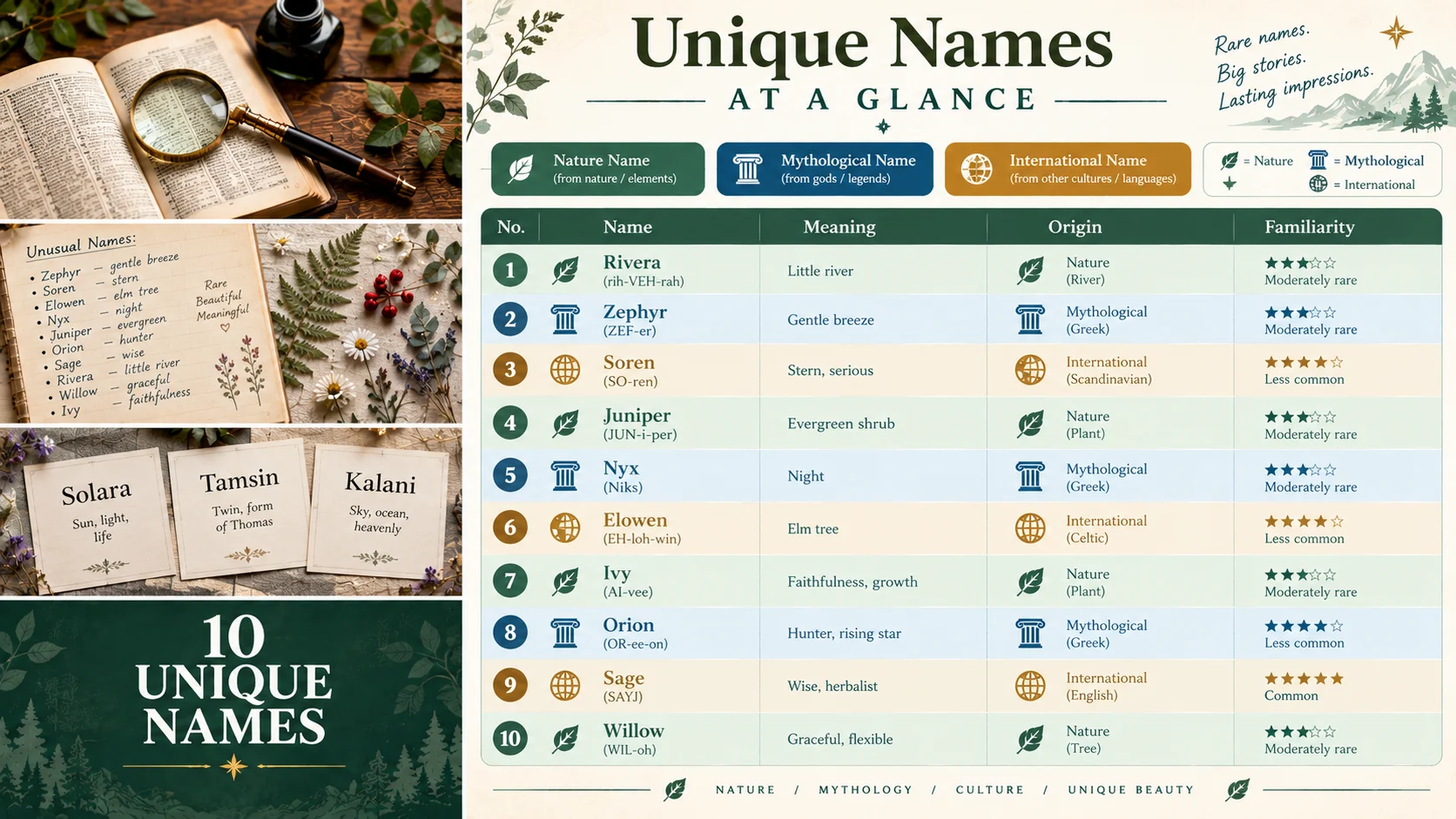
Unique names are given names that are rare or distinctive within a particular culture or language. They often come from nature, mythology, international traditions, or invented forms. Rarity is relative, so a name uncommon in one country may be familiar in another.
You want a name that stands out. But every list gives you the same suggestions. The names that felt special last year now show up on three playgrounds and two coffee cups. Here is the tricky part. Uniqueness is not fixed. It depends on where you live and who you know. A name that sounds rare in Ohio may be ordinary in Oaxaca. That is exactly why the hunt for unique names feels endless.
- This guide takes a different angle. It focuses on ten names that are genuinely uncommon in English-speaking countries. But it also tells you where each one comes from and what it carries. Some are nature words. Some come from myth. Some are regional variants that never crossed borders. Each entry covers meaning, origin, vibe, and practical notes. By the end, you will know what makes a name feel distinct without feeling difficult.
10 Unique Names Worth Considering
1. Solara
Meaning and origin: Solara comes from the Latin word sol, which means sun. It is a modern name built on a classical root. You will see it on rare-name lists as an alternative to Luna and Stella. It is not a traditional given name in Latin or any European language, but its parts are easy to recognize.
Style and vibe: Bright, open, and a little celestial. It has warm vowels and three clear syllables. Easy to say on the first try.
Best for: Families who love light and nature imagery. Good for anyone who wants something less expected than Aurora or Stella. Also works well for fantasy characters.
Familiarity: Rare in official records. It shows up in naming communities and curated lists. But you will not hear it often in daily life.
Similar names: Solana, Solene, Elara, Estella, Sunniva.
Why it works today: Solara feels modern without being made up from nothing. It connects to a real root. The meaning is clear. No one needs to ask what it means.
2. Evanthe
Meaning and origin: Evanthe is a Greek name. It combines eu, meaning good or fair, with anthos, meaning flower. It appears in classical sources. English speakers have used it occasionally, but it has never been common.
Style and vibe: Soft, floral, and literary. Three gentle syllables. It has an old-fashioned elegance without feeling dusty.
Best for: Parents who love flower names but want something beyond Rose, Lily, or Violet. Good for characters in historical or myth-inspired stories.
Familiarity: Rare. You will find it on lists of unusual Greek names. But you are unlikely to meet one at school or work.
Similar names: Evadne, Ianthe, Calanthe, Amarantha, Rhodanthe.
Why it works today: Evanthe gives you botanical beauty without the crowd. Its Greek roots add depth. The sound is distinctive but not hard to learn.
3. Bracken
Meaning and origin: Bracken is an English nature word. It refers to a type of large fern. The word comes from Old Norse brakni, which means fern. People started using it as a name in the late twentieth century.
Style and vibe: Earthy, rugged, and a little boyish. Two syllables with a hard final consonant. It sounds like the outdoors.
Best for: Families who prefer nature names that are not floral or delicate. Works well for characters in rural or outdoor settings.
Familiarity: Rare as a first name. It appears in nature-name discussions. But it is not a standard choice.
Similar names: Bramble, Birch, Heath, Rowan, Ash.
Why it works today: Bracken is distinctive without being invented. It connects to a real plant and a real landscape. The sound is sturdy and easy to remember.
4. Kalani
Meaning and origin: Kalani is a Hawaiian name. It means “the heavens” or “the sky.” It is used in Hawaii and has gained some recognition in the mainland United States. Many people treat it as a unisex name, though it leans feminine in current usage.
Style and vibe: Rhythmic, warm, and open. Three syllables with a flowing sound. It feels both grounded and airy.
Best for: Families drawn to Hawaiian culture or celestial meanings. Works across genders, though usage patterns vary.
Familiarity: More familiar than many names here, but still uncommon in most of the United States. You will see it on lists of newer unisex names.
Similar names: Kailani, Leilani, Malia, Nohea, Keanu.
Why it works today: Kalani balances distinctiveness with ease of use. It is not hard to spell or say. The meaning gives it quiet weight.
5. Tamsin
Meaning and origin: Tamsin is an English short form of Thomasina. Thomasina is the feminine version of Thomas, which means “twin.” People use it in Britain, especially in Cornwall and the southwest. It has never been common in the United States.
Style and vibe: Crisp, British, and no-nonsense. Short and efficient. The final consonant lands clean.
Best for: Families with British heritage or a taste for understated names. Works well for characters who need a name that sounds real and grounded.
Familiarity: Uncommon in North America. More recognizable in the United Kingdom. It shows up on rare-name lists as an “offbeat” British choice.
Similar names: Tessa, Thomasina, Tamzin, Tilly, Tabitha.
Why it works today: Tamsin is rare without being strange. It has real history. The meaning is clear. Most English speakers can pronounce it on the first try.
6. Tashi
Meaning and origin: Tashi is a Tibetan word. It means “good fortune.” People use it as a given name in Tibet and Bhutan. It has appeared in English-speaking countries through cultural exchange and travel writing. Every source describes the meaning as auspicious.
Style and vibe: Short, balanced, and calm. Two open syllables with a soft start.
Best for: Families drawn to Himalayan or Buddhist associations. Good for anyone who wants a short name with a positive meaning. Works as a first or middle name.
Familiarity: Rare in English-speaking countries. It appears on unusual-name lists. You may meet it in communities with Tibetan connections.
Similar names: Dawa, Pema, Karma, Sonam, Tenzin.
Why it works today: Tashi is brief and meaningful. Easy to pronounce. It gives you cultural depth without a long explanation.
7. Alcina
Meaning and origin: Alcina is a literary and operatic name. It belongs to a sorceress in Ariosto’s Orlando Furioso and in Handel’s opera Alcina. The exact origin is uncertain. It may connect to Germanic roots. It is not a traditional given name in most European languages.
Style and vibe: Dramatic, elegant, and a little mysterious. Three syllables with a soft flow.
Best for: Writers creating characters with a magical or theatrical edge. Also good for parents who love opera or Renaissance literature.
Familiarity: Very rare as a given name. It shows up on lists of rediscovered names. Short forms like Alcie or Alsie could make it more approachable.
Similar names: Morgana, Melissa, Circe, Armida, Alcestis.
Why it works today: Alcina carries a story wherever it goes. It is distinctive and beautiful. The literary associations give it instant atmosphere.
8. Bruin
Meaning and origin: Bruin is an Old English word for bear. It comes from the Dutch word for brown. People have used it as a surname and sometimes as a first name. It appears in medieval fables and place names.
Style and vibe: Sturdy, old-fashioned, and a little playful. One syllable with a solid, grounded sound.
Best for: Families who like animal names with history. Good for characters in folkloric or medieval-inspired settings.
Familiarity: Rare as a first name. It appears on lists of new additions and in discussions of animal names in hiding.
Similar names: Bruno, Bjorn, Orson, Arthur, Barrett.
Why it works today: Bruin is simple and strong. It connects to a recognizable animal without being cutesy. The brevity makes it practical.
9. Eris
Meaning and origin: Eris is the Greek goddess of strife and discord. In myth, she starts the chain of events that leads to the Trojan War by tossing the golden apple of discord. The name is short and sharp. It has appeared in modern fiction and popular culture, including as part of the inspiration for Maleficent in some interpretations.
Style and vibe: Sharp, mythological, and a little dangerous. Two syllables with a crisp first vowel.
Best for: Characters with a rebellious or chaotic edge. Also good for parents who like classical names with a bit of bite.
Familiarity: Rare as a given name. It shows up on new-name lists and in mythological discussions. But it is not common.
Similar names: Eros, Nyx, Hecate, Persephone, Lyssa.
Why it works today: Eris is short and memorable. Loaded with story. It gives you mythological depth without the length of Persephone or the familiarity of Athena.
10. Jember
Meaning and origin: Jember is an Amharic name from Ethiopia. You say it “JEM-bair.” Sources describe the meaning as sunset, sunrise, or horizon. It is rare outside Ethiopian communities.
Style and vibe: Warm, grounded, and distinctive. Two syllables with a soft start and a clear ending.
Best for: Families with Ethiopian heritage. Also good for anyone drawn to names with African origins and nature-based meanings.
Familiarity: Very rare in English-speaking countries. It appears in coverage of rare international names.
Similar names: Abebe, Tarik, Zemen, Berhan, Dawit.
Why it works today: Jember is a real name with a clear meaning. English speakers can learn the sound quickly. It offers rarity without invented spelling.
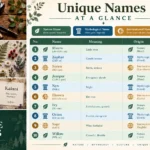
Quick Comparison Table
| Name | Meaning / Origin | Style | Best For | Familiarity |
|---|---|---|---|---|
| Solara | Sun, Latin root | Bright, celestial | Nature and light lovers | Rare |
| Evanthe | Fair flower, Greek | Floral, literary | Greek myth fans | Rare |
| Bracken | Fern, Old Norse | Earthy, rugged | Nature name seekers | Rare |
| Kalani | The heavens, Hawaiian | Rhythmic, unisex | Celestial name fans | Uncommon |
| Tamsin | Twin, English | Crisp, British | Understated name lovers | Uncommon |
| Tashi | Good fortune, Tibetan | Short, calm | Meaning-focused families | Rare |
| Alcina | Literary, uncertain | Dramatic, operatic | Writers and opera fans | Very rare |
| Bruin | Bear, Old English | Sturdy, folkloric | Animal name fans | Rare |
| Eris | Strife, Greek | Sharp, mythological | Mythological name fans | Rare |
| Jember | Sunset or horizon, Amharic | Warm, grounded | Ethiopian heritage | Very rare |
How to Choose a Unique Name
Decide what unique means to you. A name can be rare in your country. Rare in your generation. Or rare among your friends. Pick the kind of distinctiveness that matters before you start browsing.
Read it aloud to a stranger. Ask someone outside your family to say the name. If they stumble or guess wrong, the name may cause friction. This test matters most for names from languages your community does not speak.
Check the spelling burden. A name you have to correct every time can get tiring. Tamsin and Bruin are straightforward. Evanthe and Alcina may need clarification now and then.
Say the full name. Pair the first name with your surname. Listen for awkward vowel runs or repeated endings. A short first name often balances a longer surname.
Research the cultural weight. Some names carry religious or historical meaning beyond the surface. Tashi and Jember belong to living traditions. A quick search shows respect and prevents mistakes.
Run a quick internet test. Search the name with common terms. See what comes up. A name shared with a controversial figure or a major brand may carry baggage you do not want.
Do not overcorrect. A name does not need to be completely unknown to be distinctive. Many names on this list are rare but not invented. They have real history and established pronunciation.
Query Fan-Out:
- What makes a name unique? Rarity is the main factor. But uniqueness depends on location and culture. A name uncommon in the United States may be standard in Iceland or Nigeria.
- What are unique names that are still easy to pronounce? Solara, Tamsin, and Kalani offer distinctive sounds without tricky letter combinations.
- Are unique names always invented? No. Many rare names come from older traditions, regional variants, or nature words that fell out of fashion.
- What are unique unisex names? Kalani, Tashi, and Rivers appear in unisex usage across different cultures.
- How can I test whether a unique name is usable? Say it aloud. Spell it for a stranger. Check how it sounds with your surname. If all three steps feel natural, the name is likely workable.
- Do unique names cause problems for children? Research is mixed. Some studies suggest unusual names draw attention, but family and social context matter more than the name itself.
- What are unique names for characters? Literary and mythological sources offer strong options, including Alcina, Eris, and Bruin. These carry built-in associations without being overused.
FAQ
What makes a name unique?
A name is unique when it is rare in a specific community or region. Rarity is relative. A name common in one country may be unusual in another. Context determines uniqueness more than any fixed list.
What are unique names that are easy to pronounce?
Solara, Tamsin, Kalani, and Tashi all have clear phonetic structures for English speakers. They use familiar sounds and predictable stress patterns. That reduces mispronunciation.
Are unique names always modern inventions?
No. Many rare names come from older traditions. Bracken, Bruin, and Tamsin have historical roots. Eris and Evanthe come from Greek sources. Uniqueness often means rediscovery, not invention.
What are good unique unisex names?
Kalani and Tashi appear in unisex usage across different communities. Rivers and Sage also work as unisex names in English-speaking countries. Popularity varies by region.
Can a unique name cause problems for a child?
Research is mixed and depends on context. Some studies suggest unusual names draw attention. But family support, school environment, and the child’s own preferences matter more. No reliable evidence shows a rare name determines outcomes.
What are unique names for characters?
Literary and mythological sources offer strong options. Alcina, Eris, and Evanthe carry built-in associations that can enrich a story. Bruin and Bracken work well for folkloric or outdoor settings.
How can I make an unusual name feel usable?
Pair it with a familiar middle name or a simple surname. Use a common nickname in daily life. Test it in a sentence. “This is my daughter, Evanthe, and she goes by Evie.” If the sentence feels natural, the name works.
Are unique names becoming more common?
Naming diversity has grown in many countries over recent decades, according to national statistics agencies. That means the pool of names in use is wider. But it does not mean every rare name is rising. Some stay stable and uncommon.
Conclusion
Unique names are not one category. They include nature words like Bracken, mythological figures like Eris, regional variants like Tamsin, and international imports like Kalani and Jember. What they share is rarity. What they need is a careful check on pronunciation, spelling, and cultural context.
The ten names in this guide are uncommon in English-speaking countries. But each one has a real origin and a clear meaning. Use the comparison table to see them side by side. Use the pronunciation test before you commit. If a name feels right when you say it aloud, you have probably found it. Share your favorite unique names in the comments, especially the ones you have never heard on anyone else.

Benjamin Clarke is a writer and nickname enthusiast at NicknameCorner.com, where he helps readers discover creative, meaningful, funny and unique nicknames for people, pets, usernames and special occasions. His content focuses on practical ideas, clear explanations and nickname inspiration that makes choosing the perfect name easier.