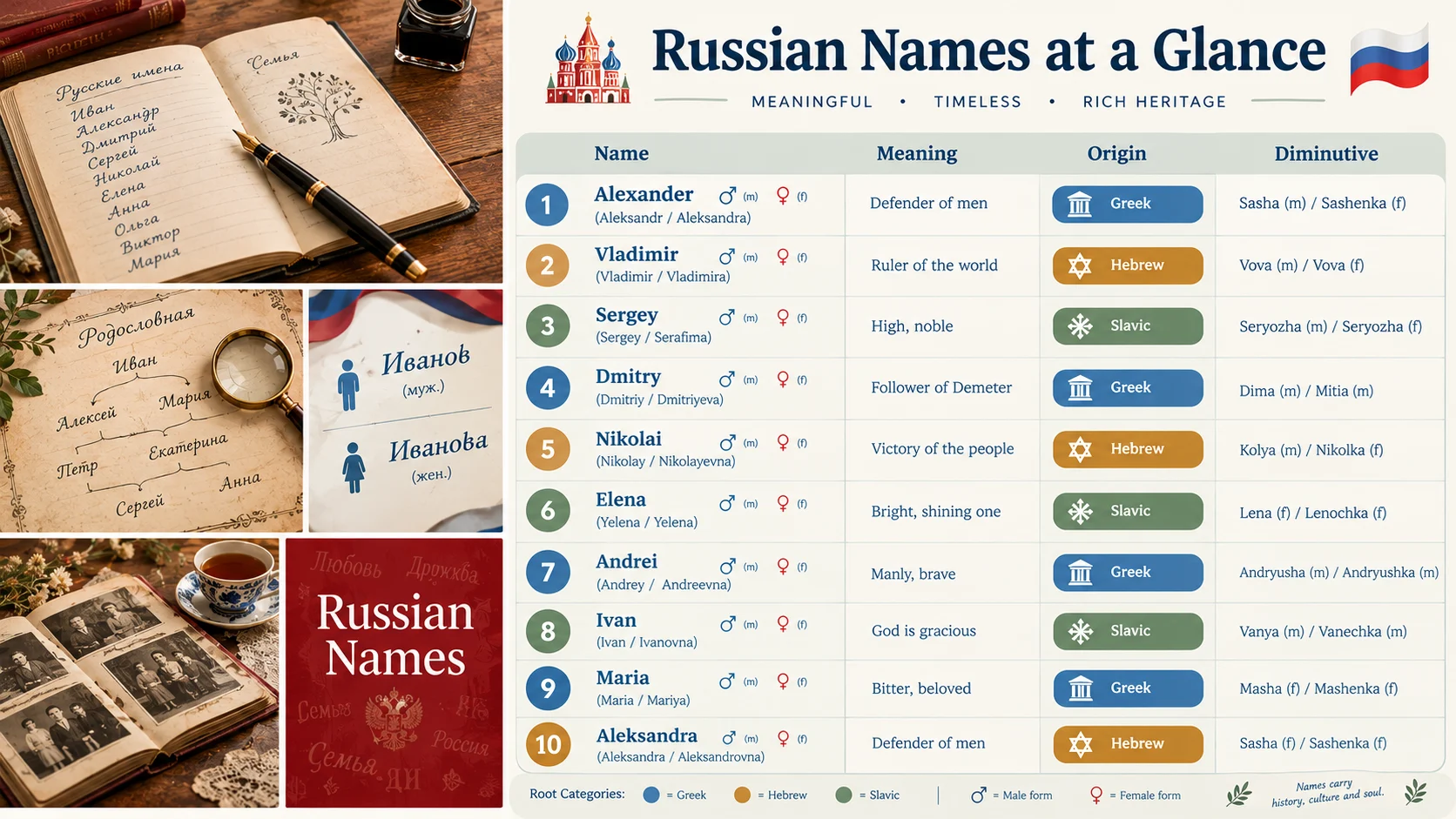
Russian names typically consist of a given name, a patronymic derived from the father’s name, and a family surname. Common sources include Greek, Hebrew, Latin, and Slavic roots. Popular examples include Alexander, Anastasia, Dmitri, and Sofia.
A Russian name carries more than a label. It carries a father’s name in its middle syllable, a family’s history in its ending, and often a saint’s legacy in its root. When you learn someone is named Anastasia Petrovna Ivanova, you are not just learning what to call her. You are learning her father’s name was Pyotr, that she comes from the Ivanov family, and that somewhere along the line, an ancestor was named after a fourth-century martyr. Russian names work differently from English names in ways that are easy to miss. The patronymic is not a middle name in the Western sense. The diminutive is not just a nickname. And the line between a name and its many affectionate forms is more fluid than outsiders expect. This guide explains the system clearly, covers ten significant Russian names, and offers practical advice for anyone choosing, researching, or writing about Russian names.
10 Russian Names Worth Understanding
1. Alexander (Александр)
Meaning and origin: Alexander derives from the Greek Alexandros, meaning defender of men. It entered Russian through Eastern Orthodox tradition and became one of the most durable names in Russian history, borne by tsars, poets, and generals .
Style and vibe: Classic, strong, and universally recognized. It has a formal weight but softens in everyday use.
Diminutive forms: Sasha is the most common affectionate form, used for both men and women in modern Russian. Shura and Sanya also appear .
Best for: A name that feels both historically grounded and internationally legible. It works across generations without sounding dated.
Similar names: Alexei, Andrei, Anton, Arkady.
Why it works today: Alexander remains in Russia’s top five names for boys, according to recent data, and its Greek root gives it recognition far beyond Russian borders .
2. Anastasia (Анастасия)
Meaning and origin: Anastasia comes from the Greek anastasis, meaning resurrection. It entered Russian through Orthodox Christianity and was borne by several saints. The name gained global attention through the story of Grand Duchess Anastasia, the youngest daughter of Tsar Nicholas II .
Style and vibe: Elegant, romantic, and slightly regal. It has a flowing, four-syllable structure that sounds formal but not cold.
Diminutive forms: Nastya is the standard short form. Asya and Stasya also appear.
Best for: Families drawn to names with historical depth and a graceful sound. It travels well across languages and cultures.
Similar names: Maria, Ekaterina, Tatiana, Sofia.
Why it works today: Anastasia balances tradition with international familiarity. It is widely recognized outside Russia without feeling generic.
3. Dmitri (Дмитрий)
Meaning and origin: Dmitri derives from the Greek Demetrios, meaning devoted to Demeter, the goddess of agriculture. It entered Russian through Orthodox tradition and has remained common for centuries .
Style and vibe: Solid, masculine, and slightly old-fashioned in a good way. It has a grounded, earthy quality.
Diminutive forms: Dima is the standard short form. Mitya offers a softer alternative.
Best for: A name with historical weight that still feels approachable. It suits characters and real people alike.
Similar names: Denis, Daniil, Dmitry variants, Demid.
Why it works today: Dmitri is familiar without being overused in English-speaking contexts. Its Greek root gives it a classical foundation.
4. Sofia (София)
Meaning and origin: Sofia comes from the Greek sophia, meaning wisdom. It has been used in Russia for centuries, particularly among the nobility, and has surged in popularity in recent decades .
Style and vibe: Soft, bright, and modern. It has a clean, two-syllable sound that feels both classic and contemporary.
Diminutive forms: Sonya is the standard affectionate form. Sonechka appears in literature and tender contexts.
Best for: Parents seeking a name that feels international, elegant, and easy to pronounce across cultures.
Similar names: Sophia, Sonia, Zoya, Vera.
Why it works today: Sofia has held the top spot for girls’ names in Russia for several consecutive years, according to recent data, and its Greek root gives it broad appeal .
5. Ivan (Иван)
Meaning and origin: Ivan is the Russian form of John, derived from the Hebrew Yochanan, meaning God is gracious. It was the name of six Russian rulers, including Ivan the Terrible, the first tsar of Russia .
Style and vibe: Sturdy, traditional, and unmistakably Russian. It carries a folkloric weight, appearing in countless fairy tales as the archetypal third son.
Diminutive forms: Vanya is the standard affectionate form. Vanyusha appears in folk tales and songs.
Best for: A name with deep cultural resonance and a straightforward, memorable sound.
Similar names: Ilya, Mikhail, Alexei, Yuri.
Why it works today: Ivan is one of the few Russian names that has become fully familiar in English-speaking countries, partly through literature and history .
6. Maria (Мария)
Meaning and origin: Maria is the Russian form of Mary, derived from Hebrew, with meanings often given as beloved or wished-for child, though the exact etymology is debated. It entered Russian through Christianity and has remained consistently popular .
Style and vibe: Classic, warm, and deeply rooted. It has a universal quality that transcends borders.
Diminutive forms: Masha is the most common affectionate form. Marusya and Manya also appear.
Best for: A name that feels both traditional and globally recognizable. It works across generations.
Similar names: Marina, Marianna, Maryana, Mariya.
Why it works today: Maria remains in Russia’s top five for girls, according to recent data, and its Hebrew root gives it recognition across Christian, Jewish, and secular communities .
7. Svetlana (Светлана)
Meaning and origin: Svetlana is a Slavic name derived from svet, meaning light or bright. It was invented or popularized in the nineteenth century and became common in the Soviet period .
Style and vibe: Luminous, feminine, and distinctly Slavic. It has a flowing, three-syllable structure that feels warm rather than formal.
Diminutive forms: Sveta is the standard short form. Svetochka appears in affectionate contexts.
Best for: A name with a clear, positive meaning and a sound that feels uniquely Russian.
Similar names: Svetlana variants, Snezhana, Milena, Zlata.
Why it works today: Svetlana offers a Slavic root and a meaning that translates easily, making it both culturally specific and emotionally accessible.
8. Mikhail (Михаил)
Meaning and origin: Mikhail is the Russian form of Michael, derived from the Hebrew Mikha’el, meaning who is like God. It entered Russian through Orthodox tradition and has been borne by tsars, poets, and the last Soviet leader, Mikhail Gorbachev .
Style and vibe: Formal, dignified, and slightly old-fashioned. It has a weight that suits public figures and historical contexts.
Diminutive forms: Misha is the standard affectionate form, familiar to international audiences through chess and culture.
Best for: A name with historical and religious depth that still feels accessible through its diminutive.
Similar names: Misha as a standalone, Mikhail variants, Gabriel, Nikolai.
Why it works today: Mikhail has held the top spot for boys’ names in Russia in recent data, and its Hebrew root gives it recognition across multiple traditions .
9. Ekaterina (Екатерина)
Meaning and origin: Ekaterina is the Russian form of Catherine, derived from the Greek Aikaterine, of uncertain origin but often associated with the Greek word for pure. It was the name of several Russian empresses, most notably Catherine the Great .
Style and vibe: Regal, elaborate, and historically rich. It has a formal grandeur that softens in its diminutive forms.
Diminutive forms: Katya is the most common affectionate form. Katerina and Katyusha also appear.
Best for: A name with imperial associations and a sound that feels both formal and warm in its shortened forms.
Similar names: Katerina, Katarina, Katrina, Yekaterina.
Why it works today: Ekaterina connects to one of Russia’s most significant historical figures while offering the approachable nickname Katya for daily use.
10. Andrei (Андрей)
Meaning and origin: Andrei is the Russian form of Andrew, derived from the Greek Andreas, meaning manly or courageous. It entered Russian through Orthodox tradition and remains one of the most common male names in the country .
Style and vibe: Simple, strong, and unpretentious. It has a direct, two-syllable structure that feels both traditional and modern.
Diminutive forms: Andryusha is the standard affectionate form, used in family contexts and literature.
Best for: A name that feels grounded and reliable without being boring. It works across social classes and generations.
Similar names: Alexei, Anton, Arkady, Andronik.
Why it works today: Andrei is common enough to feel familiar but not so common that it fades into the background. Its Greek root gives it a classical foundation.
Quick Comparison Table
| Name | Meaning | Origin | Diminutive | Best For |
|---|---|---|---|---|
| Alexander | Defender of men | Greek | Sasha, Shura | Timeless classics |
| Anastasia | Resurrection | Greek | Nastya | Historical elegance |
| Dmitri | Devoted to Demeter | Greek | Dima, Mitya | Grounded strength |
| Sofia | Wisdom | Greek | Sonya | Modern international |
| Ivan | God is gracious | Hebrew | Vanya | Folkloric tradition |
| Maria | Beloved / wished-for | Hebrew | Masha | Universal familiarity |
| Svetlana | Light, bright | Slavic | Sveta | Slavic warmth |
| Mikhail | Who is like God | Hebrew | Misha | Historical dignity |
| Ekaterina | Pure (uncertain) | Greek | Katya | Imperial grandeur |
| Andrei | Manly, courageous | Greek | Andryusha | Simple reliability |
How Russian Names Work
The three-part structure. A full Russian name consists of a given name, a patronymic, and a surname. In formal contexts, the order is given name, then patronymic, then surname. For example, Anton Pavlovich Chekhov: Anton is his given name, Pavlovich means son of Pavel, and Chekhov is the family name .
Patronymics are gendered. A son’s patronymic typically ends in -ovich or -evich. A daughter’s ends in -ovna or -evna. If a father is named Pavel, his son’s patronymic is Pavlovich and his daughter’s is Pavlovna .
Diminutives are not optional. Russian speakers use diminutive forms constantly. Alexander becomes Sasha. Natalia becomes Natasha. Maria becomes Masha. These forms signal intimacy, affection, or informality. Using a full name in a close relationship can sound cold or overly formal .
Formal and informal address. The combination of first name and patronymic is the standard formal address for adults. Colleagues who are not close, students addressing teachers, and younger people addressing elders typically use this form. First names alone are for friends, family, and children .
Surnames follow similar gender rules. Most Russian surnames have male and female forms. Ivanov becomes Ivanova. Chekhov becomes Chekhova. Surnames ending in -sky become -skaya. A few endings, such as -ko, remain unchanged .
Historical layers. Many common Russian names entered through Greek and Hebrew via Orthodox Christianity. Others are Slavic in origin, and a smaller number were created or popularized in the Soviet period. This layered history means that a single Russian name can carry Greek, Hebrew, Slavic, and modern political associations all at once.
Query Fan-Out:
- What are the most popular Russian names right now? Recent data from Russia’s Social Fund places Mikhail and Sofia at the top for newborns, followed by Alexander, Artyom, Anna, and Maria .
- What is a patronymic in Russian names? A patronymic is a middle name derived from the father’s first name, using suffixes like -ovich for sons and -ovna for daughters .
- What are common Russian girl names? Anastasia, Maria, Anna, Sofia, Tatiana, and Ekaterina are among the most familiar Russian female names .
- What are common Russian boy names? Alexander, Dmitri, Ivan, Mikhail, Sergei, and Andrei are widely used and recognized .
- Why do Russians have three names? The three-part structure of given name, patronymic, and surname serves to identify family lineage and show respect in formal address .
- What are Russian diminutives? Diminutives are affectionate short forms used among family and friends, such as Sasha for Alexander or Masha for Maria .
- Do Russian names have religious meanings? Many do. Names like Ivan (God is gracious), Anna (grace), and Mikhail (who is like God) entered Russian through Orthodox Christian tradition .
FAQ
What are the most popular Russian names for boys?
Recent data from Russia’s Social Fund places Mikhail at the top, followed by Alexander, Artyom, Matvei, and Timofei. These names reflect a preference for established classics over experimental choices .
What are the most popular Russian names for girls?
Sofia leads, followed by Anna, Eva, Maria, and Vasilisa. Sofia has held the top position for several consecutive years, according to the same data .
What is a patronymic and how does it work?
A patronymic is a name derived from the father’s first name. Sons add -ovich or -evich, and daughters add -ovna or -evna. It functions as a middle name and is used in formal address alongside the first name .
Why do Russians use diminutives so often?
Diminutives signal warmth, intimacy, and informality. Using the full formal name in a close relationship can sound distant. Common examples include Sasha for Alexander, Masha for Maria, and Dima for Dmitri .
What are some Russian names that mean light?
Svetlana derives from the Slavic root for light. Zlata is associated with gold or golden. Yelena and Elena are linked to light or torch through Greek roots .
Do Russian names have religious significance?
Many do. Names like Ivan (God is gracious), Mikhail (who is like God), and Anastasia (resurrection) entered Russian through Orthodox Christian tradition and carry religious meaning .
What is the difference between a Russian name and a Slavic name?
Russian names include Greek, Hebrew, Latin, and Slavic roots, reflecting the country’s history of cultural exchange. Slavic names specifically come from Slavic languages and often have nature-based or compound meanings, such as Svetlana (light) or Vladimir (ruler of the world) .
Can foreigners use Russian names?
Yes, though context matters. A name like Sasha or Natasha has become familiar in English-speaking countries as a standalone name. Using a full Russian name with its patronymic as a foreigner would be unusual, but adopting a given name is common and generally accepted.
Conclusion
Russian names reward a closer look. The three-part structure, the gendered patronymics, and the constant use of diminutives make them one of the most systematic naming traditions in the world. Names like Alexander and Anastasia feel familiar, but their full forms and formal address rules carry layers that English names do not. The current top names, Mikhail and Sofia, show that Russian parents continue to favor established classics over experimentation . Whether you are choosing a name for a child, writing characters with Russian heritage, or researching family history, understanding how Russian names work makes every name you encounter more legible. Use this guide as a starting point. Check primary sources for genealogy. And if you have a favorite Russian name, share it in the comments.










18 thoughts on “Russian Names Guide| Meanings, Patronymics, and Popular Picks”