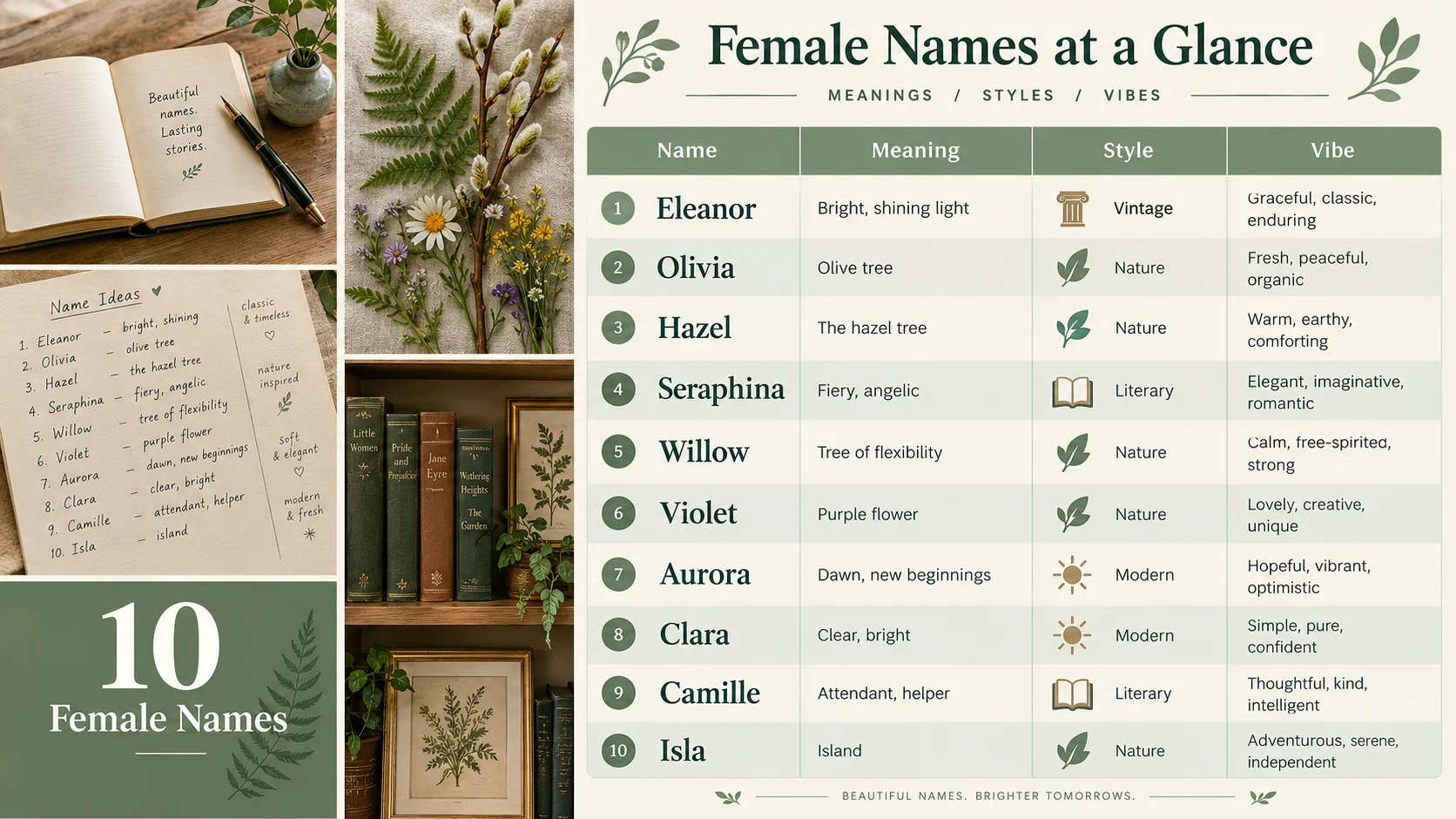
Female names are given names used for girls and women, drawn from languages, cultures, and traditions worldwide. They carry meanings, histories, and style associations. Common categories include classic, vintage, nature-inspired, literary, and modern invented names.
Choosing a female name is one of the most personal decisions a family can make. It is a word a child will hear thousands of times before she learns to write it. It will appear on school lists, job applications, and eventually, perhaps, a byline or a signature. The best female names do not just sound pleasant. They carry a sense of identity that feels right for the person who will grow into them.
Whether you are naming a daughter, creating a character, or simply exploring the landscape of female names out of curiosity, the options are genuinely vast. Some names have survived centuries because they are sturdy and familiar. Others feel fresh because they are rare, invented, or borrowed from nature and literature. This guide walks through ten distinctive female names, explains their meanings and origins, and offers practical advice for choosing one that works in real life. No name determines a personality. But a thoughtful choice can give a girl a strong, beautiful word to call her own.
10 Female Names Worth Considering
1. Ada
Meaning and origin: Ada is a Germanic name meaning “noble” or “nobility.” It has roots in the Old German element adal, meaning noble kind or noble nature. The name has been used in England since the medieval period but gained renewed attention through Ada Lovelace, the nineteenth-century mathematician often credited with writing the first algorithm intended for a machine.
Style and vibe: Ada feels short, crisp, and intelligent. It has a vintage quality without sounding fussy, and it works equally well on a child and an adult. It is familiar but not overused in most English-speaking countries.
Best for: Families drawn to short, two-syllable names with historical weight and a clean, modern sound. It pairs well with longer middle names and most surnames.
Similar names: Ava, Ida, Adeline, Adelaide, Alma.
Why it works today: Ada balances brevity with substance. It does not rely on trends, and its association with a pioneering woman in science gives it quiet strength without feeling heavy.
2. Cordelia
Meaning and origin: Cordelia is of uncertain origin, though it is most famously associated with Shakespeare’s King Lear. It may derive from the Latin cor, meaning heart, or from a Celtic root. The name appears in British literary tradition and has been used steadily, though never at the very top of popularity charts.
Style and vibe: Cordelia is elaborate, literary, and slightly dramatic. It has a romantic, old-world feel and offers the natural nicknames Cora, Delia, or Cordie.
Best for: Parents who love names with literary connections and a little flourish. It suits families who prefer longer names with multiple nickname options.
Similar names: Cornelia, Ophelia, Seraphina, Aurelia, Celia.
Why it works today: Cordelia feels distinctive without being difficult to pronounce or spell. Its literary pedigree gives it depth, while the shorter nickname Cora keeps it wearable in everyday settings.
3. Zara
Meaning and origin: Zara has multiple possible origins. It is often linked to the Arabic name Zahra, meaning “flower” or “blooming,” and it also appears as a name of Hebrew and Russian derivation. In recent decades it has become common across Europe, the Middle East, and English-speaking countries.
Style and vibe: Zara is short, sharp, and international. It has a modern feel but is not an invented name. The initial Z gives it energy and memorability.
Best for: Families seeking a name that travels well across cultures and languages. It works for parents who want something short and striking without being unusual.
Similar names: Zahra, Zaria, Zora, Sara, Lara.
Why it works today: Zara is efficient and confident. It does not need a nickname, and its cross-cultural recognition makes it practical in a globalized world.
4. Elodie
Meaning and origin: Elodie is a French name derived from the Germanic elements ali, meaning foreign or other, and od, meaning wealth or fortune. It is related to the name Alodia and has been used in France for centuries. It remains more common in French-speaking regions than in the English-speaking world.
Style and vibe: Elodie is soft, melodic, and distinctly European. It has a gentle, flowing sound with a slightly romantic edge. The natural nickname El or Ellie makes it flexible.
Best for: Parents who want a name that sounds elegant and slightly uncommon in English-speaking countries. It suits families with French heritage or a love of French culture.
Similar names: Eloise, Amelie, Aurelie, Cleo, Sylvie.
Why it works today: Elodie offers a fresh alternative to the heavily used Eloise and Ellie family of names. It is recognizable but not commonplace, and its sound is undeniably lovely.
5. Judith
Meaning and origin: Judith is a Hebrew name meaning “woman of Judea” or “praised.” It appears in the biblical Book of Judith and has been used in Jewish, Christian, and secular communities for centuries. It was among the most popular names for girls in the United States in the 1940s and has since declined, though some forecasts suggest a revival may be approaching .
Style and vibe: Judith is sturdy, classic, and slightly serious. It carries an old-fashioned dignity and offers the warm, approachable nickname Judy or the sleeker Jude.
Best for: Families who value traditional names with deep historical roots. It works well for parents who prefer a name that sounds established rather than trendy.
Similar names: Judith’s variants include Judy, Jude, Jodie, and the French Judith. Related classic names include Margaret, Helen, and Frances.
Why it works today: Judith is due for reappraisal. It is a strong, unambiguous name with a clear meaning and a long history, and its decline in use means it now feels distinctive rather than dated.
6. Mira
Meaning and origin: Mira has multiple origins. In Sanskrit, it means “ocean” or “limit.” In Slavic languages, it derives from mir, meaning peace or world. It also appears as a short form of names like Mirabelle or Almira. The name is used across India, Eastern Europe, and the Middle East.
Style and vibe: Mira is brief, calm, and cross-cultural. It has a serene quality and works equally well as a standalone name or a nickname.
Best for: Parents looking for a short, meaningful name with international resonance. It suits families who want something simple but not plain.
Similar names: Mila, Mina, Mara, Mirabelle, Amira.
Why it works today: Mira is efficient and beautiful. Its multiple meanings give it depth without requiring explanation, and its brevity makes it practical in daily life.
7. Winifred
Meaning and origin: Winifred is a Welsh name derived from gwen, meaning fair or blessed, and frewi, meaning peace or reconciliation. It is associated with Saint Winifred, a seventh-century Welsh martyr. The name was common in medieval England and remained in use through the nineteenth and early twentieth centuries.
Style and vibe: Winifred is vintage, warm, and slightly quirky. It offers the nicknames Winnie, Fred, or Freddie, giving it flexibility across different tastes.
Best for: Families who love vintage revivals and names with a cozy, grandmotherly charm. It works well for parents who want a name that feels lived-in and friendly.
Similar names: Winnie, Wilhelmina, Frederica, Gwendolyn, Mabel.
Why it works today: Winifred is part of the broader revival of vintage names that were once considered too old-fashioned. Its nickname potential makes it adaptable, and its Welsh roots give it a specific cultural anchor.
8. Amara
Meaning and origin: Amara has roots in several languages. In Igbo, it means “grace” or “mercy.” In Sanskrit, it can mean “immortal” or “unfading.” It also appears in Spanish and Italian contexts, sometimes connected to the Latin amarus, meaning bitter, though the more common associations are positive. It entered the US Top 100 for the first time in recent years .
Style and vibe: Amara is smooth, warm, and globally minded. It has a melodic quality and feels both modern and grounded.
Best for: Parents drawn to names with African or South Asian roots, or families who want a name that sounds beautiful across cultures.
Similar names: Amaya, Amira, Mara, Tamara, Samara.
Why it works today: Amara combines a pleasing sound with meaningful roots in multiple traditions. It is rising in use but remains far from overexposed, and it pairs well with a wide range of middle and last names.
9. Fern
Meaning and origin: Fern is an English nature name referring to the fern plant. It came into use as a given name in the nineteenth century, alongside other botanical names like Rose and Violet. It has never been common but has maintained a quiet presence.
Style and vibe: Fern is green, simple, and understated. It has a earthy, practical feel and works well as a standalone name or a middle name.
Best for: Families who love nature-inspired names and prefer something short and uncommon. It suits parents who want a name that feels gentle and unpretentious.
Similar names: Wren, Sage, Hazel, Ivy, Willow.
Why it works today: Fern fits the broader interest in nature names and cottagecore aesthetics without being as expected as Lily or Rose. Its simplicity is its strength .
10. Selah
Meaning and origin: Selah is a Hebrew word found in the Psalms, likely indicating a musical interlude or a pause for reflection. Its exact meaning is uncertain, but it is often interpreted as “pause” or “praise.” It has been used as a given name primarily in Christian communities and has gained broader attention in recent years.
Style and vibe: Selah is contemplative, musical, and slightly unusual. It has a soft sound and a spiritual resonance that appeals to families across religious backgrounds.
Best for: Parents who want a name with spiritual or musical meaning and a gentle, distinctive sound. It works well for families who value reflection and calm.
Similar names: Sarah, Selina, Sela, Lela, Nahla.
Why it works today: Selah offers a combination of brevity, meaning, and rarity. It is easy to pronounce but uncommon enough to feel personal, and its musical association gives it a quiet lyricism.
Quick Comparison Table
| Nickname | Meaning | Style | Best For | Vibe |
|---|---|---|---|---|
| Ada | Noble | Vintage-short | History lovers | Crisp, intelligent |
| Cordelia | Uncertain (literary) | Literary-elaborate | Shakespeare fans | Romantic, dramatic |
| Zara | Flower / blooming | Modern-international | Global families | Sharp, confident |
| Elodie | Foreign wealth | French-soft | Francophiles | Melodic, gentle |
| Judith | Praised / Judea | Classic-revival | Traditionalists | Sturdy, dignified |
| Mira | Ocean / peace | Cross-cultural-short | Minimalists | Calm, serene |
| Winifred | Fair peace | Vintage-quirky | Vintage revivalists | Warm, friendly |
| Amara | Grace / immortal | Modern-global | Multicultural families | Smooth, warm |
| Fern | Fern plant | Nature-simple | Nature lovers | Green, understated |
| Selah | Pause / praise | Spiritual-rare | Music and faith | Contemplative, soft |
How to Choose the Perfect Female Name
Start with sound, not meaning. Say the name aloud with your surname. Check the rhythm. A two-syllable first name often pairs well with a longer last name, and vice versa. Avoid combinations that run together awkwardly or create unintended phrases.
Consider the nickname landscape. Some names come with obvious short forms. Elizabeth becomes Liz, Beth, Ellie, or Betsy. Others, like Fern or Zara, are already short. Decide whether you want a name that offers options or one that stands alone.
Check cultural and family resonance. A name does not need to match your surname’s origin, but many families find meaning in names that reflect heritage. If a name comes from a culture that is not yours, research its significance and use it with respect.
Think about the adult, not just the baby. A name that sounds adorable on a toddler will eventually belong to a teenager, a professional, and perhaps an elder. Names like Judith and Winifred may sound old-fashioned now, but they carry dignity that serves adults well.
Test pronunciation and spelling. If you choose a name with multiple spellings (Catherine/Katherine, Sara/Sarah), decide which version you prefer and accept that correction may sometimes be needed. Unusual spellings can add friction in daily life.
Avoid overthinking popularity. A name being common does not make it wrong. Olivia and Charlotte top current charts, but millions of people have common names and live perfectly happy lives. Conversely, a rare name is not automatically better. Choose what feels right for your family .
Query Fan-Out:
- What are the most classic female names? Mary, Elizabeth, Margaret, and Catherine remain among the most enduring female names in English-speaking countries .
- What female names mean strength? Bridget derives from the Irish word for strength, while Matilda carries a Germanic meaning of mighty in battle.
- What are vintage female names making a comeback? Judith, Nancy, and Betsy appear in revival forecasts, alongside Fern and Lettie .
- What female names work well internationally? Maria, Anna, Sofia, and Sara have broad recognition across languages and cultures.
- How do I choose a female name with a good nickname? Consider names like Elizabeth (Liz, Beth, Ellie) or Katherine (Kate, Katie, Kit) that offer multiple natural short forms.
- What are nature-inspired female names? Willow, Juniper, Rose, Violet, and Hazel connect to plants and natural elements.
- Do female names need to match a surname’s origin? No rule requires matching origins, but many families consider sound, length, and cultural coherence when pairing first and last names.
FAQ
What are the most popular female names right now?
In the United States, recent top names include Olivia, Charlotte, Emma, Amelia, and Sophia, based on Social Security Administration data and hospital-reported lists. Popularity shifts yearly, so checking the most recent SSA list is the most reliable approach .
What female names have the strongest meanings?
Names meaning strength include Bridget (from Irish brígh, strength), Matilda (mighty in battle), and Audrey (noble strength). Meaning is subjective, and many families prioritize sound or family connection over literal definitions.
Are vintage female names coming back?
Yes, several vintage names are seeing renewed interest. Forecasts and sales data point to revivals of names like Judith, Nancy, Fern, and Lettie, alongside continued interest in Edwardian and Victorian-era choices .
What female names work well in multiple languages?
Names with broad international recognition include Maria, Anna, Sofia, Sara, and Maya. These names have variants across languages and are generally easy to pronounce in many cultural contexts.
How do I choose a name that will not date my daughter?
Classic names with long histories tend to age well. Elizabeth, Catherine, Margaret, and Sarah have remained in use for centuries. Avoiding extremely trendy names or spellings can reduce the chance of a name feeling tied to a single decade.
What are some short female names?
Short options include Ada, Zara, Mira, Fern, Rose, June, Ivy, and Elle. Short names are practical and often pair well with longer middle or last names.
Can a female name work for a boy?
Some names traditionally used for girls have been adopted for boys, though the reverse is more common. Names like Ashley and Whitney were once male names that shifted to female use. Today, most parents choose names with clearer gender associations, but exceptions exist.
How can I honor a family member with a female name?
You can use the exact name, a variant (e.g., Josephine to honor a Joseph), a nickname (e.g., Evie for a grandmother named Evelyn), or a name with the same meaning. Some families use the honored name as a middle name to preserve it without repeating it exactly.
Conclusion
Female names carry weight. They are sounds a child hears before she understands language, and words she will write, say, and grow into for the rest of her life. The ten names in this guide range from the crisp modernity of Zara to the vintage warmth of Winifred, and from the literary elegance of Cordelia to the quiet simplicity of Fern. None is objectively better than another. The right choice depends on sound, meaning, family, and the feeling you want a name to carry.
Use this guide as a starting point, not a rulebook. Say each name aloud. Consider the nicknames. Think about the adult she will become. And trust your judgment. If you have a favorite female name that is not on this list, share it in the comments. The best name conversations are the ones where everyone brings something different to the table.

Benjamin Clarke is a writer and nickname enthusiast at NicknameCorner.com, where he helps readers discover creative, meaningful, funny and unique nicknames for people, pets, usernames and special occasions. His content focuses on practical ideas, clear explanations and nickname inspiration that makes choosing the perfect name easier.