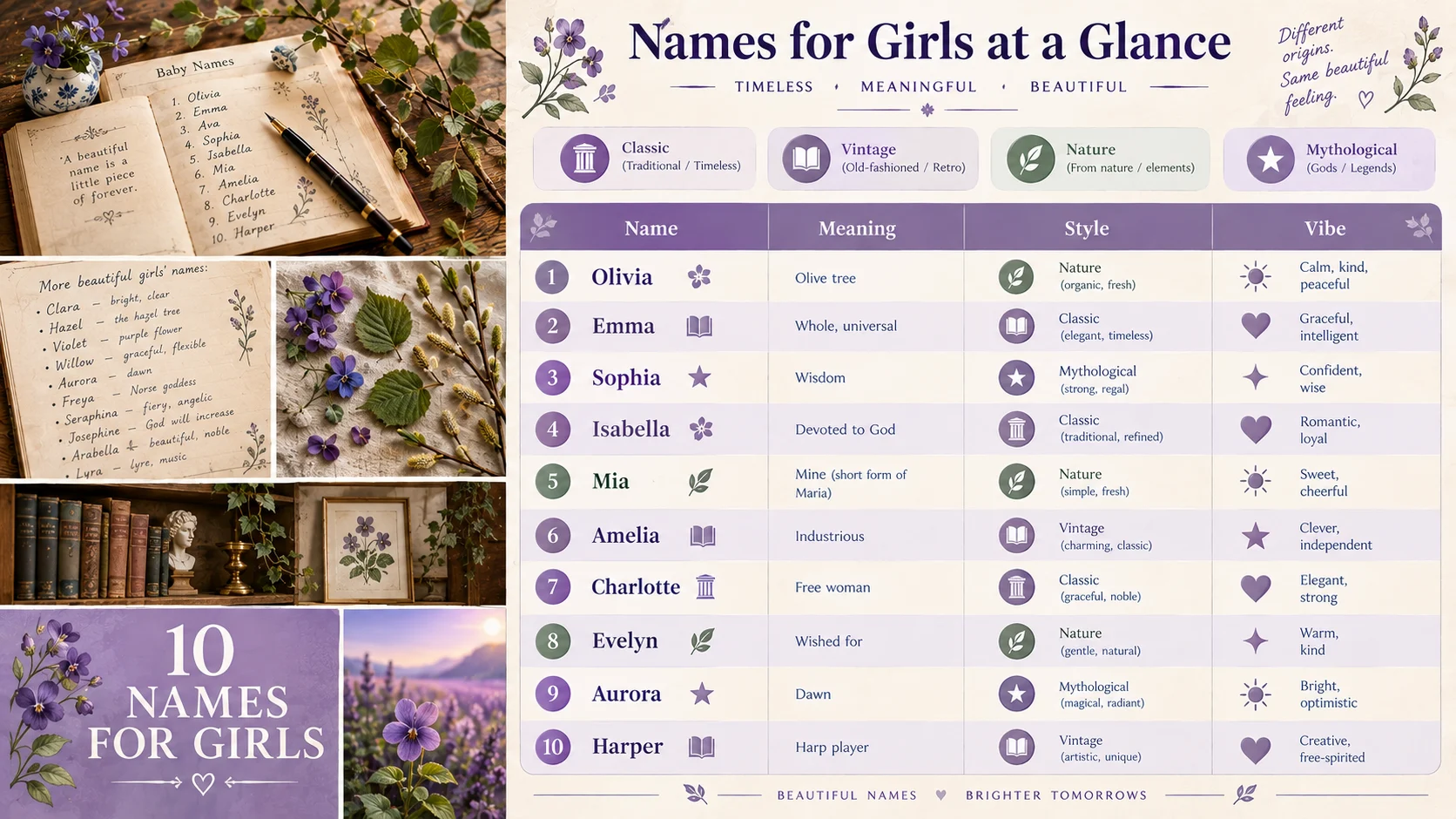
Names for girls come from languages and traditions worldwide, including Hebrew, Latin, Greek, French, and Germanic roots. They range from enduring classics like Elizabeth and Charlotte to vintage revivals like Mabel and nature-inspired choices like Violet and Hazel.
Choosing a name for a girl is an act of imagination. You are trying to picture someone who does not exist yet, and then give her a word she will carry for a lifetime. It should sound right in a playground and on a business card. It should honor something without being weighed down by it. The search for names for girls is not really about finding the single best option. It is about narrowing a vast field into something that feels inevitable once you land on it. This guide covers ten names from different traditions, explains what each one means and where it comes from, and offers practical advice for choosing well. It draws on established name dictionaries and current popularity data where relevant, without pretending that any list is definitive. The right name is the one that fits your family, your ear, and the person you are trying to imagine.
10 Names for Girls Worth Considering
1. Charlotte
Meaning and origin: Charlotte is a French feminine diminutive of Charles, which derives from the Germanic karl, meaning free man or strong. The name entered English usage through noble families and has remained in circulation for centuries.
Style and vibe: Charlotte is classic, polished, and slightly formal. It has a soft sound with a strong backbone, and the natural nickname Charlie or Lottie gives it flexibility.
Best for: Families who want a name that feels established and elegant without being ornate. It works well across social settings and age groups.
Popularity: Charlotte has climbed to the number two spot on the U.S. Social Security Administration’s girls’ list, ending Emma’s long run at number two .
Similar names: Caroline, Eleanor, Margaret, Katherine, Victoria.
Why it works today: Charlotte balances tradition with warmth. Its royal associations and literary connections give it depth, while its nickname potential keeps it wearable in everyday life.
2. Mabel
Meaning and origin: Mabel derives from the Latin amabilis, meaning lovable. It entered English usage in the medieval period as a diminutive of Amabel and became common in the Victorian era.
Style and vibe: Mabel is vintage, cozy, and slightly quirky. It has a soft, old-fashioned sound that feels friendly rather than formal.
Best for: Parents drawn to vintage revivals with a warm, approachable character. It suits names that feel lived-in and unpretentious.
Popularity: Mabel has seen renewed interest in recent years after a long period of low usage, part of the broader revival of early twentieth-century names .
Similar names: Mavis, Hazel, Edith, Florence, Winifred.
Why it works today: Mabel carries the charm of a bygone era without feeling inaccessible. Its meaning, lovable, matches its soft sound.
3. Violet
Meaning and origin: Violet is an English flower name derived from the Latin viola. It came into use as a given name in the nineteenth century alongside other botanical names.
Style and vibe: Violet is elegant, gentle, and quietly confident. The color association adds a layer of richness beyond the floral meaning.
Best for: Families who love nature names but want something more formal than Daisy or Lily.
Popularity: Violet has been identified as a vintage name set to rise further, with roots in Latin and associations with beauty, grace, and nature .
Similar names: Rose, Lily, Iris, Hazel, Poppy.
Why it works today: Violet bridges the nature-name category and the classic-name category. It feels both old-fashioned and entirely current.
4. Eloise
Meaning and origin: Eloise is a French and English variation of Heloise, derived from the Germanic elements hail, meaning healthy or whole, and wid, meaning wide. It has been used in France for centuries and gained literary attention through the Eloise children’s books.
Style and vibe: Eloise is chic, playful, and slightly French. It has a flowing sound with a sophisticated edge.
Best for: Parents who want a name with literary charm and a European feel. It offers the nicknames Ellie or Lulu.
Popularity: Eloise has climbed back into the top 100 in recent years, part of a broader revival of vintage names with literary connections .
Similar names: Adelaide, Clementine, Margot, Colette, Sylvie.
Why it works today: Eloise manages to be both elegant and mischievous. The children’s book association gives it a playful spirit that keeps it from feeling too formal.
5. Hazel
Meaning and origin: Hazel is an English nature name referring to the hazel tree and its nut. It came into use as a given name in the late nineteenth century.
Style and vibe: Hazel is earthy, warm, and understated. It has a cozy, natural quality that fits the broader interest in botanical names.
Best for: Families drawn to nature-inspired names that are not overtly floral. It works well as a first or middle name.
Popularity: Hazel has become one of the most-loved girls’ names in recent years, helped by celebrity and pop culture associations .
Similar names: Willow, Fern, Olive, June, Wren.
Why it works today: Hazel combines simplicity with depth. It is easy to say and spell, and its connection to the natural world gives it quiet substance.
6. Freya
Meaning and origin: Freya derives from the Old Norse Freyja, meaning lady or noble woman. In Norse mythology, Freyja is a goddess associated with love, beauty, and war.
Style and vibe: Freya is strong, mythological, and slightly wild. It has a crisp sound and a built-in sense of power.
Best for: Parents who want a name with mythological roots and a feminist edge. It suits families drawn to Norse or Scandinavian heritage.
Popularity: Freya has grown in popularity in the U.K. and the U.S., alongside the broader interest in mythological names .
Similar names: Astrid, Ingrid, Signe, Brenna, Runa.
Why it works today: Freya offers strength without aggression. Its mythological background gives it a story, and its sound is short and memorable.
7. Luna
Meaning and origin: Luna is the Latin word for moon and the name of the Roman goddess of the moon. It has been used as a given name in various European languages.
Style and vibe: Luna is celestial, modern, and slightly mystical. It has a soft, open sound that feels both contemporary and timeless.
Best for: Families drawn to celestial names or names with a gentle, ethereal quality.
Popularity: Luna has been climbing steadily, reflecting the broader interest in nature-derived and celestial names .
Similar names: Stella, Nova, Aurora, Celeste, Selene.
Why it works today: Luna connects to something universal. The moon is a shared human reference point, and the name carries that quiet grandeur without effort.
8. Eliana
Meaning and origin: Eliana is a name of Hebrew origin, often interpreted as “God has answered” or “my God is the Lord.” It appears in various forms across Romance languages.
Style and vibe: Eliana is melodic, feminine, and international. It has a flowing, vowel-rich sound that feels both classic and fresh.
Best for: Families who want a name with spiritual meaning and a beautiful sound that travels well across languages.
Popularity: Eliana entered the U.S. top ten for the first time recently, marking a significant rise in visibility .
Similar names: Elena, Iliana, Liana, Ariana, Juliana.
Why it works today: Eliana combines a clear meaning with a sound that feels elegant and accessible. Its rise reflects a broader interest in names that are both meaningful and melodic.
9. Maeve
Meaning and origin: Maeve is an Irish name derived from the Old Irish Medb, meaning “she who intoxicates” or “she who rules.” It is associated with the legendary warrior queen of Connacht in Irish mythology.
Style and vibe: Maeve is strong, ancient, and slightly mysterious. It has a single syllable that lands with quiet authority.
Best for: Families drawn to Irish heritage or mythological names with a powerful feminine figure at their center.
Popularity: Maeve has surged in popularity, particularly among parents drawn to names that feel both ancient and modern .
Similar names: Niamh, Saoirse, Aoife, Ciara, Orla.
Why it works today: Maeve is short but carries a great deal of weight. Its mythological roots give it depth, and its sound is crisp and memorable.
10. Willa
Meaning and origin: Willa is a feminine form of William, derived from the Germanic elements wil, meaning will or desire, and helm, meaning helmet or protection. It has been used as a standalone name in the United States since the late nineteenth century.
Style and vibe: Willa is literary, understated, and slightly tomboyish. It has a clean, modern sound with a vintage foundation.
Best for: Families who want a name that feels both soft and strong, with a literary connection to author Willa Cather.
Popularity: Willa has been part of the cottagecore and vintage revival, appearing on lists of names with rustic and earthy appeal .
Similar names: Willodean, Wilhelmina, Milla, Hattie, Elsie.
Why it works today: Willa balances softness and strength. It is short, easy to spell, and carries a quiet literary pedigree.
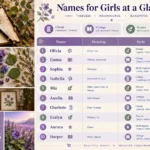
Quick Comparison Table
| Name | Meaning | Origin | Style | Best For | Vibe |
|---|---|---|---|---|---|
| Charlotte | Free man, strong | French/Germanic | Classic-polished | Broad appeal | Elegant, warm |
| Mabel | Lovable | Latin | Vintage-cozy | Vintage revivalists | Friendly, soft |
| Violet | Flower | Latin | Nature-elegant | Nature lovers | Gentle, rich |
| Eloise | Healthy, wide | French/Germanic | Literary-chic | Francophiles | Playful, sophisticated |
| Hazel | Hazelnut tree | English | Nature-warm | Earthy families | Cozy, understated |
| Freya | Lady, noble woman | Old Norse | Mythological | Norse heritage | Strong, wild |
| Luna | Moon | Latin | Celestial-modern | Dreamers | Mystical, soft |
| Eliana | God has answered | Hebrew | Spiritual-melodic | Multicultural families | Flowing, bright |
| Maeve | She who rules | Irish | Mythic-strong | Irish heritage | Ancient, crisp |
| Willa | Will, protection | Germanic | Literary-understated | Book lovers | Soft, strong |
How to Choose the Perfect Name for a Girl
Start with sound. Say the first name and surname together. Check the rhythm and the initials. A name that sounds beautiful alone may clash with a particular surname, and a quick spoken test catches most problems.
Decide on style before you shortlist. Classic, vintage, nature, mythological, and modern are broad categories. Knowing which style appeals to you narrows the field faster than scrolling endless lists.
Consider the nickname landscape. Some names come with obvious short forms. Charlotte becomes Charlie or Lottie. Eloise becomes Ellie or Lulu. Others, like Maeve or Hazel, stand alone. Decide whether you want options or a single, fixed name.
Check current popularity if it matters to you. The Social Security Administration publishes annual data on name usage. A name in the top ten will be common in schools. A name outside the top 500 will be rare. Neither is inherently better, but knowing the difference helps you choose deliberately .
Think about meaning and heritage. A name’s origin may connect to family history, religious tradition, or a culture you want to honor. If a name comes from a tradition that is not yours, research its significance and use it with awareness.
Test it for the adult, not just the baby. A name that sounds adorable on a toddler will eventually belong to a teenager and an adult. Names like Charlotte and Willa age well because they carry dignity alongside charm.
Avoid overthinking uniqueness. A rare name is not automatically better, and a common name is not automatically worse. Millions of people have common names and live contented lives. Choose what feels right for your family, not what a ranking says.
Query Fan-Out:
- What is the most popular name for a girl right now? Olivia has held the top spot on the U.S. Social Security Administration’s girls’ list for several years, followed by Charlotte, Emma, Amelia, and Sophia .
- What are classic names for girls? Elizabeth, Katherine, Margaret, Anne, Charlotte, and Victoria remain enduring choices with documented historical usage .
- What vintage girl names are coming back? Eloise, Mabel, Hazel, Maeve, and Marjorie have seen renewed interest, alongside other early twentieth-century names .
- What are nature names for girls? Violet, Hazel, Willow, Lily, Ivy, and Poppy are widely used nature-inspired choices .
- What girl names work well internationally? Maria, Anna, Sofia, Sara, and Maya have broad recognition across languages and cultures.
- How do I choose a name that will not date my daughter? Classic names with long histories tend to age well, while avoiding extremely trendy spellings can reduce the chance of a name feeling tied to one decade.
- What are short names for girls? Ada, Fern, June, Rose, Ivy, and Elle offer brevity with strong meanings.
FAQs
What is the most popular name for a girl right now?
Olivia has led the U.S. Social Security Administration’s girls’ list for several years. Charlotte has climbed to the number two spot, followed by Emma, Amelia, and Sophia .
What are the classic names for girls?
Elizabeth, Katherine, Margaret, Anne, Charlotte, Victoria, and Caroline are widely recognized as classic names with long histories of continuous use in English-speaking countries .
What vintage girl names are making a comeback?
Eloise, Mabel, Hazel, Maeve, and Marjorie have seen renewed interest. Other vintage names gaining attention include Winifred, Florence, and Edith .
What are good nature names for girls?
Violet, Hazel, Willow, Lily, Ivy, Poppy, and Fern are among the most familiar nature-inspired choices. Luna and Stella offer celestial alternatives .
What girl names work well internationally?
Maria, Anna, Sofia, Sara, Maya, and Eliana have broad recognition across languages and cultures. Names with simple vowel-consonant patterns tend to travel more easily.
How do I choose a name that will not date my daughter?
Classic names with long histories tend to age well. Avoiding extremely trendy spellings and choosing a name that sounds natural in both casual and formal settings can reduce the chance of a name feeling tied to a single decade.
What are short names for girls with strong meanings?
Ada (noble), Fern (fern plant), Maeve (she who rules), Rose (flower), June (young), and Elle (she) offer brevity without sacrificing meaning.
What are some literary names for girls?
Eloise, Willa, Matilda, Beatrice, Cordelia, and Ophelia all have literary connections. These names carry stories with them, which can add depth without requiring explanation.
Conclusion
Names for girls carry more weight than most everyday words. They are spoken thousands of times before a child learns to write them, and they shape first impressions in ways that are difficult to measure. The ten names in this guide range from the polished familiarity of Charlotte to the quiet strength of Maeve, and from the vintage warmth of Mabel to the celestial calm of Luna. None is objectively better than another. The right choice depends on sound, meaning, family, and the feeling you want a name to carry. Use this guide as a starting point, not a rulebook. Say each name aloud. Consider the nicknames and the adult she will become. And trust your judgment. If you have a favorite name for girls that is not on this list, share it in the comments. The best naming conversations are the ones where everyone brings something different to the table.

Benjamin Clarke is a writer and nickname enthusiast at NicknameCorner.com, where he helps readers discover creative, meaningful, funny and unique nicknames for people, pets, usernames and special occasions. His content focuses on practical ideas, clear explanations and nickname inspiration that makes choosing the perfect name easier.