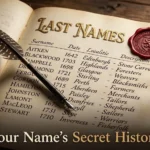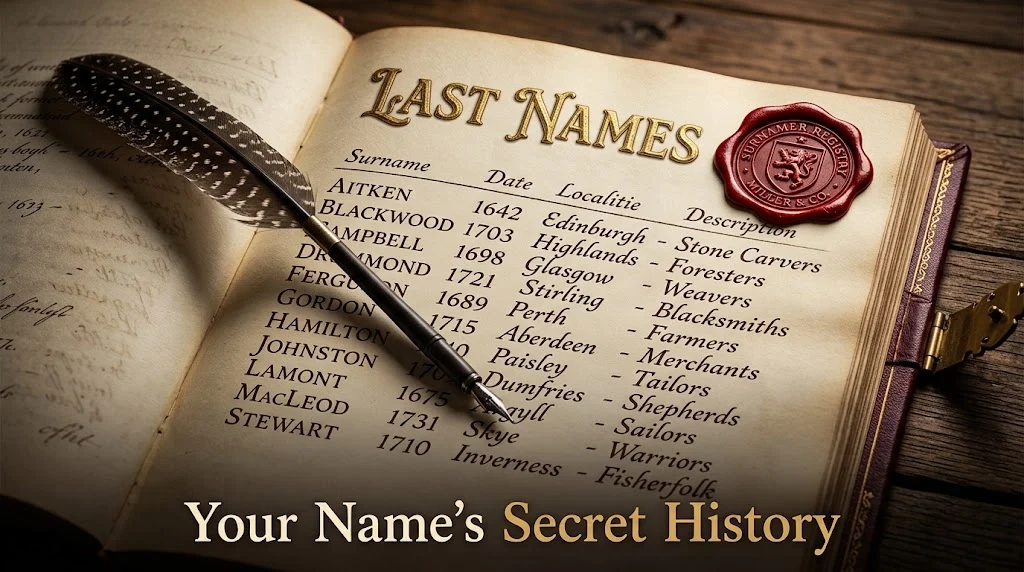
Last names, also called surnames or family names, are hereditary names shared among family members. They originated from occupations, locations, personal characteristics, or patronymic connections. Common types include Smith (occupational), Johnson (patronymic), and Garcia (patronymic from Spanish roots) .
Surnames appeared in China as early as 2852 BC for census purposes, then spread globally at different times. In Western countries, hereditary surnames became common during the Middle Ages. They reveal ancestral occupations, geographic origins, physical traits, and family lineages. Today, surnames also serve as popular first names for babies and characters .
Your last name carries centuries of history in every syllable. It tells stories of ancestors who shaped metal, guarded villages, or lived by a river bend. It connects you to a lineage that survived wars, migrations, and countless generations before you arrived.
Understanding last names goes beyond genealogy. Surnames reveal how societies organized themselves, what trades mattered, and how languages evolved across regions. They also inspire modern parents seeking meaningful baby names and writers crafting authentic characters. Whether you’re curious about your own family name, searching for the perfect surname-inspired first name, or exploring naming traditions across cultures, understanding how last names work opens a window into human history. This guide explores surname meanings, origins, and practical uses for anyone curious about the names that define families .
What Are Last Names?
Last names, also called surnames or family names, are hereditary identifiers passed through generations. While the specific customs vary across cultures, the fundamental purpose remains consistent: distinguishing families and preserving lineage connections .
Surname origins typically fall into five primary categories. Occupational names describe ancestral trades like Smith (metalworker) or Miller (grain grinder). Patronymic names derive from fathers or ancestors, such as Johnson (son of John) or Williams (son of William). Toponymic names reference places, from specific villages to landscape features. Descriptive names capture personal characteristics like Brown or Short. Finally, some names indicate patronage or other connections .
The history of hereditary surnames varies dramatically by region. China pioneered surname use around 2852 BC for census purposes. European countries adopted them gradually between 900 and 1300 AD, initially among nobility before spreading to common populations. Some cultures, including Iceland, still use patronymic systems where surnames change each generation .
10 Notable Last Names and Their Stories
1. Smith
Meaning: Metalworker
Origin: Old English “smið” meaning “one who works in metal”
Style: Occupational, classic, universally recognizable
Best for: Baby names seeking heritage, character names requiring instant familiarity
Smith dominates English-speaking countries as the most common surname, with approximately 2.3 million bearers in the United States alone . The name dates to Anglo-Saxon times, when “Ecceard Smith” appeared in County Durham around 975 AD .
The surname spread across languages and cultures through translation. German “Schmidt,” Italian “Ferrari,” French “Lefebvre,” Spanish “Herrera,” and Arabic “Haddad” all share the same metalworker meaning . This universality explains its remarkable frequency wherever metalworking mattered to society.
Smith works beautifully as a first name today, offering strength and simplicity. Its one-syllable punch pairs well with longer middle and last names. Similar options include Schmidt, Smythe, and Smyth.
2. Johnson
Meaning: Son of John
Origin: English and Scottish patronymic
Style: Patronymic, traditional, warm
Best for: Families honoring ancestral Johns, gender-neutral naming
Johnson ranks second in United States surname frequency, with roughly 1.9 million bearers . The name combines “John,” derived from Hebrew “Yochanan” meaning “Yahweh is gracious,” with the patronymic suffix “-son” .
The name’s popularity stems from John’s status as one of the most common given names in Christian Europe. Johnson appears in virtually every English-speaking country, with variants including Johnston, Johnstone, and Jonson. In Ireland, Johnson sometimes anglicizes the Gaelic names Mac Seáin (McShane) and Mac Eoin (McKeown) .
As a first name, Johnson feels both traditional and approachable. It suits boys particularly well and honors family connections without requiring exact name matching. Consider Johnston or Jansen as alternatives.
3. Wang
Meaning: King
Origin: Chinese patronymic
Style: Regal, powerful, globally significant
Best for: Celebrating Chinese heritage, strong one-syllable first names
Wang claims the title of world’s most common surname, with over 92 million bearers globally . The name originated during the Qin dynasty when royal families adopted it both to preserve status and protect themselves after kingdoms fell. What began as a marker of power became one of Earth’s most widespread family names .
The name’s simplicity makes it work well as a first name in Western contexts. Its single syllable carries weight and dignity. Wang connects to Chinese cultural traditions while remaining accessible across languages. Similar East Asian surnames include Wong, Hwang, and Vang.
4. Garcia
Meaning: Bear (from Basque “hartz”) or possibly “young warrior”
Origin: Spanish and Portuguese, with Basque roots
Style: Warm, romantic, cross-cultural
Best for: Hispanic heritage celebration, gender-neutral baby names
Garcia ranks among the most common surnames in Spanish-speaking countries and appears consistently in top United States surname lists. Over 4.8 million Mexicans alone bear this surname, making it Mexico’s most common last name .
The name likely derives from the Basque word for “bear” or the Germanic element “hart” meaning “hard” or “strong.” Garcia works beautifully across gender lines, its “-ia” ending softening the sound while maintaining strength . The name gained additional familiarity through literary associations like Gabriel García Márquez.
Garcia transitions smoothly to first name usage while maintaining cultural authenticity. Consider similar options like Garcia, Garza, or Garsia.
5. Kim
Meaning: Gold or iron (depending on Chinese character used)
Origin: Korean, with Chinese origins
Style: Ancient, noble, globally recognized
Best for: Korean heritage, short modern names
Kim is the most prevalent surname in both North and South Korea, borne by roughly 20% of the Korean population . The name has Chinese origins, with the character meaning “gold” or “iron” depending on the historical period and region.
Despite its ancient origins, Kim feels remarkably modern with its single syllable and crisp ending. The name gained international recognition through prominent figures in politics, technology, and entertainment. Kim works as a first name while honoring Korean heritage and carries no gender restrictions.
6. Murphy
Meaning: Sea warrior
Origin: Irish Gaelic “Ó Murchadha” meaning “descendant of Murchadh”
Style: Irish, spirited, approachable
Best for: Irish heritage, friendly first names
Murphy ranks as Ireland’s most common surname and appears frequently throughout the Irish diaspora . The name derives from “Murchadh,” an ancient personal name combining “muir” (sea) and “cath” (battle), creating a meaning of “sea warrior.”
The surname spread globally through Irish emigration and gained cultural associations ranging from the Murphy bed to Eddie Murphy. Its “y” ending gives it a friendly, approachable quality that translates well to first name usage. Consider Murphy for either boys or girls seeking Irish connections.
7. Ivanov
Meaning: Son of Ivan
Origin: Russian patronymic
Style: Slavic, traditional, strong
Best for: Russian heritage, meaningful patronymic names
Ivanov represents the classic Russian patronymic pattern, meaning “son of Ivan.” Russia’s surname system developed relatively late, becoming widespread only in the 19th century following the fall of serfdom . The name changes form based on gender: Ivanov for men, Ivanova for women.
Ivan derives from the Hebrew name Yochanan, same as the English John, meaning “Yahweh is gracious.” The name connects to a vast web of related surnames across languages: Johnson, Jean, Giovanni, Juan, and Hans. As a first name, Ivanov carries strength and Slavic heritage.
8. Nguyen
Meaning: Uncertain, possibly from a Chinese dynasty name
Origin: Vietnamese
Style: Exotic, melodic, culturally rich
Best for: Vietnamese heritage, distinctive first names
Nguyen ranks as Vietnam’s most common surname, with estimates suggesting it belongs to approximately 40% of the Vietnamese population. The name’s origins remain debated, with some scholars tracing it to a Chinese dynasty while others see it as a distinctly Vietnamese development.
Pronounced approximately “ngwen,” the name carries a musical quality uncommon in Western naming traditions. Nguyen works as a first name for those celebrating Vietnamese heritage, though pronunciation guidance helps. The name gained international visibility through figures like author Viet Thanh Nguyen.
9. Fernandez
Meaning: Son of Fernando
Origin: Spanish patronymic
Style: Warm, traditional, romantic
Best for: Spanish heritage, flowing first names
Fernandez ranks among the most common surnames across Spanish-speaking countries and appears regularly in United States surname rankings . The patronymic suffix “-ez” indicates “son of,” while “Fernando” derives from Germanic elements meaning “bold voyager” or “peace through bravery.”
The name’s rhythm and warmth make it appealing as a first name. Fernandez flows beautifully in both English and Spanish contexts. Similar patronymic options include Hernandez, Gonzalez, Rodriguez, and Martinez .
10. Tanaka
Meaning: Middle of the rice field
Origin: Japanese
Style: Nature-connected, grounded, elegant
Best for: Japanese heritage, meaningful first names
Tanaka ranks among Japan’s most common surnames, combining “ta” (rice field) and “naka” (middle). The name reflects Japan’s agricultural heritage and connection to the land. Japanese surnames often derive from natural features and rural landscapes .
Tanaka works as a first name for those celebrating Japanese heritage. Its three-syllable rhythm feels balanced and approachable. Similar Japanese surname options include Yamada (mountain field), Takahashi (high bridge), and Watanabe (crossing over).
How to Choose the Perfect Last Name
Selecting a last name for a baby, character, or personal change requires balancing meaning, sound, and practical considerations. Here’s how to approach the decision.
Start with meaning. Decide what message or heritage you want the name to carry. Occupational names connect to ancestral trades. Patronymic names honor family lineages. Place names root identity in geography. Descriptive names capture qualities or characteristics .
Consider sound and rhythm. Say the full name aloud repeatedly. Consider how the surname flows with first and middle names. Check for unfortunate word combinations, awkward initials, or pronunciation difficulties. A name that reads well but stumbles when spoken creates lifelong inconvenience.
Match relationship dynamics. For family naming, consider whose surname gets passed on and why. The Hispanic double-surname system honors both parents. Some families use the mother’s maiden name as a child’s first name. There’s no single correct approach, only what works for your family .
Factor in age and style. Will the name suit a child, teenager, adult, and elder? Names like “Seymour” (meaning “marshy land near the sea”) sound dated to some ears, while “Knox” feels contemporary . Consider whether you prefer classic, vintage, modern, or trend-forward styles.
Balance uniqueness and familiarity. Extremely unusual surnames can be memorable but may invite teasing or constant correction. Extremely common names feel safe but lack distinction. Aim for the sweet spot: recognizable but not ubiquitous.
Research cultural accuracy. If choosing a name from a culture outside your own, learn its pronunciation, meaning, and significance. Consult native speakers and cultural resources. Respect matters more than trend-following.
Test pronunciation and spelling. Consider how easily others will spell and pronounce the name. If you must repeat the pronunciation three times in conversation, or if the name sounds very different from its spelling, practical difficulties may arise.
Think about social media and professional contexts. Your surname appears on email addresses, professional profiles, social handles, and business cards. Consider how it looks in these formats. Avoid names that could be embarrassing or misunderstood.
Quick Comparison Table
| Surname | Meaning | Origin Type | Best For | Vibe |
|---|---|---|---|---|
| Smith | Metalworker | Occupational | Heritage, character names | Strong, universal |
| Johnson | Son of John | Patronymic | Family honor, boys | Warm, traditional |
| Wang | King | Patronymic | Chinese heritage | Regal, global |
| Garcia | Bear/strong | Patronymic | Hispanic heritage, unisex | Romantic, warm |
| Kim | Gold/Iron | Toponymic/noble | Korean heritage | Modern, ancient |
| Murphy | Sea warrior | Patronymic | Irish heritage | Spirited, friendly |
| Ivanov | Son of Ivan | Patronymic | Russian heritage | Strong, Slavic |
| Nguyen | Uncertain | Patronymic | Vietnamese heritage | Melodic, exotic |
| Fernandez | Son of Fernando | Patronymic | Spanish heritage | Flowing, romantic |
| Tanaka | Middle of rice field | Toponymic | Japanese heritage | Grounded, elegant |
Modern Last Name Trends
Using surnames as first names has moved from occasional practice to mainstream trend. Parents increasingly choose names like Harper, Jackson, Riley, and Carter as first names rather than middle or family names .
Several patterns drive current momentum. Last names ending in “s” have surged, including Hayes, Brooks, and Collins. Names ending in unusual letters like “w” (Harlow, Winslow) and “x” (Lennox, Knox) attract parents seeking distinctive sounds . Rock-and-roll surnames like Jagger, Hendrix, and Lennon appeal to music-loving parents.
Gender-neutral appeal explains much of the trend. Surnames inherently avoid gendered expectations, giving children flexibility in identity formation. This appeals to parents who value equality and self-determination .
The practice isn’t new. Milton and Sidney were popular first names in the 1910s. Curtis and Stewart peaked in the 1950s. Kelly and Bradley dominated the 1970s. What changes is which surnames feel fresh. Names like Montgomery, Shepard, and Jennings may represent the next wave .
FAQ
What is the difference between a last name and a surname?
Last name and surname mean the same thing: a hereditary family name passed through generations. “Surname” is the more formal term, while “last name” reflects its typical position in Western naming order. Some cultures place family names first, making “last name” technically inaccurate .
What are the five types of last names?
Surnames fall into five categories: occupational (from jobs like Smith or Miller), patronymic (from fathers’ names like Johnson), toponymic (from locations), descriptive (from characteristics like Brown or Short), and patronage-related names indicating service or connections .
Why do Spanish people have two last names?
Spanish and Latin American naming traditions carry two surnames: one from each parent. The father’s surname traditionally comes first, but both are part of the legal name. This system honors both family lines equally and appears on official documents .
What is the most common last name in the United States?
Smith ranks as the most common United States surname, followed by Johnson, Williams, Brown, and Jones. Approximately 2.3 million Americans share the Smith surname, a position held consistently across multiple census counts .
- What does my last name reveal about my family?
- Your surname may indicate ancestral occupations, geographic origins, physical characteristics, or patronymic lineage. Names like Baker suggest a bread-making ancestor. Names like York indicate connection to that English city. Names like Johnson reveal a paternal ancestor named John .
Can I use a last name as a first name?
Absolutely. Surname-as-first-name usage has grown significantly. Harper, Jackson, Riley, and Carter all rank among popular first names. This trend honors family heritage, provides gender-neutral options, and creates distinctive names that still feel familiar .
What makes a last name rare?
Rare surnames typically have obscure origins, limited geographic distribution, unusual spellings, or connections to small families or villages. Names like Purrock have uncertain etymologies and exist only in specific Scottish records .
How do I choose a last name for a character?
Match the surname to character background, personality, and setting. Occupational names suit working-class characters. Patronymic names suggest family importance. Place names ground characters in specific regions. Test pronunciation and consider how the name sounds when spoken by other characters.
Query Fan-Out
What are the most common last names in the world?
The most common surname globally is Wang, a Chinese patronymic name meaning “king” with over 92 million bearers. Smith ranks highest in English-speaking countries, while Devi is among India’s most common surnames .
What does my last name mean?
Surname meanings typically fall into five categories: occupational (Smith, Miller), patronymic (Johnson, Williams), toponymic (from places), descriptive (Brown, Short), and patronage-related names .
Why do last names exist?
Last names developed as populations grew and record-keeping became necessary. They distinguished individuals with the same given name and helped track families for taxation, censuses, and inheritance purposes .
How do last names work in different cultures?
Naming systems vary widely. Spanish cultures often use two surnames from both parents. East Asian countries place family names first. Iceland uses patronymic systems where surnames change each generation .
Are last names becoming first names?
Yes, using surnames as first names has grown in popularity. Names like Harper, Jackson, Riley, and Carter now rank among top baby names in the United States .
What are occupational last names?
Occupational surnames describe ancestral trades. Examples include Smith (metalworker), Miller (grain grinder), Baker (bread maker), and Taylor (tailor) .
What is a patronymic last name?
Patronymic surnames derive from a father’s or ancestor’s name. Johnson means “son of John,” Williams means “son of William,” and Ivanov means “son of Ivan” in Russian .
What are the rarest last names?
Extremely rare surnames often have obscure origins, unusual spellings, or limited geographic distribution. Examples include Purrock (Scottish, uncertain origin) and names tied to specific small villages or families.
Conclusion
Last names are far more than identifiers. They’re living records of ancestral trades, geographic roots, family lineages, and cultural traditions. From Smith’s ancient metalworkers to Tanaka’s rice field dwellers, every surname carries a story worth discovering .
Whether you’re exploring your own family history, searching for the perfect baby name, or creating authentic characters, understanding surname meanings and origins adds depth and meaning. The trend of using last names as first names opens creative possibilities while honoring heritage .
Take time to explore what your last name reveals. Share your findings with family. Consider the stories embedded in every syllable. Your surname connects you to centuries of human history, and that connection deserves celebration.
What’s your last name? Share its meaning in the comments below, and pass this guide along to someone curious about their family name.
Mia Kensington is a name and nickname enthusiast at NicknameCorner.com, she writes helpful guides on cute nicknames, baby names, usernames and creative name ideas, making it easier for readers to find names that feel unique, meaningful and memorable.