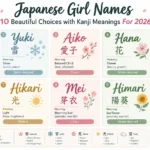
Japanese girl names are unique because the same sound can carry different meanings depending on the kanji characters used. For example, “Hana” can mean flower or splendor. Parents often choose names based on positive qualities, natural elements, or wishes for their daughter’s future happiness and success.
Query Fan-Out (5–8 Questions with Answers):
- What are the most popular Japanese girl names?
Recent surveys show Sui, Himari, and Tsumugi among Japan’s top baby girl names. - What does Sakura mean in Japanese?
Sakura means “cherry blossom,” a flower deeply symbolic of beauty and the fleeting nature of life in Japanese culture. - Can Japanese names have multiple meanings?
Yes. The same pronunciation can use different kanji characters, each carrying distinct meanings. This gives parents flexibility in choosing their preferred interpretation. - What Japanese girl name means love?
Aiko means “beloved child,” while Ai directly translates to “love” or “affection”. - Are there Japanese names that work internationally?
Names like Mika, Sora, Rin, and Kairi translate easily across cultures while retaining their Japanese origins. - What Japanese names mean light or sun?
Hikari means “light,” while Himari combines sun imagery with floral associations. - How do I pronounce Japanese girl names correctly?
Japanese syllables are evenly stressed. Each vowel is pronounced clearly: A as “ah,” E as “eh,” I as “ee,” O as “oh,” U as “oo.” - What are traditional Japanese girl names?
Names ending in -ko (meaning child) like Sachiko, Yumiko, and Hanako were traditional in the 20th century.
Choosing a name for your daughter is one of the most meaningful decisions you will ever make. Japanese girl names carry a unique beauty: they blend natural imagery, poetic meaning, and cultural depth into sounds that feel both delicate and strong. Whether you are drawn to the softness of Sakura, the brightness of Hikari, or the warmth of Aiko, each name tells a story. What makes Japanese names especially fascinating is that the same pronunciation can be written with different kanji characters, each offering its own meaning and nuance. This guide explores ten beautiful Japanese girl names, their origins, kanji possibilities, and why they continue to resonate with parents around the world. From timeless classics to modern favorites, you will find inspiration for a name that feels just right.
Quick Comparison Table
| Name | Meaning | Style | Best For | Vibe |
|---|---|---|---|---|
| Sakura | Cherry blossom | Classic nature | Nature lovers | Elegant, fleeting beauty |
| Yuki | Snow; happiness | Seasonal | Winter babies | Pure, gentle |
| Aiko | Beloved child | Traditional | Families valuing love | Warm, affectionate |
| Hana | Flower | Nature classic | Garden enthusiasts | Fresh, blooming |
| Rin | Dignified; cold | Modern cool | Minimalist parents | Crisp, strong |
| Sora | Sky | Unisex nature | Dreamers | Vast, free |
| Hikari | Light | Luminous | Parents seeking brightness | Radiant, hopeful |
| Mei | Sprout; beautiful | Modern simple | International families | Fresh, delicate |
| Himari | Sunflower; sunshine | Contemporary | Optimists | Bright, warm |
| Tsumugi | Pongee silk; to spin | Modern traditional | Craft lovers | Woven, enduring |
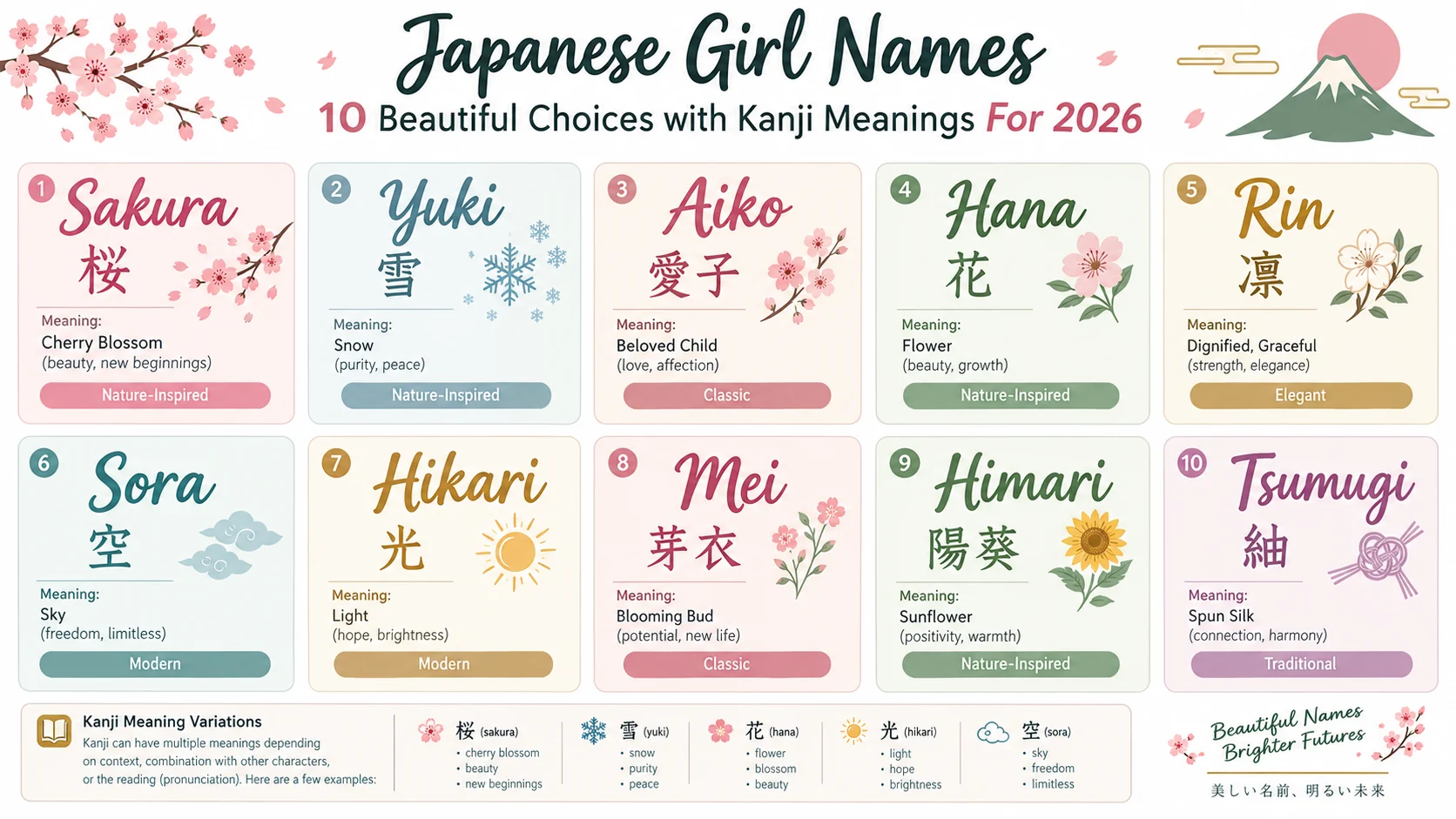
10 Beautiful Japanese Girl Names with Meanings
1. Sakura (桜)
Sakura means “cherry blossom,” one of Japan’s most iconic symbols. The name represents spring’s arrival and the bittersweet beauty of impermanence. While cherry blossoms appear in Japanese literature dating back centuries, Sakura only became a common given name in the 1990s, when parents sought names connected to traditional culture that still felt fresh.
The name carries gentle, graceful energy. It evokes images of pink petals drifting on a spring breeze and hanami gatherings beneath blooming trees. Sakura works beautifully for families who appreciate nature’s cycles and the Japanese concept of mono no aware, the poignant awareness of life’s transience.
Similar options: Saki, Mio, Ichika, Hanami, Haruko
Why it works today: Sakura balances cultural authenticity with international appeal. It is recognizable worldwide while retaining deep Japanese roots.
2. Yuki (雪)
Yuki typically means “snow,” though it can also mean “happiness” depending on the kanji chosen. The name is unisex in Japan, but parents frequently give it to girls for its soft, pure associations. Winter imagery in Japanese culture carries connotations of quiet beauty and renewal.
The sound Yuki feels crisp and clean, like fresh snowfall. It is short, easy to pronounce internationally, and carries a peaceful quality. Families welcoming winter babies often choose Yuki to honor the season of their daughter’s birth. The dual meaning of snow and happiness adds warmth to the wintery image.
Similar options: Yuna, Yui, Miyuki, Koyuki, Sachi
Why it works today: Yuki feels simultaneously delicate and resilient. It suits a child who will grow into any path she chooses.
3. Aiko (愛子)
Aiko means “beloved child” or “child of love,” a meaning that resonates deeply with parents. The first character, Ai (愛), represents love and has ranked as the most-used kanji for girls’ names in Japan for several consecutive years. The suffix -ko (子) means “child” and was the standard feminine ending throughout much of the 20th century.
While -ko names have declined in modern Japanese naming trends, Aiko retains appeal for its heartfelt simplicity. It expresses a parent’s affection without reservation. The name feels traditional yet accessible, and the meaning translates easily across languages.
Similar options: Aimi, Aina, Manami, Megumi, Airi
Why it works today: Aiko says exactly what every parent feels. Its meaning requires no translation.
4. Hana (花)
Hana means “flower,” a straightforward yet profound name. The single kanji 花 represents blossoms of all kinds, making it a versatile choice that encompasses beauty in many forms. Hana has been a popular girls’ name in Japan for decades and appears frequently in literature and poetry.
The name is short and musical, ending with a soft open vowel. It works well internationally because the sound is simple and the meaning universal. Hana can also be written with the character 華, meaning splendor or gorgeous, adding layers of meaning to this seemingly simple name.
Similar options: Hanae, Hanako, Nanoha, Kana, Hina
Why it works today: Hana is timeless and unpretentious. It finds beauty in simplicity, much like a single perfect flower.
5. Rin (凛)
Rin carries the meaning “dignified,” “severe,” or “cold,” depending on the kanji. The most common character, 凛, conveys a sense of composed strength and quiet resolve. It has become one of Japan’s most popular girls’ names in recent years, ranking consistently high on national surveys.
The name is short, crisp, and modern. It works exceptionally well internationally because it uses sounds familiar to many languages. Rin feels cool and confident without being harsh, elegant without being ornate. It suits parents drawn to minimalist aesthetics and names that speak through understatement.
Similar options: Rina, Riko, Rio, Kairi, Ran
Why it works today: Rin embodies modern Japanese naming: short, meaningful, and internationally viable.
6. Sora (空)
Sora means “sky,” a name that captures vastness and possibility. It is unisex in Japan, used for both boys and girls, though it has gained particular affection as a girls’ name internationally. The kanji 空 represents emptiness and openness, concepts valued in Japanese philosophy and aesthetics.
The name has a light, airy quality that matches its meaning. Sora suggests freedom, clarity, and limitless potential. It has gained recognition outside Japan through popular media, including video games and anime, making it familiar to international audiences while remaining authentically Japanese.
Similar options: Hikari, Yuki, Aoi, Nozomi, Kokoro
Why it works today: Sora is simple, beautiful, and meaningful. It feels modern while honoring nature.
7. Hikari (光)
Hikari means “light,” a name that embodies brightness and clarity. The single kanji 光 represents radiance, glow, and brilliance. While traditionally more common as a girls’ name, Hikari can be used for any gender.
The name has a luminous quality in both sound and meaning. It suggests guidance, hope, and illumination. Hikari feels warm and welcoming, suitable for a child who brings joy to those around her. The name has appeared in popular culture, including anime and manga, giving it recognition beyond Japan.
Similar options: Hina, Hiyori, Hikaru, Akari, Homura
Why it works today: Hikari radiates positivity. It is a name that feels like sunshine in human form.
8. Mei (芽)
Mei carries meanings of “sprout” or “bud,” symbolizing new life and growth. The character 芽 represents the first shoots of a plant emerging from soil, a fitting metaphor for a newborn daughter. Mei can also be written with different characters to mean “beautiful” or other positive attributes.
The name is short, sweet, and internationally friendly. It sounds similar to the English name May while maintaining distinct Japanese identity. Mei has gained recognition through various media, including animated films, making it approachable for families outside Japan.
Similar options: Mai, Mio, Miu, Moe, Mika
Why it works today: Mei feels fresh and hopeful. It captures the beginning of life’s journey.
9. Himari (陽葵)
Himari combines images of sunshine and flora. The most common kanji 陽 means “sun” or “sunshine,” while 葵 refers to hollyhock or mallow, a flower that turns toward the sun. The name ranked second among Japan’s most popular baby girl names in recent surveys.
The name feels bright and optimistic. It suggests warmth, growth, and a sunny disposition. Himari has a melodic quality with its three syllables, and the meaning resonates with parents who wish their daughter a life filled with light and flourishing. It represents modern Japanese naming trends that favor longer, more expressive names.
Similar options: Hina, Hinata, Hikari, Haruka, Honomi
Why it works today: Himari blends nature imagery with positive wishes. It feels contemporary yet rooted in meaning.
10. Tsumugi (紬)
Tsumugi refers to pongee, a traditional silk fabric, and can also mean “to spin” or “to weave”. The name carries associations with craftsmanship, patience, and the careful creation of something beautiful. It ranked third on Japan’s recent popular names list.
The name represents connection and perseverance, as weaving involves bringing threads together to create a whole. Tsumugi feels grounded and thoughtful, suitable for parents who value traditional arts and the idea that character is carefully built over time. Its three-syllable rhythm gives it a pleasant, substantial sound.
Similar options: Tsumugi, Kokoro, Koto, Kanade, Sachi
Why it works today: Tsumugi honors craftsmanship and tradition while sounding fresh and modern.
How to Choose the Perfect Japanese Girl Name
Choosing a Japanese name involves considerations beyond sound and meaning. Here are practical guidelines.
Understand kanji possibilities. Most Japanese names can be written multiple ways. Before committing, research which kanji combinations appeal to you and what they convey.
Consider pronunciation across languages. If your daughter will grow up outside Japan, think about how the name sounds in your primary language. Names like Rin and Mei travel easily; others may require explanation.
Check for unintended meanings. Some sounds carry different meanings in other languages. A quick search can prevent awkward surprises.
Honor family connections. Many Japanese families incorporate kanji from a relative’s name, creating a meaningful link across generations.
Think about length. Japanese girl names tend to be short, typically two to three syllables. This brevity contributes to their elegant, uncluttered quality.
Consider the -ko tradition. Names ending in -ko were standard for much of the 20th century. While less common now, they carry a sense of heritage and warmth.
Frequently Asked Questions
What are the most popular Japanese girl names right now?
Recent surveys show Sui, Himari, and Tsumugi as top choices in Japan. These names blend traditional aesthetics with modern sensibilities and positive meanings.
What Japanese name means beautiful?
Several names carry this meaning. Miyu combines beauty with gentleness. Meiko means beautiful child. Bijin directly translates to beautiful person but is rarely used as a given name.
Can Japanese names have multiple meanings?
Yes. The same pronunciation can use different kanji, each with distinct meanings. This flexibility lets parents choose the interpretation that resonates most.
What are traditional Japanese girl names?
Traditional names often end in -ko (child), such as Sachiko, Yumiko, and Hanako. While less common in modern naming, they remain cherished for their heritage and clarity.
What Japanese name means light?
Hikari directly means light. Akari suggests brightness or vermilion. Hina can mean sunlight or grebe depending on the kanji.
Are there unisex Japanese names?
Yes. Names like Sora (sky), Rin (dignified), Aoi (hollyhock), and Yuki (snow) are used for both genders.
How do I pronounce Japanese names correctly?
Japanese syllables receive even stress. Each vowel is pronounced clearly: A as “ah,” E as “eh,” I as “ee,” O as “oh,” U as “oo.” Avoid stressing any single syllable.
What Japanese girl name means love?
Ai directly means love. Aiko means beloved child. Megumi means blessing, often associated with love and kindness.
Conclusion
Japanese girl names offer a remarkable blend of beauty, meaning, and cultural depth. From the fleeting elegance of Sakura to the woven strength of Tsumugi, each name tells a story worth telling. The dual nature of kanji adds richness, allowing parents to choose layers of meaning that resonate with their hopes for their daughter. Whether you prefer short, modern names like Rin or traditional choices like Aiko, the right name will feel like a gift you give your child for life. Take time with the sounds and meanings. Say each name aloud. Imagine it on a birth certificate, a school roster, a wedding invitation. Which Japanese girl name speaks to you? Share your favorites in the comments, and pass this guide to anyone beginning their own naming journey.

Benjamin Clarke is a writer and nickname enthusiast at NicknameCorner.com, where he helps readers discover creative, meaningful, funny and unique nicknames for people, pets, usernames and special occasions. His content focuses on practical ideas, clear explanations and nickname inspiration that makes choosing the perfect name easier.