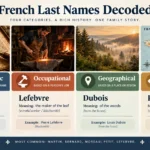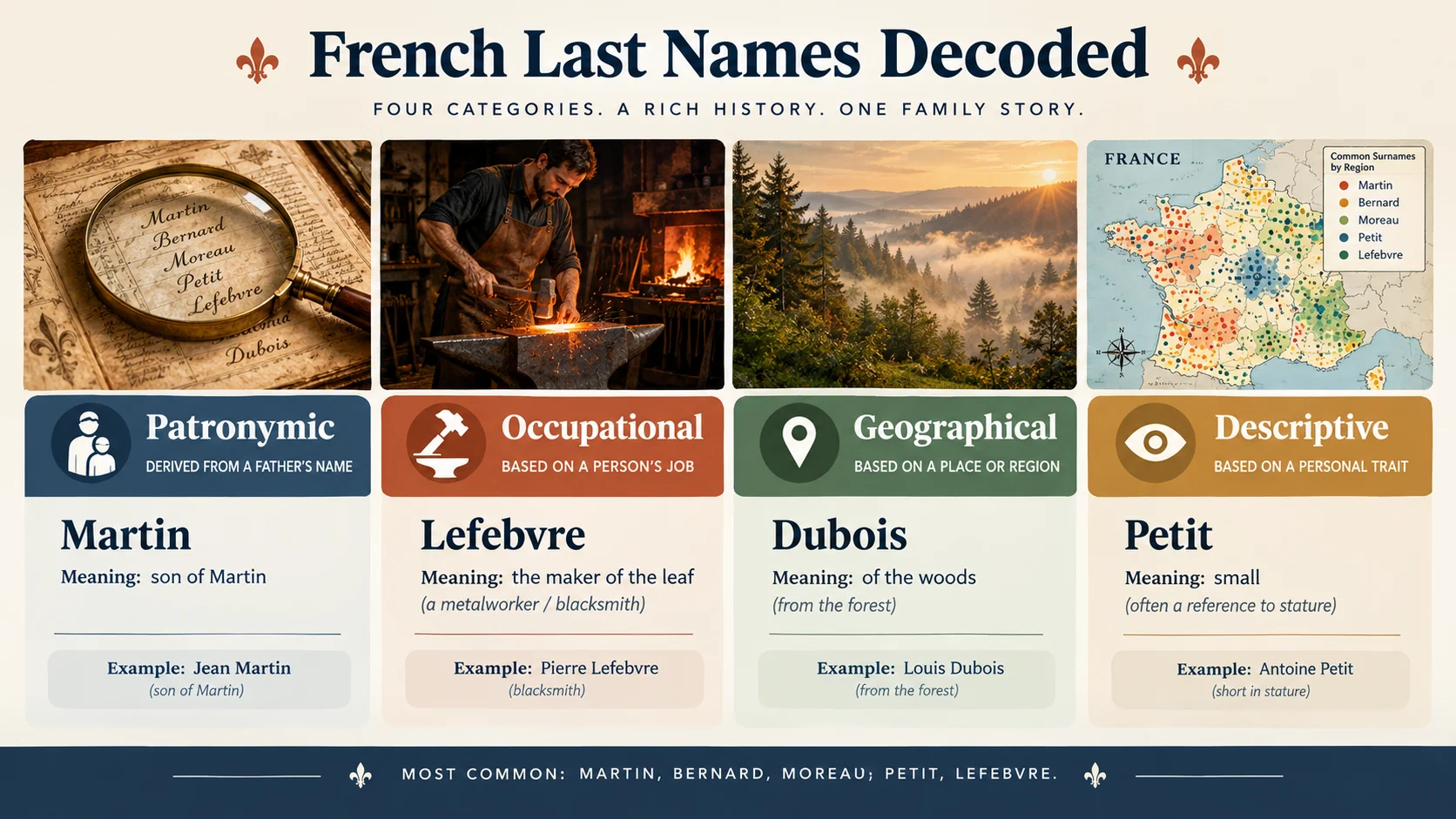
French last names are hereditary surnames that originated in France, typically falling into four categories: patronymic (from a father’s name), occupational (from a trade), geographical (from a location), or descriptive (from a nickname or trait). Most became fixed and passed down through generations between the 11th and 19th centuries .
A surname is more than a label. It is a thread pulled from the fabric of history, connecting you to ancestors you will never meet. For millions of people worldwide, that thread leads back to France. French last names carry the weight of medieval villages, the clang of the blacksmith’s forge, the quiet of the forest, and the authority of the Church. They tell stories of survival, migration, and identity across centuries.
Whether you are researching your family tree, choosing a name for a character, or simply curious about the meaning behind a name you have heard all your life, understanding French last names opens a window into a culture defined by regional pride and linguistic richness. France boasts over one million distinct surnames, the most of any country in the world . This guide walks you through the major types of French surnames, the meanings behind the most common ones, and the practical tools to trace your own. By the end, you will see your last name, or someone else’s, in a completely different light.
What Are French Last Names? A Quick Definition
French last names are hereditary family names that developed in France and French-speaking regions. They began as nicknames and identifiers in the Middle Ages, when populations grew and communities needed a way to tell one Jean from another. Most French surnames fall into four clear categories: patronymic (from a parent’s given name), occupational (from a trade), geographical (from a place or landscape feature), and descriptive (from a physical trait or character nickname) . Over centuries, these identifiers became fixed, passed from father to child, and carried across oceans through French colonial expansion and migration.
The Four Main Types of French Surnames
Before diving into specific names, it helps to understand the logic behind them. Knowing which category a surname belongs to immediately unlocks its meaning.
Patronymic Surnames: Names from the Father
The most common type of French surname is the patronymic, derived from the father’s given name. In a village where half the men were named Martin or Bernard, “Pierre, son of Martin” became Pierre Martin. Prefixes like “de” or “fitz” (from the Norman) could indicate sonship, though most patronymics simply used the father’s name directly . The rise of Christianity made saints’ names enormously popular, which is why names like Martin, Bernard, and Laurent became so widespread.
Occupational Surnames: What Your Ancestor Did for a Living
Occupational surnames describe the trade of an ancestor. These are often the most vivid because they paint a picture of daily medieval life. Lefebvre means blacksmith, from the Old French “fevre” . Boulanger means baker. Charpentier means carpenter. Marchand means merchant . Because certain trades were essential everywhere, occupational surnames tend to be distributed widely, with regional variations in spelling. The blacksmith, for example, appears as Lefebvre in the north, Faure in the south, Favre in the southeast, and Schmitt in Alsace .
Geographical Surnames: Where Your Family Lived
Geographical surnames describe a person’s home or origin. These can refer to a specific village, a landscape feature, or a relative direction. Dubois means “from the woods.” Dumont means “from the mountain.” Beaumont combines “beautiful” and “mountain” . The prefixes “de” and “du” are typical of geographical names, translating roughly to “of” or “from.” Importantly, while “de” is sometimes associated with nobility, the connection is not automatic. Many commoners took geographical “de” names simply because it described where they lived .
Descriptive Surnames: Nicknames That Stuck
Descriptive surnames came from physical traits, personality characteristics, or ironic nicknames. Petit means small. Legrand means tall or large. Leblanc means the white or blonde one, referring to hair or complexion . Roux described someone with reddish hair. Moreau originally referred to someone with dark skin or dark hair, linked to the Latin “Maurellus” . These names offer an intimate glimpse into how medieval communities saw one another, sometimes affectionately, sometimes not.
The Most Common French Last Names and What They Mean
Martin: The Undisputed Champion
Martin is the most common surname in France by a significant margin. Over 235,000 recorded births between 1891 and 2000 bear this name . It derives from the Latin “Martinus,” meaning “consecrated to Mars,” the Roman god of war. Its popularity in France is largely due to Saint Martin of Tours, a 4th-century bishop who evangelized Gaul and became one of the most venerated saints in French history . The name is especially concentrated in Paris, the Rhône region, and Loire-Atlantique. It is a patronymic surname, originally a given name that became hereditary.
Vibe: Timeless, solid, and deeply rooted in French religious and cultural history.
Bernard: Strength of the Bear
Bernard ranks second, with over 95,000 recorded births . It has Germanic roots, combining “bern” (bear) and “hard” (strong or brave), giving the meaning “strong as a bear” or “brave bear” . Originally a personal name, it became hereditary over time. Bernard is particularly common in northern France and among descendants of French immigrants worldwide. Like Martin, it is a patronymic surname tied to a revered medieval figure, Saint Bernard of Clairvaux.
Vibe: Sturdy, warm, and grounded in medieval Germanic-French tradition.
Dubois: Of the Woods
Dubois is a geographical surname meaning “from the woods” or “of the forest.” It indicated that an ancestor lived near or in a wooded area, a common identifier in medieval France where forests covered vast stretches of land . The name can also appear as Du Bois, with a space. It is one of the most widespread surnames in France and among French diaspora communities. If your surname is Dubois, your ancestors likely lived in a rural, forested region, though pinpointing exactly which forest requires genealogical research.
Vibe: Earthy, rustic, and deeply connected to the French landscape.
Lefebvre: The Blacksmith’s Legacy
Lefebvre is an occupational surname from the Old French “fevre,” meaning blacksmith . The blacksmith was a crucial figure in medieval communities, working with fire and metal to create tools, weapons, and household goods. The name is most concentrated in northern France, particularly Pas-de-Calais, Nord, and Seine-Maritime. Regional variations include Lefèvre, Faure, Fabre, and Favre . Lefebvre ranks fifth in the national top 20, with over 75,000 recorded births .
Vibe: Artisanal, industrious, and tied to the essential crafts of medieval life.
Moreau: The Dark-Haired One
Moreau comes from the Old French “more,” meaning Moor or dark-skinned, and originally served as a nickname for someone with dark hair or a dark complexion . It ranks third nationally, with over 81,000 births . The name is widely distributed across France, with particular concentrations in Centre-Val de Loire and Nouvelle-Aquitaine. Moreau also appears frequently in early colonial records from Quebec and Louisiana, making it a common surname among French Canadians and Cajuns.
Vibe: Warm, distinctive, and evocative of Mediterranean or southern European ancestry.
Petit: The Small One
Petit is a descriptive surname meaning “small” or “little.” It likely began as a nickname for someone short in stature or the youngest in a family . With over 80,000 births, it ranks fourth nationally . Petit is particularly common in Saône-et-Loire, Nièvre, and the Île-de-France region. The name is a reminder that medieval nicknames were often blunt and practical, based on observable characteristics rather than sentiment.
Vibe: Humble, affectionate, and refreshingly straightforward.
Durand: The Enduring
Durand comes from the Latin “Durandus,” meaning “enduring” or “steadfast,” from the verb “durare” (to last) . It ranks sixth nationally, with over 70,000 births . Originally a personal name, it became hereditary over time. Durand is widespread throughout France and appears in French-speaking parts of North America. The name carries a quiet strength, suggesting reliability and persistence.
Vibe: Steady, dependable, and quietly resilient.
Quick Comparison Table
| Nickname | Meaning | Style | Best For | Vibe |
|---|---|---|---|---|
| Martin | Of Mars; consecrated to Mars | Patronymic | Heritage research; classic names | Timeless, solid |
| Bernard | Brave bear | Patronymic | Northern French ancestry | Sturdy, warm |
| Dubois | From the woods | Geographical | Nature-connected identities | Earthy, rustic |
| Lefebvre | Blacksmith | Occupational | Artisan and trade heritage | Industrious, skilled |
| Moreau | Dark-skinned | Descriptive | Southern French ancestry | Warm, distinctive |
| Petit | Small | Descriptive | Family history with character | Humble, direct |
| Durand | Enduring | Patronymic | French resilience narratives | Steady, reliable |
| Leroy | The king | Descriptive/Patronymic | Norman heritage | Regal, historical |
| Faure | Blacksmith (southern) | Occupational | Occitan and southern roots | Regional, craft-focused |
How to Choose and Research a French Last Name
Whether you are tracing your own surname or selecting one for a creative project, a few practical principles will guide you.
Start with the category. Is your name likely a trade, a place, a father’s name, or a nickname? This narrows your search immediately. If you know your family came from a specific region, focus on regional variations. Lefebvre in the north becomes Faure in the south; the blacksmith trade follows you either way.
Check regional spelling. French surnames have countless variants. A name spelled “Moreau” in one record might appear as “Morel” or “Moreault” in another. Before the 19th century, spelling was not standardized, and priests and clerks wrote names as they heard them . Do not assume a spelling difference means a different family.
Learn about dit names if you have French Canadian roots. In Quebec, many families carried a “dit” name, a secondary surname often based on a nickname, military service, or a location. Tremblay dit Leblond, for example, indicates a Tremblay branch distinguished by the “Leblond” descriptor . Dit names are essential for French Canadian genealogy.
Use authoritative sources. Geneanet, Ancestry, and MyHeritage all maintain extensive French surname databases. For etymology, consult established dictionaries and academic sources on French onomastics rather than relying on unsourced websites. The meaning of a name is a historical claim, and it deserves verification.
Consider pronunciation and modern use. If you are choosing a French surname for a character or a child, say it aloud. Some names that look elegant on paper (like Gautier, pronounced “goat-ee-ay” in some regions) may present challenges in English-speaking contexts . Balance authenticity with practicality.
Query Fan-Out
What is the most common French last name?
Martin is the most common French surname, with over 235,000 recorded births in France between 1891 and 2000 .
What does the French last name Dubois mean?
Dubois is a geographical surname meaning “from the woods” or “of the forest,” indicating an ancestor who lived near or in a wooded area .
What are dit names in French genealogy?
Dit names are secondary or alternate surnames used in French Canada, often based on nicknames, military service, or physical traits, to distinguish branches of the same family .
Why do French last names often start with “de” or “du”?
These prefixes typically indicate geographical origin (“of” or “from”), though some “de” names were historically associated with nobility. However, a “de” prefix alone does not prove noble ancestry .
What does Lefebvre mean?
Lefebvre is an occupational surname derived from the Old French word for blacksmith, “fevre,” indicating an ancestor who worked metal .
How did French surnames become hereditary?
Surnames gradually became hereditary from the 11th century onward, formalized by church records during the Renaissance and locked in by Napoleonic civil registration in the 19th century .
Frequently Asked Questions
What is the most common French last name?
Martin is the most common French surname, with over 235,000 recorded births in France between 1891 and 2000. It derives from the Latin name Martinus and became widespread due to devotion to Saint Martin of Tours .
What does the name Dubois mean?
Dubois is a geographical surname meaning “from the woods” or “of the forest.” It indicated that an ancestor lived near or in a wooded area. The name can also be spelled Du Bois .
Why are so many French last names also first names?
Many French surnames began as patronymic identifiers, derived from the father’s given name. Names like Martin, Bernard, and Robert were extremely common medieval given names, so “Pierre Martin” meant “Pierre, son of Martin.” Over time, these identifiers became fixed hereditary surnames .
What are dit names in French Canadian genealogy?
Dit names are secondary or alternate surnames used in French Canada to distinguish different branches of the same family. They often originated from nicknames, military service, or physical traits. An example is Tremblay dit Leblond, where Leblond distinguishes one Tremblay line from another .
Does a “de” or “du” prefix mean my family was noble?
Not necessarily. While “de” and “du” are associated with nobility in some contexts, many commoners also used these prefixes to indicate geographical origin. A name like Dubois simply means “from the woods” and carries no inherent noble status .
What does Lefebvre mean?
Lefebvre is an occupational surname from the Old French “fevre,” meaning blacksmith. It indicated that an ancestor worked as a blacksmith, a crucial trade in medieval communities. Regional variants include Faure, Fabre, and Favre .
How did French surnames become hereditary?
Surnames gradually became hereditary from the 11th century onward as populations grew. Church records during the Renaissance helped stabilize their use, and Napoleonic civil registration in the 19th century locked in spelling and transmission .
What is the rarest type of French surname?
Dit names are among the least common and are largely confined to French Canada. Within France itself, the rarest surnames are those borne by very few individuals, often localized to a single village or region .
Conclusion
French last names are far more than words on a birth certificate. They are compressed histories of medieval trades, ancient landscapes, saintly devotion, and the quiet human need to be known. Whether your surname connects you to a blacksmith’s forge, a forest’s edge, or a village saint, it carries the fingerprints of people who lived, worked, and endured before you.
- Understanding french last names gives you a tool for genealogy, a lens for storytelling, and a deeper appreciation for the culture that shaped millions of families across the globe. Take a moment to look at your own surname with fresh eyes. What trade does it hide? What landscape does it name? What nickname did a medieval neighbor give your ancestor, never imagining it would outlast empires? Share your surname in the comments, and pass this guide to someone who has ever wondered where their name came from.

Scarlett Howard is a writer and name enthusiast at NicknameCorner. She creates creative and helpful guides on nicknames, names, usernames and naming ideas, helping readers find meaningful, memorable and unique names for every occasion.