How are wines named? Most wines are named either after the grape variety used (New World wines like Cabernet Sauvignon) or the region where the wine is made (Old World wines like Bordeaux) . New World wines are typically labeled by the grape, while Old World wines emphasize the place.
Have you ever stood in front of a wall of wine, feeling completely lost? You’re not alone. The names on wine bottles can seem like a foreign language. But once you understand the simple rules behind wine names, the whole world of wine opens up.
Wines are primarily named in one of two ways. In the New World countries like the United States, Australia, and Chile wines are usually named after the grape variety, such as Chardonnay or Merlot . In the Old World regions like France, Italy, and Spain wines are often named after the place they come from. A wine from Bordeaux, for example, might be made from Merlot or Cabernet Sauvignon grapes, but it’s called Bordeaux on the label .
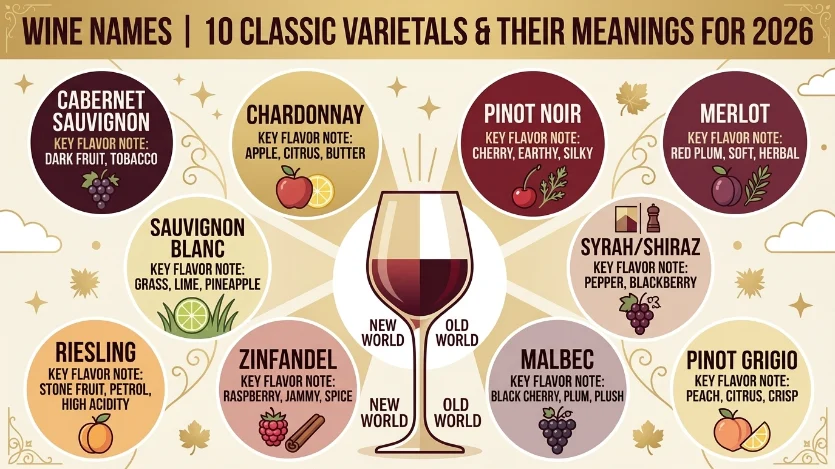
This is a key reason why wine names can be confusing. Two bottles might contain the same grape, but one is called by the grape’s name and the other by the region’s name. Learning the most common wine names helps you navigate this world with ease. This guide breaks down ten essential wine names, their meanings, their origins, and what they taste like.
10 Essential Wine Names with Meanings and Personalities
1. Cabernet Sauvignon
Meaning: Derived from “Cabernet” (the grape family) and “Sauvignon” (wild vine)
Origin: French
Personality: Cabernet Sauvignon is the confident leader of the wine world. It’s bold, structured, and commands attention. A wine for those who appreciate depth and complexity .
Style: Bold, Structured, Classic
Best For: Red meat lovers, special occasions, or cellaring
Popularity: The most widely planted and popular wine grape in the world .
Flavor Profile: Black cherry, black currant, baking spices, cedar oak, with firm tannins .
Food Pairing: Lamb, beef, smoked meats, aged cheddar, hard cheeses like Pecorino .
Similar Names: None generally, but note that in Bordeaux blends it is often paired with Merlot and Cabernet Franc .
Why It Still Works Today: Cabernet Sauvignon’s powerful structure and ability to age make it the undisputed king of red wines.
2. Chardonnay
Meaning: From the village of Chardonnay in Burgundy, France
Origin: French
Personality: Chardonnay is the versatile chameleon. It can be crisp and mineral or rich and buttery, depending on how it’s made. It adapts to its environment and winemaker .
Style: Versatile, Elegant, Popular
Best For: A wide range of palates and cuisines
Popularity: The world’s most widely planted white wine grape .
Flavor Profile: Citrus (Meyer lemon), yellow apple and pear, tropical fruit (banana, pineapple), vanilla, butterscotch from oak aging .
Food Pairing: Lobster, crab, shrimp, chicken, pork, mushroom, cream sauces, soft cheeses like triple cream brie .
Similar Names: Burgundy (when from the region in France), Pinot Chardonnay.
Why It Still Works Today: Chardonnay’s incredible range from crisp and unoaked to rich and oaked makes it a favorite worldwide.
3. Pinot Noir
Meaning: “Pine” (pinot) and “black” (noir) referring to the grape’s pine cone-shaped clusters and dark color
Origin: French
Personality: Pinot Noir is the elegant, sensitive artist. It’s light, delicate, and expresses the subtle nuances of its terroir. This grape can be challenging to grow but produces some of the world’s most sublime wines .
Style: Light, Elegant, Complex
Best For: A sophisticated palate, pairing with lighter meats or enjoying on its own
Popularity: One of the most highly regarded and sought-after red wines .
Flavor Profile: Very red-fruited (cherry, cranberry), rose floral notes, earthy elements of beet, rhubarb, or mushroom .
Food Pairing: Chicken, pork, veal, duck, cured meats, cream sauces, soft cheeses like Gruyère .
Similar Names: Spätburgunder (Germany), Pinot Nero (Italy) .
Why It Still Works Today: Pinot Noir’s elegance and ability to reflect its origin make it a lifelong pursuit for wine lovers.
4. Merlot
- Meaning: Derived from “merle,” the French word for blackbird, which is fond of eating the ripe grapes
- Origin: French
- Personality: Merlot is the friendly, approachable companion. It’s softer and more approachable than Cabernet Sauvignon, making it perfect for those new to red wine or seeking a smooth, easy-drinking experience .
- Style: Smooth, Approachable, Versatile
- Best For: Casual dinners, a reliable crowd-pleaser
- Popularity: One of the most popular red wine grapes globally .
- Flavor Profile: Cherry, plum, dark fruits, chocolate, sometimes a leafy or herbal note. It’s typically lower in tannins than Cabernet Sauvignon .
- Food Pairing: Pairs well with roasted poultry, pork, pasta dishes, and lighter red meat preparations.
- Similar Names: In Bordeaux, it is often blended with Cabernet Sauvignon and Cabernet Franc, and the final wine is named after the region (e.g., Pomerol, Saint-Émilion) .
- Why It Still Works Today: Merlot’s approachable character and soft texture make it a constant favorite for casual drinking and fine dining alike.
5. Sauvignon Blanc
Meaning: “Wild vine” (sauvage) and “white” (blanc)
Origin: French
Personality: Sauvignon Blanc is the zesty, vibrant, and refreshing white. It’s known for its crisp acidity and distinct herbaceous notes that give it a lively character .
Style: Crisp, Herbaceous, Refreshing
Best For: Warm weather sipping, seafood, or as an apéritif
Popularity: A widely grown and popular white wine .
Flavor Profile: Aggressively citrus-driven (grapefruit), with honeydew melon, kiwi, and a distinctive herbaceous quality (grass, mint, green pepper) .
Food Pairing: Fish, shellfish, salads, herbed goat cheese, vegetarian dishes .
Similar Names: Fumé Blanc (in some parts of California) .
Why It Still Works Today: Its bright, zesty character makes it the perfect summer wine, and its herbaceous nature pairs wonderfully with a wide range of foods.
6. Syrah/Shiraz
Meaning: Both names refer to the same grape. Syrah is from France, while Shiraz is the name primarily used in Australia
Origin: French (Syrah), Australian (Shiraz)
Personality: Syrah/Shiraz is the bold, powerful, and flavorful wine. Depending on the origin, it can be elegant and savory (French Syrah) or jammy and bold (Australian Shiraz) .
Style: Bold, Spicy, Distinctive
Best For: Those who love full-bodied, rich red wines
Popularity: Highly popular, especially from France and Australia .
Flavor Profile: Blueberry, plum, tobacco, black pepper, violet, with a meaty quality (beef broth, jerky) .
Food Pairing: Lamb, beef, smoked meats, hearty stews, barbecue .
Similar Names: Shiraz (Australia, South Africa), Hermitage (French regional name) .
Why It Still Works Today: The dual identity of Syrah/Shiraz offers two distinct styles from the same grape, making it endlessly fascinating.
7. Riesling
Meaning: Named after the Rhine region in Germany, a historical center for the grape’s cultivation
Origin: German
Personality: Riesling is the aromatic, versatile, and often misunderstood gem. It can be bone-dry or lusciously sweet, but always with a backbone of high acidity. It’s a wine of incredible purity and longevity .
Style: Aromatic, Versatile, Long-Aging
Best For: Food pairing, especially Asian cuisine, or for those who enjoy complex, aromatic whites
Popularity: One of the most respected and sought-after white wine grapes, particularly from Germany and Alsace.
Flavor Profile: Citrus (lime, lemon), stone fruit (white peach, nectarine), floral notes, and often a distinct minerality .
Food Pairing: Pairs exceptionally well with Asian cuisine, spicy food, pork, and poultry .
Similar Names: Rhine Riesling (in some regions), Johannisberg Riesling .
Why It Still Works Today: Riesling’s incredible ability to pair with food—from spicy Thai to rich roast pork—makes it a sommelier’s secret weapon.
8. Zinfandel
Meaning: Of uncertain origin, but related to the Croatian grape Tribidrag
Origin: American
Personality: Zinfandel is the bold, fruity, and sometimes spicy wine. It’s known for its intense fruit and sometimes high alcohol. It plays a dual role as a robust red and a slightly sweet pink wine .
Style: Fruity, Spicy, Bold
Best For: Barbecue, hearty red meat dishes, or as a crowd-pleasing red
Popularity: Hugely popular in California, where it has become a signature grape.
Flavor Profile: Red and black fruits (raspberry, plum, blueberry), exotic spices (Asian 5-spice), and sweet tobacco notes .
Food Pairing: Barbecue, cured meats, lamb, beef, spicy Italian or Asian dishes .
Similar Names: Primitivo (Italy), Tribidrag (Croatia) .
Why It Still Works Today: Zinfandel’s bold fruit flavors and versatility make it a favorite for casual gatherings and hearty meals.
9. Malbec
Meaning: Named after the French town of Malbec, though it found its true home in Argentina
Origin: French
Personality: Malbec is the juicy, smooth, and intensely fruity wine. It offers a rich, velvety texture that makes it instantly approachable and a favorite for those who enjoy bold, fruit-forward reds .
Style: Juicy, Smooth, Fruity
Best For: Steak lovers, casual dinners, or those who enjoy a rich, easy-drinking red
Popularity: Huge popularity in Argentina, where it has become the country’s flagship grape.
Flavor Profile: Plums, blackberries, cherries, and a smoky, sometimes chocolatey finish .
Food Pairing: Steak, grilled meats, burgers, spicy Mexican or South American cuisine.
Similar Names: Cot (France) .
Why It Still Works Today: Malbec offers the bold, satisfying character of a full-bodied red with a smoothness that makes it instantly enjoyable.
10. Pinot Grigio/Pinot Gris
- Meaning: “Gray pine cone” (pinot gris), referring to the grape’s clusters and greyish-blue skin
- Origin: French (Pinot Gris), Italian (Pinot Grigio)
- Personality: Pinot Grigio/Gris is the crisp, light, and refreshing white. The Italian style is typically leaner and more mineral, while the French style is often richer and more textured. Both are immensely popular for their easy-drinking nature .
- Style: Light, Crisp, Refreshing
- Best For: Light seafood, salads, summer afternoons, or as an apéritif
- Popularity: One of the most popular white wine imports in many countries.
- Flavor Profile: Delicate citrus (lime zest, orange peel), white floral notes, apple, pear, often with a slight bitter note on the finish .
- Food Pairing: Salads, delicate poached fish, light pasta dishes, mild cheeses .
- Similar Names: Pinot Grigio (Italy), Pinot Gris (France, US) .
- Why It Still Works Today: Its light, crisp profile makes it the quintessential summer sipper, and it offers a refreshing alternative to heavier whites.
Quick Comparison Table
| Wine Name | Meaning | Style | Flavor Profile |
|---|---|---|---|
| Cabernet Sauvignon | Wild vine | Bold, Classic | Black cherry, currant, cedar |
| Chardonnay | Village in Burgundy | Versatile, Elegant | Apple, citrus, vanilla, butter |
| Pinot Noir | Pine + black | Light, Elegant | Cherry, cranberry, rose, earth |
| Merlot | Blackbird | Smooth, Approachable | Plum, cherry, chocolate |
| Sauvignon Blanc | Wild white | Crisp, Herbaceous | Grapefruit, grass, melon |
| Syrah/Shiraz | French/Australian | Bold, Spicy | Blueberry, pepper, plum, meaty |
| Riesling | Rhine region | Aromatic, Versatile | Lime, peach, floral, mineral |
| Zinfandel | Croatian origin | Fruity, Spicy | Raspberry, plum, spice |
| Malbec | French town | Juicy, Smooth | Plum, blackberry, smoky |
| Pinot Grigio/Gris | Gray pine cone | Light, Crisp | Citrus, apple, pear, floral |
How Are Wines Named?
The key to understanding wine names lies in the concept of “New World” vs. “Old World” .
- New World Wines (Americas, Australia, South Africa, etc.): These wines are almost always named after the sole or principal grape variety used. If you see a bottle of “Cabernet Sauvignon,” the wine is made primarily from that grape .
- Old World Wines (France, Italy, Spain, Germany, etc.): These wines are typically named after the region where the grapes are grown. A wine called “Bordeaux” is from the Bordeaux region of France. The winemakers believe that the place—the terroir—is as important as the grape, and the regional name reflects that .
Additionally, the same grape can have different names in different countries. For instance, Syrah is called Shiraz in Australia , and Pinot Noir is known as Spätburgunder in Germany . Learning these synonyms is a great way to discover new wines .
Frequently Asked Questions
What are the most common types of wine names?
The most common wine names are either grape varietals (like Chardonnay or Merlot) or regional names (like Bordeaux or Chianti). The type of name used often depends on whether the wine is from the New World or Old World .
Why do some wines have different names for the same grape?
Regional names and language differences often play a role. For example, the grape Syrah is called Shiraz in Australia and South Africa. Pinot Noir is called Spätburgunder in Germany .
What is the difference between Syrah and Shiraz?
They are the same grape. Syrah” is the name used in France and other parts of the Old World, while “Shiraz” is the name used primarily in Australia. The wine styles can differ, with Syrah typically being more elegant and savory, and Shiraz often being more full-bodied and fruit-forward .
What are the most popular red wine names?
Some of the most popular red wines include Cabernet Sauvignon, Merlot, Pinot Noir, Syrah/Shiraz, Zinfandel, and Malbec .
What are the most popular white wine names?
The most popular white wines include Chardonnay, Sauvignon Blanc, Riesling, Pinot Grigio/Gris, and Moscato .
What does “varietal” mean on a wine label?
“Varietal” simply means that the wine is named after the grape variety it is made from, such as Cabernet Sauvignon or Chardonnay . The wine must be made up of at least 75% of that grape variety to carry its name .
What does “terroir” mean?
“Terroir” is a French term that encompasses the unique combination of soil, climate, and topography of a specific place. Old World winemakers believe it significantly impacts the character of the wine, which is why they name wines after the region rather than the grape .
What is a good wine for a beginner?
For a beginner, a smooth Merlot is a great red choice, while a crisp Pinot Grigio or a friendly Sauvignon Blanc are excellent white options. These wines are approachable and widely available .
Conclusion
Navigating the world of wine names doesn’t have to be intimidating. By understanding the simple distinction between grape-named (New World) and region-named (Old World) wines, you’ve unlocked a key to the entire wine world. Each bottle tells a story—a story of a grape, a place, and a winemaker’s craft.
From the bold structure of Cabernet Sauvignon to the elegant complexity of Pinot Noir and the refreshing crispness of Sauvignon Blanc, the wine names you’ve learned today represent some of the most celebrated and beloved styles in the world. Next time you’re faced with a wine list or a shelf full of bottles, you’ll be ready to explore with confidence.

Mia Kensington is a name and nickname enthusiast at NicknameCorner.com, she writes helpful guides on cute nicknames, baby names, usernames and creative name ideas, making it easier for readers to find names that feel unique, meaningful and memorable.