French last names are family surnames originating in France, typically classified into four types: patronymic (from a father’s name), occupational (from a trade), geographical (from a location), and descriptive (from a nickname or trait). Martin is the most common French last name today .
AIO Expansion (40–60 words)
French surnames became hereditary around the 14th century, though they emerged in the 11th century to distinguish people with the same first name . Many common French last names trace back to saints, like Martin from Saint Martin of Tours, or to medieval trades like Lefebvre, meaning blacksmith .
Introduction
A French last name is more than a label on a birth certificate. It is a fragment of medieval life, a clue to where your ancestors stood in a village, what they did for a living, or how others saw them. When you look at French last names, you are reading a quiet record of centuries of daily existence .
France holds the world record for surname diversity, with approximately 1.5 million different family names recorded . Some, like Martin, belong to hundreds of thousands of people. Others are so rare that fewer than ten individuals carry them today.
Understanding French last names opens a door to genealogy, cultural history, and personal identity. Whether you are tracing your roots, writing a story, or simply curious about a name you have encountered, this guide will walk you through the origins, meanings, and human stories behind French surnames.
The Four Pillars of French Surnames
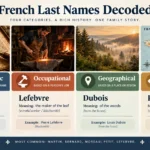
French surnames emerged around the 11th century as populations grew and villages needed a way to tell one Jean from another. By the 14th century, hereditary surnames had become common . Most French last names fall into one of four categories, a framework used by genealogists and historians to this day .
Patronymic surnames come from a parent’s given name. “Martin” began as “son of Martin.” These are the most common type in France .
Occupational surnames describe an ancestor’s trade. “Lefebvre” means blacksmith. “Boulanger” means baker. These names often vary by region: the same blacksmith became Lefebvre in the north and Faure in the south .
Geographical surnames point to where a family lived. “Dubois” means “from the woods.” “Dupont” means “from the bridge.” The prefixes “de,” “du,” and “des” often signal these names, though they do not automatically indicate nobility .
Descriptive surnames began as nicknames based on appearance or character. “Petit” means small. “Leblanc” means the white or blond one. “Moreau” described someone with dark hair or skin .
10 Common French Last Names and What They Reveal
1. Martin
Meaning: Derived from Martinus, a Latin name linked to Mars, the Roman god of war .
Origin: Patronymic. Popularized by Saint Martin of Tours, a 4th-century bishop .
Vibe: Steady, classic, deeply rooted in French history.
Best for: Anyone researching the most widespread French surname. Over 250,000 people in France bear this name .
Similar names: Martineau, Martel, Martial.
Why it matters: Martin dominates French surname lists for a simple reason: the cult of Saint Martin was immense in medieval France, making his name one of the most common given names, which then became a hereditary surname .
2. Bernard
Meaning: From the Germanic Bernhard, meaning “brave bear” .
Origin: Patronymic, originally a personal name that became hereditary.
Vibe: Strong, warm, traditional.
Best for: Those with roots in northern France, where it is especially common.
Similar names: Bernier, Bernat, Bernaud.
Why it matters: Bernard ranks among the top French surnames, reflecting the medieval popularity of Germanic names among the Franks .
3. Dubois
Meaning: “From the woods” or “of the forest” .
Origin: Geographical. Indicated an ancestor who lived near or in a forest.
Vibe: Nature-connected, grounded, simple.
Best for: Anyone drawn to place-based surnames.
Similar names: Dubosc, Du bois, Boisvert.
Why it matters: Dubois is a textbook example of how French surnames encode landscape. The prefix “du” means “of the,” making the name literally “of the woods” .
4. Petit
Meaning: “Small” or “little” .
Origin: Descriptive. Likely a nickname for a short person or the youngest child in a family.
Vibe: Approachable, unpretentious, human.
Best for: Those who appreciate names that reflect ordinary medieval life.
Similar names: Legrand (the big one), Leroux (the red-haired one), Leblanc (the blond one).
Why it matters: Petit shows how medieval communities used direct observation to distinguish people. It is the fifth most common surname in France .
5. Lefebvre
Meaning: “The blacksmith,” from the Old French “fèvre” .
Origin: Occupational. One of the oldest and most widespread trade names.
Vibe: Artisan, sturdy, historical.
Best for: Anyone with roots in northern France, where this form dominates.
Similar names: Lefèvre, Fabre, Faure, Favre (regional variants for the same trade).
Why it matters: The blacksmith was essential to medieval villages, which is why the name appears in so many forms across France .
6. Moreau
Meaning: Dark-skinned or dark-haired, from the Latin Maurellus .
Origin: Descriptive. A nickname for someone with a darker complexion.
Vibe: Earthy, distinctive, southern European.
Best for: Those exploring physical-descriptor surnames.
Similar names: Morin, Morel, Maurel.
Why it matters: Moreau is a top-ten French surname and appears frequently in early records from Quebec and Louisiana, making it a name with both European and North American roots .
7. Laurent
Meaning: From Laurentum, an ancient Roman city. Also associated with the laurel plant, a symbol of victory .
Origin: Patronymic, from the Latin name Laurentius.
Vibe: Refined, classical, Mediterranean.
Best for: Those with connections to southern France or Francophone communities worldwide.
Similar names: Laurence, Laurencin, Lorin.
Why it matters: Laurent carries the weight of Roman history and Christian tradition. Saint Lawrence was a popular figure, and the name spread across Europe .
8. Leroy
Meaning: “The king,” from Old French “le roi” .
Origin: Descriptive or occupational. Could have referred to someone who worked for a king or behaved regally.
Vibe: Regal, bold, slightly ironic.
Best for: Those who love names with a touch of character.
Similar names: Leroi, Roy, Leroux (different origin, similar sound).
Why it matters: Leroy is a Norman French name with Viking roots. The Normans brought it to England in 1066, where it became a common English surname as well .
9. Durand
Meaning: “Enduring” or “steadfast,” from the Latin durans .
Origin: Descriptive, from a nickname for a stubborn or resilient person.
Vibe: Solid, dependable, quietly strong.
Best for: Those who value names with moral or character-based meanings.
Similar names: Durance, Durandeau, Durant.
Why it matters: Durand was originally a given name in medieval France before becoming a hereditary surname. It remains common in both France and French-speaking Canada .
10. Rousseau
Meaning: “Red-haired” or “ruddy,” from the Old French “rous” .
Origin: Descriptive. A nickname for someone with red hair or a reddish complexion.
Vibe: Warm, artistic, literary.
Best for: Those drawn to names with cultural resonance. Jean-Jacques Rousseau gave this surname global recognition.
Similar names: Roux, Leroux, Roussel.
Why it matters: Rousseau ranks among the top 15 French surnames and carries the legacy of one of the Enlightenment’s most influential thinkers .
Quick Comparison Table
| Nickname/Surname | Meaning | Style | Best For | Vibe |
|---|---|---|---|---|
| Martin | Of Mars; warrior | Patronymic | Genealogy research | Classic, enduring |
| Bernard | Brave bear | Patronymic | Northern French roots | Strong, warm |
| Dubois | From the woods | Geographical | Nature lovers | Grounded, simple |
| Petit | Small | Descriptive | History enthusiasts | Humble, human |
| Lefebvre | Blacksmith | Occupational | Artisan heritage | Sturdy, medieval |
| Moreau | Dark-skinned | Descriptive | Southern European roots | Earthy, distinctive |
| Laurent | From Laurentum; laurel | Patronymic | Roman history fans | Refined, classical |
| Leroy | The king | Descriptive | Norman ancestry | Regal, bold |
| Durand | Enduring | Descriptive | Character-driven names | Solid, dependable |
| Rousseau | Red-haired | Descriptive | Literary connections | Warm, artistic |
How to Choose and Research a French Last Name
Whether you are selecting a surname for a character, exploring your family tree, or simply curious about a name you have inherited, a few practical principles can guide you.
Start with meaning, not sound. A French surname’s original meaning often tells you more about your ancestors than how it sounds. Occupational names reveal trades. Geographical names reveal landscapes. Descriptive names reveal how communities saw one another.
Check regional variations. The same trade or trait appears in different forms across France. A blacksmith is Lefebvre in the north, Faure in the south, and Fabre in Occitania . Knowing where your family lived can narrow down the correct form.
Do not assume “de” means nobility. The prefix “de” simply means “of” or “from” and usually indicated a place. While aristocrats used it, so did ordinary people. There is no reliable evidence that a “de” surname automatically signals upper-class ancestry .
Use reputable genealogy sources. Geneanet, Ancestry, and MyHeritage all provide surname distribution maps and historical records. French departmental archives also hold civil registration records dating back to the late 18th century.
Consider the “dit” name if you have French Canadian roots. In Quebec, families often carried a secondary surname, called a “dit” name, which could change between generations. Tremblay dit Leblond, for example, indicates a Tremblay branch known as “the blond one” .
Query Fan-Out
What is the most common French last name?
Martin is the most common French last name, with over 250,000 people bearing it in France. It derives from the Latin name Martinus, linked to Mars, the Roman god of war .
What does the French surname Dubois mean?
Dubois means “from the woods” or “of the forest.” It is a geographical surname given to ancestors who lived near or in a forested area .
Why do some French last names start with “de”?
The prefix “de” means “of” or “from” and originally indicated geographical origin, not necessarily nobility. However, it later became associated with aristocratic families .
What are the four types of French surnames?
French surnames fall into patronymic (father’s name), occupational (profession), geographical (location), and descriptive (physical trait or nickname) categories .
What is a “dit” name in French Canadian genealogy?
A “dit” name is a secondary surname used in French Canada, often based on a nickname, military alias, or place. It helped distinguish branches of the same family .
What does Lefebvre mean?
Lefebvre is an occupational surname meaning “the blacksmith,” from the Old French word “fèvre.” Regional variants include Fabre, Faure, and Favre .
Are French last names always inherited from the father?
Historically, most were patronymic, but matronymic surnames existed when the father was unknown. Today, French law allows children to take either parent’s surname .
FAQ
What is the most common French last name?
Martin is the most common French surname, with roughly 250,000 bearers in France. It comes from the Latin Martinus, linked to Mars, and gained popularity through Saint Martin of Tours .
What does the surname Dubois mean?
Dubois means “from the woods” or “of the forest.” It is a geographical surname given to ancestors who lived near a wooded area. The prefix “du” means “of the” .
Why do some French last names have “de” or “du”?
These prefixes mean “of” or “from” and originally indicated where a person lived or came from. They are geographical markers, not automatic signs of nobility, despite popular belief .
What are the four types of French surnames?
French surnames are classified as patronymic (from a father’s name), occupational (from a trade), geographical (from a location), or descriptive (from a nickname or physical trait) .
What is a French Canadian “dit” name?
A “dit” name is a secondary surname used in Quebec and French Canada. It often began as a nickname, military alias, or place reference, helping distinguish different branches of the same family .
What does Lefebvre mean?
Lefebvre means “the blacksmith.” It comes from the Old French word “fèvre,” meaning smith. Regional variants include Lefèvre, Fabre, Faure, and Favre .
Are French surnames always inherited from the father?
Historically, most were patronymic, but matronymic surnames existed when the father was unknown. Today, French law allows parents to pass either their surname to their children .
What is the rarest type of French surname?
No single type is inherently rarest, but many highly localized geographical and descriptive names are borne by fewer than ten people. France has about 1.5 million distinct surnames, and half are carried by fewer than ten individuals .
Conclusion
French last names carry centuries of human history in a handful of syllables. From Martin, the warrior’s name that became France’s most common surname, to Dubois, a simple marker of “the woods,” each French surname tells a story about where a family lived, what they did, or how a community saw them. Whether you carry a French last name yourself or are simply fascinated by naming traditions, these names offer a quiet, enduring connection to the past. Take a moment to look up your own French surname or ask a friend about theirs. You might discover a blacksmith, a king’s servant, or a red-haired ancestor hiding in plain sight. Share this guide with someone who loves family history, and leave a comment with the French surname that caught your attention.