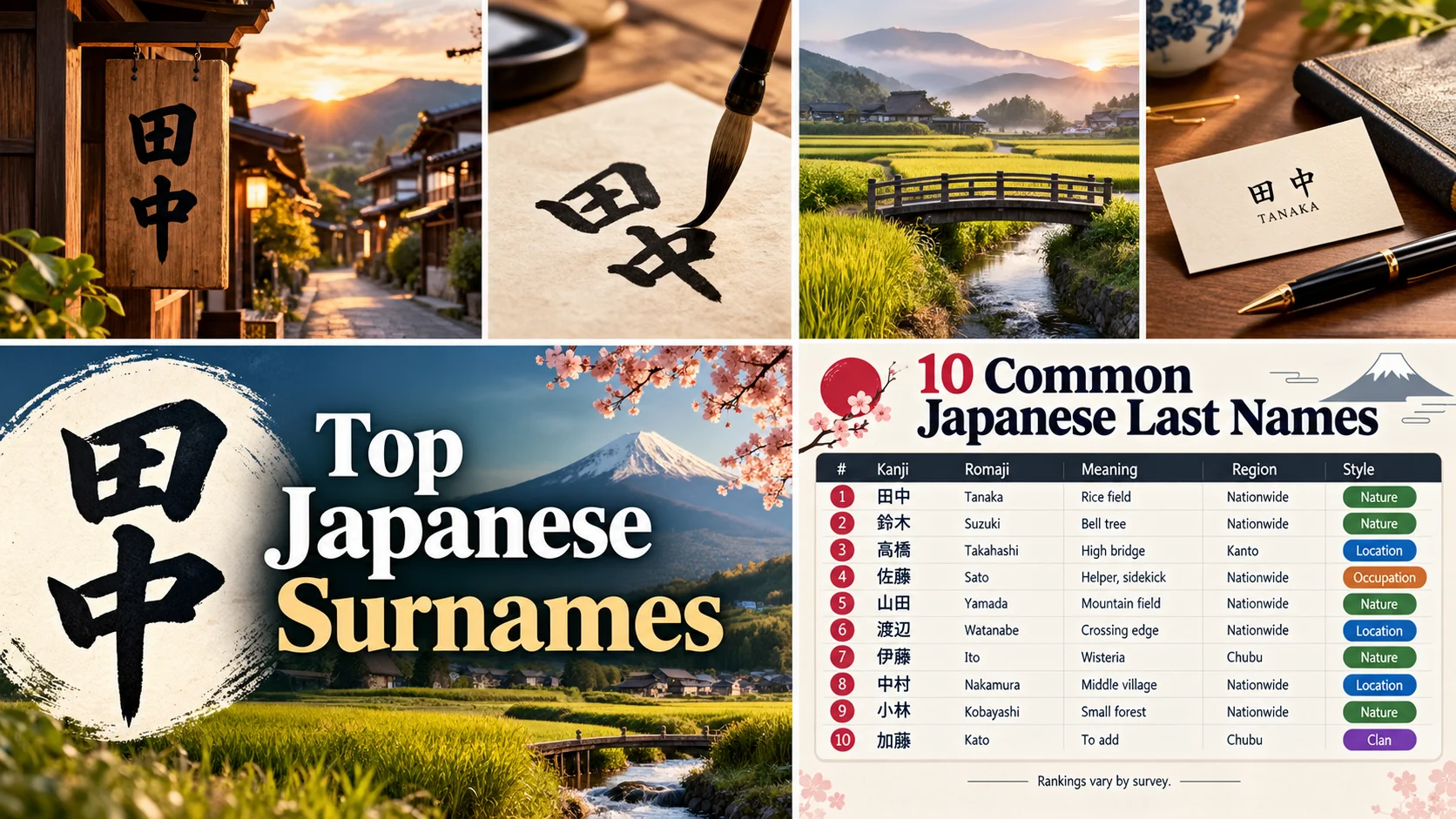
Japanese last names, or myōji, are family names written mostly in kanji and placed before the given name. Common examples include Sato, Suzuki, Takahashi, and Tanaka, and many describe landscapes, places, or clan links such as Fujiwara.
A surname can tell a small story in two or three characters. Japanese last names often name a field, a bridge, a forest, or a village, and a few carry echoes of powerful clans. That is why readers, language learners, writers, and families tracing their roots keep looking for them.
Japanese last names are easier to grasp than they first appear. Once you know the building blocks, a name like 田中 reads almost like a sentence.
This guide covers the ten surnames you will meet most often, what each one means, where it may come from, and where it is found. It also explains name order, kanji readings, and how to pick a surname for a story or a character. Where origins are uncertain, we say so.
Japanese Last Names at a Glance
- Japanese term: myōji (苗字/名字) or sei (姓)
- Order: family name first, then given name
- Script: mostly kanji, with readings in hiragana or katakana
- Count: roughly 100,000 surnames by common estimates
- Concentration: the top ten cover about 10 percent of people, and the top 100 cover just over a third (2008 Meiji Yasuda Life study)
Counts differ between surveys, so treat every figure as an estimate rather than a fixed number.
How Japanese Last Names Work
Three ideas explain most surnames.
1. Name order. Japan puts the family name first. Western-style writing often flips it, so you may see “Ichiro Suzuki” in English and “鈴木 朗” in Japanese.
2. Kanji building blocks. Many surnames combine common elements:
- 田 (ta/da): rice field
- 中 (naka): middle, inside
- 村 (mura): village
- 山 (yama): mountain
- 林 (hayashi/bayashi): forest
- 橋 (hashi/bashi): bridge
- 藤 (fuji/tō): wisteria, tied to Fujiwara
3. Readings are not always obvious. The same kanji can be read more than one way, and some identical spellings are pronounced differently. When accuracy matters, ask for the reading rather than guessing.
A short history. Before the Meiji era, officially recorded surnames were mostly for nobles and samurai. Commoners took family names later. That helps explain how a small set of names became so widespread.
The 10 Most Common Japanese Last Names
Rankings come from published surveys and shift slightly by source. The first seven below follow the 2008 Meiji Yasuda Life order. Kobayashi, Yamamoto, and Kato are commonly listed in the following places.
1. Sato (佐藤)
Meaning and origin: Commonly linked to the Fujiwara clan through the kanji 藤, with 佐 often explained as coming from a place or office name. Some details are debated.
Vibe: Familiar, steady, widely recognized.
Region: Especially common in Akita and Yamagata.
Familiarity: Usually ranked first, with around 2 million bearers.
Similar surnames: Ito, Kato, Endo, Saito.
Why it works today: It is short, easy to pronounce, and instantly reads as Japanese in fiction.
2. Suzuki (鈴木)
Meaning and origin: The kanji mean “bell” and “tree.” The likely origin is susuki, a word tied to a sacred ear of rice in the Kumano region, though the history is not fully settled.
Vibe: Friendly, everyday, recognizable abroad.
Region: Common in Aichi, Shizuoka, Kanagawa, and the Kanto area.
Pop culture: Baseball player Suzuki Ichiro is a well-known bearer.
Similar surnames: Suzukawa, Susuki, Takeda.
Why it works today: It is globally familiar through brands and people, yet remains purely Japanese.
3. Takahashi (高橋)
Meaning and origin: “Tall bridge.” It appears in the eighth-century Nihon shoki, but its roots are unclear. People may simply have named themselves after high bridges in mountain terrain.
Vibe: Literal and scenic.
Region: Notably common in Tohoku and Shikoku.
Similar surnames: Hashimoto, Ohashi, Kobashi.
Why it works today: The meaning is obvious from the kanji, which makes it a good teaching example.
4. Tanaka (田中)
Meaning and origin: “In the rice field.” It reflects Japan’s farming heritage.
Vibe: Grounded, humble, agricultural.
Region: Found throughout Japan, and more frequent in the west.
Familiarity: Around 1.3 to 1.4 million bearers by most counts.
Similar surnames: Nakata, Tashiro, Tajima.
Why it works today: Clear imagery and easy pronunciation make it a favorite in textbooks.
5. Watanabe (渡辺)
Meaning and origin: The characters suggest a crossing and its vicinity. The kanji 辺 appears in several written variants, which is a common source of confusion.
Vibe: Classic, slightly formal.
Similar surnames: Watabe, Watanuki, Wada.
Why it works today: It is a strong example of how variant kanji forms exist for one sound.
6. Ito (伊藤)
Meaning and origin: Commonly explained as “Fujiwara of Ise,” combining a place name with the Fujiwara kanji.
Vibe: Refined, historic.
Region: Strong in the Mie area.
Similar surnames: Sato, Kato, Saito, Endo.
Why it works today: Short and balanced, and it shows the clan-name pattern clearly.
7. Nakamura (中村)
Meaning and origin: “Middle village,” a simple descriptive name, likely marking where a family lived.
Vibe: Warm, community-rooted.
Region: Widespread, with a notable presence in western Japan.
Similar surnames: Nakano, Nakajima, Murata.
Why it works today: The meaning is transparent and the sound is smooth.
8. Kobayashi (小林)
Meaning and origin: “Small forest.” Nature-based and direct.
Region: Often associated with Nagano, Yamanashi, and Niigata.
Similar surnames: Hayashi, Morita, Kimura.
Why it works today: Gentle imagery that suits characters and brands alike.
9. Yamamoto (山本)
Meaning and origin: “Base of the mountain.” Another name that likely marks where a family lived.
Similar surnames: Yamada, Yamaguchi, Yamashita.
Why it works today: Easy to remember, and it anchors a nature pattern worth recognizing.
10. Kato (加藤)
Meaning and origin: Commonly explained as another Fujiwara-linked name, similar in structure to Sato and Ito.
Similar surnames: Sato, Ito, Kondo.
Why it works today: It completes the “tō” family and shows how one clan shaped many names.
Quick Comparison Table
| Surname | Kanji | Meaning | Style | Best For |
|---|---|---|---|---|
| Sato | 佐藤 | Fujiwara-linked | Classic | Realistic characters |
| Suzuki | 鈴木 | Bell tree | Friendly | Everyday personas |
| Takahashi | 高橋 | Tall bridge | Scenic | Learning kanji |
| Tanaka | 田中 | In the rice field | Grounded | Textbook examples |
| Watanabe | 渡辺 | Crossing area | Formal | Variant-kanji lessons |
| Ito | 伊藤 | Ise plus Fujiwara | Refined | Historical settings |
| Nakamura | 中村 | Middle village | Warm | Community stories |
| Kobayashi | 小林 | Small forest | Gentle | Nature themes |
| Yamamoto | 山本 | Mountain base | Steady | Clear imagery |
| Kato | 加藤 | Fujiwara-linked | Traditional | Clan-pattern study |
A Rare Surname Worth Knowing
Takanashi (小鳥遊) is written with characters meaning “little birds play.” A popular explanation is that small birds can play freely where no hawk (taka) is present, a wordplay on taka nashi, “no hawk.” Treat the story as a folk explanation rather than a documented record.
Kamado (竈門) is also unusual, and many readers know it as the surname of Tanjiro in Demon Slayer.
Surnames by Theme
- Land and farming: Tanaka, Ueda, Yoshida
- Water and crossings: Watanabe, Takahashi, Ishikawa
- Trees and forests: Kobayashi, Matsumoto, Kimura
- Direction and place: Nakamura, Yamamoto, Kita-
- Clan-linked: Sato, Ito, Kato
How to Choose or Use a Japanese Surname
For writers, designers, and students, a few practical rules help:
- Match the setting. Common names like Sato or Suzuki suit modern, realistic stories. Rarer names suit memorable characters.
- Check the reading. Confirm pronunciation before publishing.
- Use kanji intentionally. Pick characters whose meanings fit the character you imagine.
- Respect culture. Avoid inventing a surname from random kanji.
- Mind name order. Decide whether you will use family-first or Western order, and stay consistent.
- Consider the audience. For international readers, short names such as Ito or Kato are easier to say.
Family names also carry personal and legal weight in Japan. If you are choosing one for a real person, consult official records or a qualified professional.
Why Surnames Matter in Japan
Japan is often described as a “last name” culture. In everyday and business settings, people usually address each other by surname plus -san, and business cards put the family name first. Using a surname correctly shows respect and awareness of context.
Query Fan-Out
What is the most common Japanese last name? Sato (佐藤) is usually ranked first, followed by Suzuki (鈴木) and Takahashi (高橋). Exact counts vary by survey.
Do Japanese last names come first? In Japan, yes. The family name comes before the given name, as in “Suzuki Ichiro.” English-language writing often reverses it.
How many Japanese last names exist? Estimates point to around 100,000 or more, depending on how variant kanji and readings are counted.
Do Japanese last names have meanings? Most do. Many combine kanji for places, land, plants, or directions, such as Tanaka, “in the rice field.”
Why are Sato, Ito, and Kato so common? They are commonly linked to the Fujiwara clan, since each ends in the kanji 藤 (fuji).
Can the same kanji be read differently? Yes. Some surnames written identically are pronounced differently, so a reading should always be confirmed.
What is a rare Japanese last name? Takanashi (小鳥遊) is a well-known unusual example, written with kanji that look unrelated to the sound.
Are Japanese surnames used with honorifics? Yes. Adding “-san” after the surname is the standard polite form.
FAQs
1. What are the most common Japanese last names?
Sato, Suzuki, Takahashi, Tanaka, Watanabe, Ito, and Nakamura lead most surveys. Kobayashi, Yamamoto, and Kato often follow. Rankings and counts vary by survey and year, so treat any list as an estimate.
2. What does a Japanese last name usually mean?
Most describe places, landscapes, land use, plants, or clan connections. Tanaka means “in the rice field,” Kobayashi means “small forest,” and Yamamoto means “base of the mountain.” A few origins remain debated.
3. Does the family name come first in Japanese?
Yes. In Japanese order the family name comes first, so you would write Suzuki Ichiro. English writing frequently reverses this to given name first, which is why you see both versions online.
4. How many Japanese surnames are there?
Commonly cited estimates are around 100,000, though counts depend on how variant kanji and readings are treated. Despite that variety, the ten most common names cover about 10 percent of the population.
5. Why are Sato, Ito, and Kato so common?
They are commonly linked to the Fujiwara clan, whose name includes the kanji 藤. Many families adopted names that combined a place or title element with that character, which helped these names spread widely.
6. Can one kanji surname have multiple pronunciations?
Yes. Some surnames written identically are pronounced differently, and variant kanji can share a sound. When accuracy matters, confirm the reading directly with the person or an official record.
7. What is the rarest Japanese surname?
There is no single verified rarest surname. Examples often cited as unusual include Takanashi (小鳥遊) and Kamado (竈門). Rarity depends on survey methods, so avoid claiming one definitive answer.
8. What honorific do you use with a Japanese last name?
Add -san after the surname for a polite, neutral form, such as Tanaka-san. Other honorifics exist for specific contexts, but -san is the safest default in most everyday and business situations.
Conclusion
Japanese last names reward a closer look. A few kanji can point to a field, a forest, a bridge, or a famous clan, and the most common names are common for historical reasons rather than chance. Knowing the order, the kanji, and the reading helps you use names respectfully, whether you are learning Japanese, writing fiction, or tracing family history.
If you remember one idea, let it be this: read the kanji, then check the reading. Which surname from this list tells the best story for you? Leave your favorite in the comments, and share this guide with someone who loves names.

Benjamin Clarke is a writer and nickname enthusiast at NicknameCorner.com, where he helps readers discover creative, meaningful, funny and unique nicknames for people, pets, usernames and special occasions. His content focuses on practical ideas, clear explanations and nickname inspiration that makes choosing the perfect name easier.