Every great Dungeons & Dragons character begins with a single, powerful choice: their name. For most races, this is a simple decision. But for the kenku, it’s a profound journey into sound, memory, and identity.
The kenku are a race of avian humanoids cursed to lose their wings, their creativity, and their voice. They cannot create original sounds or speech. Instead, they are perfect mimics, building their entire existence from the echoes of the world around them.
This is what makes kenku names so fascinating. A kenku’s name isn’t a word they invented. It’s a sound they heard, a moment they witnessed, a memory they carry. It might be the clang of a blacksmith’s hammer, the whisper of wind through reeds, or the crack of a lightning bolt.
In this comprehensive guide, we’ll explore everything you need to know about kenku names. You’ll discover the unique naming conventions, explore categories of names, and find the perfect moniker for your next character.
Let’s dive into the world of sound and mimicry.
What Makes Kenku Names So Unique?
Kenku names are unlike any other in D&D lore. Here’s why:
They Are Sounds, Not Words
Kenku cannot create original language. Every word they speak, every name they carry, is a perfect imitation of something they’ve heard. This means a kenku’s name is often an onomatopoeic fragment—a sonic snapshot of a moment they witnessed.
A kenku might be called Crack-of-Lightning because they were born during a storm. Another might be named Hush for the silence they learned to value. Others might carry names like Iron-on-Stone or Whistle-Wind.
They Reflect a Kenku’s Life and Environment
A kenku’s name tells you where they came from and what they do. The sounds they hear most frequently become their identity.
A kenku raised in a port city might be named Sail Snap or Anchor Splash. A forest-dwelling kenku might answer to Reed-Cry or Owl-at-Midnight. A criminal kenku might adopt animal noises as code, earning names like Rat Scratch or Mouser.
They Are Assigned, Not Chosen
Because kenku lack creativity, they cannot invent a name for themselves. Instead, their name is often given by others—usually the flock, sometimes companions. The name sticks because it’s the sound that defines them.
They Are Gender-Neutral
Kenku society does not use gendered naming conventions. A kenku’s name, like their identity, is defined by sound, not by sex.
The Three Main Categories of Kenku Names
Kenku names typically fall into three broad categories, each reflecting a different aspect of their lives:
| CategoryDescriptionExample Names | ||
|---|---|---|
| Battle & Combat Sounds | Adopted by thugs, warriors, and toughs. Mimics the sounds of weapons and violence. | Smasher, Clanger, Slicer, Basher, Chomper, Breaker |
| Animal Sounds | Adopted by thieves, con artists, and burglars. Used for stealthy communication in urban environments. | Rat Scratch, Whistler, Mouser, Growler, Owl Hoot, Snake Hiss |
| Craft & Profession Sounds | Adopted by law-abiding kenku pursuing legitimate trades. Mimics the sounds of their work. | Sail Snap, Hammerer, Cutter, Potion Swirl, Chisel Carve |
100+ Kenku Names and Their Meanings
Here’s a curated list of kenku names organized by category. Each name includes its meaning and origin.
Battle & Combat Names
| Name | Meaning/Origin |
|---|---|
| Clanger | The sound of a mace striking armor |
| Smasher | The sound of a weapon crushing bone |
| Slicer | The sound of a blade cutting through flesh |
| Basher | The sound of a blunt weapon impact |
| Chomper | The sound of teeth or a blade biting into a target |
| Breaker | The sound of bones cracking |
| Crusher | The sound of a heavy object pulverizing |
| Grinder | The sound of grinding metal or stone |
| Squisher | The sound of a heavy impact |
| Striker | The sound of a precise blow |
Animal Sound Names
| Name | Meaning/Origin |
|---|---|
| Rat Scratch | The sound of a rat scratching in a wall |
| Whistler | The sound of a bird’s whistle |
| Mouser | The sound of a cat stalking mice |
| Growler | The sound of a dog growling |
| Snake Hiss | The sound of a snake hissing |
| Owl Hoot | The sound of an owl calling at night |
| Wolf Howl | The sound of a wolf howling |
| Bear Stomp | The sound of a bear’s heavy footsteps |
| Eagle Screech | The sound of an eagle’s cry |
| Fox Yelp | The sound of a fox’s yelp |
| Dragon Roar | The sound of a dragon’s roar (a rare and coveted name) |
| Albatross Flap | The sound of an albatross’s wings |
Craft & Profession Names
| Name | Meaning/Origin |
|---|---|
| Sail Snap | The sound of a fluttering sail |
| Hammerer | The sound of a hammer on metal |
| Cutter | The sound of a blade cutting material |
| Potion Swirl | The sound of liquid swirling in a flask |
| Chisel Carve | The sound of a chisel cutting stone or wood |
| Bell Ring | The sound of a temple bell |
| Book Slam | The sound of a heavy book closing |
| Fire Crackle | The sound of a crackling fire |
| Lute Pluck | The sound of a lute string being plucked |
| Ship Creak | The sound of a ship’s hull creaking |
| Wood Chop | The sound of an axe splitting wood |
| Anchor Splash | The sound of an anchor hitting water |
Compound Names (Sound + Context)
These names combine a sound with its source or context for a more evocative name:
| Name | Meaning/Origin |
|---|---|
| Crack-of-Lightning | The sound of a lightning strike |
| Whistle-Wind | The sound of wind through reeds |
| Iron-on-Stone | The sound of iron striking stone |
| Bell-at-Dawn | The sound of a temple bell at sunrise |
| Snap-of-Bowstring | The sound of a bowstring releasing |
| Toll-Before-Storm | The sound of a bell before thunder |
| Echo-in-the-Deep | The sound of dripping water in a cavern |
| Reed-Cry | The sound of a hollow reed in the wind |
| Coin-on-Cobblestone | The sound of a coin hitting the street |
| Shattering-Glass | The sound of glass breaking |
Simple Onomatopoeic Names
Short, sharp names that capture a single sound in one or two syllables:
| Name | Meaning |
|---|---|
| Clack | A sharp, hard sound |
| Scritch | The sound of claw on wood |
| Rasp | A harsh, grating sound |
| Caw | The sound of a crow |
| Hush | The sound of enforced silence |
| Flick | A quick, light sound |
| Snap | A sharp breaking sound |
| Pop | A soft bursting sound |
| Tick-tock | The sound of a clock |
| Click | A short, sharp sound |
| Roar | A loud, deep sound |
Names Inspired by Famous Kenku Characters
Some kenku have become famous in the D&D community. These names often make great inspiration:
| Name | Description |
|---|---|
| Fizzle | A kenku wizard/cook who loved the sound of sizzling |
| Whiporwill | A kenku ranger named after the bird’s call |
| Ruffle | A kenku arcane trickster named for the sound of rustling feathers |
| Notes | A kenku bard named for the sound of music |
| Scribbles | A kenku scribe named for the sound of writing |
| Scratches | A kenku scribe named for the sound of quill on parchment |
| Scuffs | A kenku scribe named for the sound of footsteps |
| Sigh | A kenku scribe named for the sound of a deep breath |
How to Choose the Perfect Kenku Name
Choosing a kenku name is different from naming other D&D characters. Here’s how to find the perfect fit:
1. Consider Your Kenku’s Background
Where did your kenku grow up? What sounds did they hear most often?
- Port City: Ship Creak, Anchor Splash, Sail Snap
- Forest: Reed-Cry, Owl-at-Midnight, Wolf Howl
- Battlefield: Clanger, Smasher, Breaker
- Temple: Bell-at-Dawn, Toll-Before-Storm
- Library: Book Slam, Scribbles
2. Think About Their Profession
What does your kenku do for a living?
- Thief/Rogue: Rat Scratch, Mouser, Whistler, Silent Step
- Warrior/Fighter: Smasher, Grinder, Chomper
- Artisan/Crafter: Hammerer, Chisel Carve, Potion Swirl
- Bard/Performer: Lute Pluck, Notes, Whistle-Wind
- Wizard/Researcher: Book Slam, Scribe’s Scritch
3. Match Their Personality
Your kenku’s name should reflect their character.
- Bold & Aggressive: Clanger, Breaker, Roar
- Stealthy & Cunning: Hush, Whisper, Scritch
- Playful & Mischievous: Flick, Click, Pop
- Melancholy & Soulful: Echo-in-the-Deep, Reed-Cry
- Noble & Wise: Bell-at-Dawn, Toll-Before-Storm
4. Consider How Others Will Pronounce It
At the table, you and your DM will need to say the name aloud. A name like Crack-of-Lightning is evocative but wordy. A shorter name like Clack or Scritch is easier to use in conversation.
Some DMs choose to have the kenku’s friends give them a simpler nickname. This can add depth to your roleplaying.
5. Decide If They Have a “Second Name”
Some kenku have a public name (the sound others hear) and a private name (the sound they associate with themselves, which they can never speak aloud). This can create a poignant character moment if you choose to reveal it.
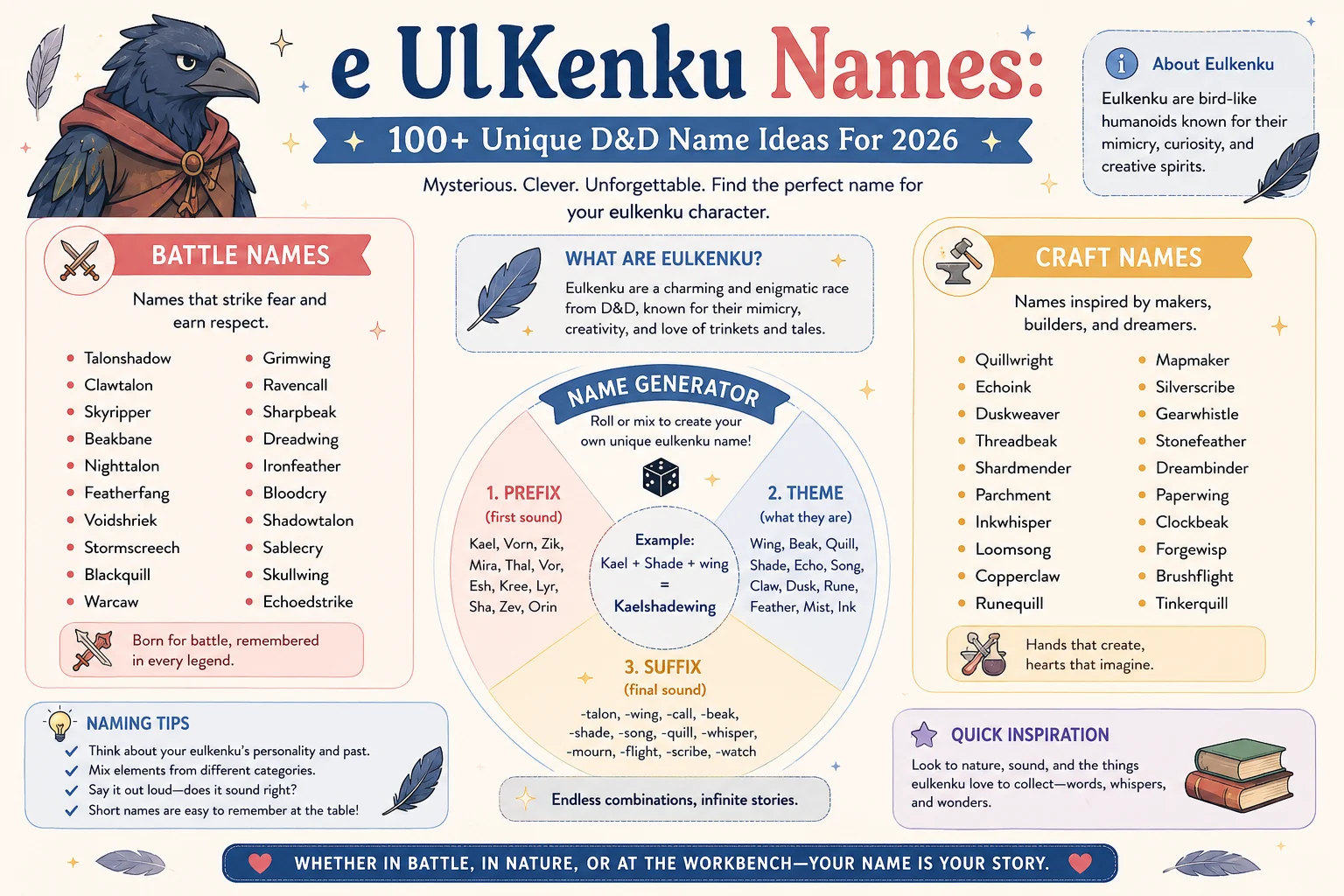
Kenku Name Generator
Need inspiration? Here’s a quick kenku name generator:
Roll 1d10 for a category:
1-3: Battle Name (use table below)
4-6: Animal Name (use table below)
7-9: Craft Name (use table below)
10: Compound Name (combine two sounds)
Battle Names (d10):
- Smasher 2. Clanger 3. Slicer 4. Basher 5. Breaker
- Crusher 7. Grinder 8. Striker 9. Chomper 10. Squisher
Animal Names (d10):
- Rat Scratch 2. Whistler 3. Mouser 4. Growler 5. Snake Hiss
- Owl Hoot 7. Wolf Howl 8. Bear Stomp 9. Eagle Screech 10. Fox Yelp
Craft Names (d10):
- Sail Snap 2. Hammerer 3. Cutter 4. Potion Swirl 5. Chisel Carve
- Bell Ring 7. Book Slam 8. Fire Crackle 9. Lute Pluck 10. Ship Creak
The Most Popular Kenku Names Today
Based on D&D community discussions, these are some of the most popular kenku names:
| Name | Why It’s Popular |
|---|---|
| Caw | Simple, recognizable, and evocative of a bird’s call |
| Clack | Short, percussive, and easy to remember |
| Scritch | Unique and perfectly onomatopoeic |
| Smasher | Classic and fits the tough archetype |
| Whistler | Mysterious and works for stealth characters |
| Echo | Poetic and captures the kenku’s essence |
| Notes | Perfect for bard characters |
| Rat Scratch | Gritty and fits the urban thief archetype |
Vintage Kenku Names Making a Comeback
Some classic kenku names from earlier editions are seeing a resurgence:
| Vintage Name | Why It’s Coming Back |
|---|---|
| Click | Simple and timeless |
| Tick-tock | Nostalgic and quirky |
| Roar | Bold and dramatic |
| Raven | Connects to their crow-like appearance |
| Crow | Direct and simple |
Modern Kenku Naming Trends
Recent D&D campaigns have seen new trends in kenku names:
1. Poetic Compound Names
Names like Echo-in-the-Deep and Toll-Before-Storm add a layer of mystery and depth to the character.
2. Names That Reflect a Curse
Some players choose names that hint at the kenku’s curse, like Fallen Feather or Grounded One.
3. Names That Break the Mold
While kenku cannot create original sounds, some DMs allow kenku to adopt names given by friends—names that represent not a sound, but a concept the friend thought was fitting.
Frequently Asked Questions
What are kenku names?
Kenku names are sound-based identifiers rather than traditional given names. Because kenku can only communicate through mimicry, their names are phonetic representations of sounds they have heard and adopted—things like Crack-of-Lightning, Hush, or Scritch.
Why are kenku names so unique?
Kenku names are unique because they are not invented. Instead, they are sounds the kenku has heard and mimicked. A kenku’s name tells a story about their environment, their profession, and their experiences.
Are kenku names gendered?
No. Kenku society does not use gendered naming conventions. All kenku names are gender-neutral.
How do kenku get their names?
Kenku are usually named by others—often their flock or companions—based on a distinctive sound associated with them. The name is a sound they hear frequently or a sound that defines their identity.
Can a kenku change their name?
Yes. A kenku might adopt a new name if their circumstances change—for example, moving from a criminal lifestyle to a lawful trade. They would begin mimicking the new sounds of their environment and be renamed accordingly.
What if I can’t decide on a kenku name?
Use the name generator in this guide or ask your DM for suggestions. You can also build the name into your backstory: perhaps a companion gave your kenku a name during a pivotal moment.
Conclusion
Kenku names are a beautiful blend of sound, memory, and identity. They reflect a creature that has lost its voice and must rebuild itself from the echoes of others.
Whether you choose a simple name like Caw or a compound name like Echo-in-the-Deep, your kenku’s name will tell a story. It will reveal where they’ve been, what they’ve done, and who they are.
Take your time. Listen to the world around you. Find the sound that defines your character. Then, carry that sound forward into your next D&D campaign.
And remember: in a world without original words, the most powerful thing a kenku can have is a name that truly echoes who they are.

Benjamin Clarke is a writer and nickname enthusiast at NicknameCorner.com, where he helps readers discover creative, meaningful, funny and unique nicknames for people, pets, usernames and special occasions. His content focuses on practical ideas, clear explanations and nickname inspiration that makes choosing the perfect name easier.