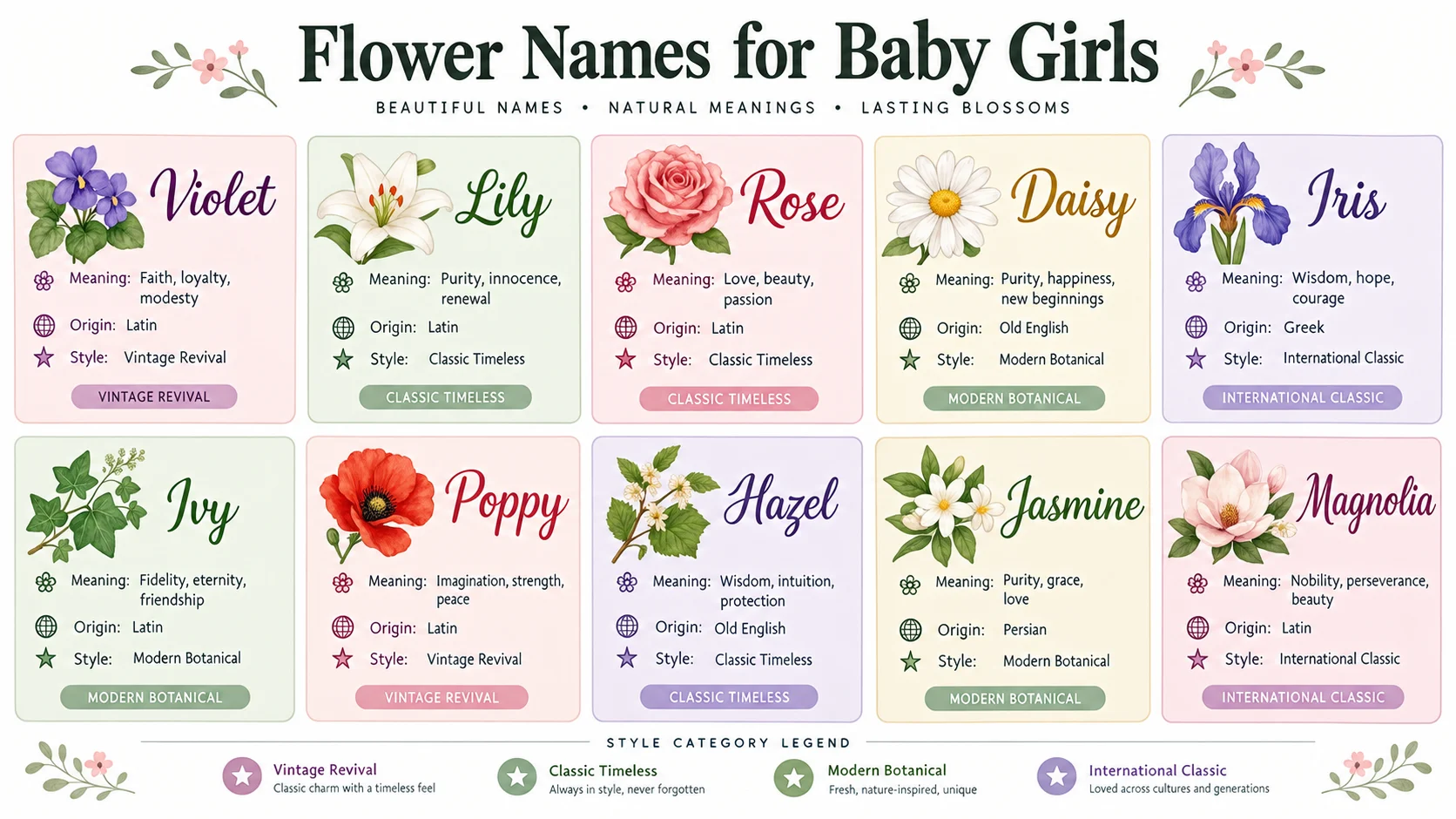
Flower names are botanical-inspired given names drawn from blooms like Rose, Lily, Violet, and Daisy. These names often carry symbolic meanings related to beauty, purity, love, and resilience. Parents choose flower names for their natural elegance, timeless appeal, and personal significance.
A flower name carries the garden into your daughter‘s identity. It whispers of spring mornings and summer gardens, of petals unfurling with purpose. Parents have chosen flower names for centuries, drawn to their natural beauty and the meanings woven into every bloom . Today, flower names for baby girls span from timeless classics like Rose and Lily to modern favorites such as Violet and Ivy. Each name offers something distinct: a connection to nature, a symbolic meaning, or simply a sound that feels right when spoken aloud. This guide explores ten beautiful flower names, their origins, and why they continue to resonate with families seeking something meaningful and enduring. Whether you prefer the familiar or the rare, there is a bloom waiting to become her name.
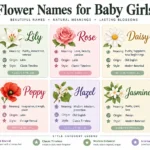
Quick Comparison Table
| Flower Name | Meaning | Style | Best For | Vibe |
|---|---|---|---|---|
| Violet | Purple flower | Vintage revival | Lovers of old-fashioned elegance | Soft, regal |
| Lily | Purity, innocence | Classic timeless | Families seeking tradition | Graceful, pure |
| Rose | Love, beauty | Perennial classic | Those wanting iconic beauty | Romantic, warm |
| Daisy | Day‘s eye | Fresh and cheerful | Parents wanting simplicity | Bright, joyful |
| Iris | Rainbow | Mythological classic | Fans of Greek heritage | Wise, colorful |
| Ivy | Faithfulness | Botanical modern | Nature-loving families | Energetic, loyal |
| Poppy | Red flower | Spirited choice | Parents wanting spunk | Bold, playful |
| Hazel | Hazelnut tree | Vintage nature | Those seeking warmth | Cozy, earthy |
| Jasmine | Gift from God | International classic | Families loving fragrance | Exotic, gentle |
| Magnolia | Magnol’s flower | Southern belle | Lovers of grandeur | Dignified, sweet |
10 Beautiful Flower Names for Baby Girls
1. Violet
Violet comes from the Latin word viola, referring to the purple flower. The name entered English usage in the 19th century and has roots in the color name as well . Historically, Violet was a popular choice in the early 1900s, declined through the mid-century, and has returned to favor in recent decades. It ranked in the US Top 100 for girls in the 2020s .
The name suggests softness and dignity. Violet carries a vintage charm that feels both refined and approachable, working well for a child and an adult. In flower symbolism, violets represent modesty, faithfulness, and true love . The name‘s sound is gentle yet distinctive, with a pleasing rhythm that pairs well with both one-syllable and longer middle names.
Similar options: Viola, Violetta, Ione, Lavender, Lilac
Why it works today: Violet balances vintage appeal with modern freshness. It feels classic without being common.
2. Lily
Lily derives directly from the flower name, which comes from the Latin lilium. The name has been used in English-speaking countries for centuries and carries strong associations with purity and innocence in Christian imagery . Lily ranks consistently among the top flower names for girls and appears frequently in the US Top 100 .
The name‘s simplicity gives it enduring appeal. Lily is easy to spell, pronounce, and remember, making it practical for daily life. Its floral meaning connects to grace and renewal. Parents often choose Lily for its elegant sound and the way it suits women of any age. The name works internationally, with variants like Lillian and Liliana offering longer alternatives.
Similar options: Lillian, Liliana, Lila, Lilly, Tigerlily
Why it works today: Lily offers timeless elegance in a short, accessible form. It feels fresh with every generation.
3. Rose
Rose comes from the Latin rosa, referring to the flower. Some sources also connect it to the Germanic name Hrodohaidis, meaning “famous type” . The name has been used since the Middle Ages and remains one of the most recognizable flower names worldwide. Rose is a perennial favorite that never fully leaves style.
Rose symbolizes love, beauty, and passion, with meanings varying by color in the language of flowers . The name‘s brevity gives it strength and versatility. It works as a first name, middle name, or nickname. Rose pairs beautifully with longer middle names and feels equally at home in formal and casual settings.
Similar options: Rosa, Rosalie, Rosie, Rosalind, Rosemary
Why it works today: Rose is iconic without being overused. It carries centuries of meaning in just four letters.
4. Daisy
Daisy originated as a nickname for Margaret, derived from the Old English “dæges eage,” meaning “day’s eye,” referring to the flower‘s habit of opening at dawn . The name became independent in the 19th century and has fluctuated in popularity since. In 2024, Daisy re-entered the US Top 100 for the first time since 1908 .
Daisy symbolizes innocence, new beginnings, and childlike joy . The name has a cheerful, wholesome quality that appeals to parents seeking something bright and uncomplicated. It works particularly well for spring babies, as Daisy is April’s birth flower . The name feels approachable and warm, suitable for a girl who will grow into a woman of substance.
Similar options: Maisie, Posey, Rosie, Poppy, Marguerite
Why it works today: Daisy feels fresh and optimistic. Its simplicity is its strength.
5. Iris
Iris comes from the Greek word for rainbow and was the name of the Greek goddess who served as a messenger of the gods . The iris flower shares the name due to its many colors. The name has classical roots and has remained in consistent use, appearing in the US Top 1000 for decades.
Iris represents faith, hope, wisdom, and valor in flower symbolism . The name has a crisp, modern sound that belies its ancient origins. It works across cultures and feels equally at home in mythology and contemporary life. Iris is short, distinctive, and carries an air of quiet confidence.
Similar options: Iris, Irene, Isis, Ilona, Irisa
Why it works today: Iris connects ancient mythology with modern appeal. It is short, strong, and memorable.
6. Ivy
Ivy derives from the Old English ifig, referring to the climbing evergreen plant. The name has botanical roots rather than flower-specific origins, but it frequently appears on flower name lists due to its natural associations . Ivy has experienced significant revival in recent years, propelled partly by its choice by high-profile parents .
The name symbolizes faithfulness and fidelity in the language of flowers . Ivy has an energetic, slightly quirky quality that distinguishes it from more traditional floral names. It works well for December babies, as ivy is traditionally associated with Christmas . The name feels both vintage and modern, a balance that explains its growing appeal.
Similar options: Iva, Ivie, Ivana, Yvette, Fern
Why it works today: Ivy offers botanical charm with a hint of edge. It is distinctive without being difficult.
7. Poppy
Poppy comes from the Old English popig, referring to the red-flowered plant. The name gained recognition in English-speaking countries through its association with the poppy as a symbol of remembrance. It entered the US Top 1000 for the first time in 2016 and has been rising since .
Poppy symbolizes beauty and eternal life in some traditions . The name has a spirited, bouncy quality that sets it apart from softer floral choices. It works especially well for August babies, as Poppy is August‘s birth flower . The name feels modern and energetic, appealing to parents who want something cheerful and distinctive.
Similar options: Poppaea, Pippa, Polly, Posy, Penelope
Why it works today: Poppy brings energy and personality. It is memorable and full of life.
8. Hazel
Hazel comes from the Old English hæsel, referring to the hazelnut tree. While not strictly a flower name, it appears consistently on botanical name lists and shares the natural, earthy quality of floral choices . Hazel was a top 100 name in the early 20th century, declined, and re-entered the US Top 100 in 1998 .
The name suggests warmth and wisdom. Hazel has a cozy, vintage quality that feels both nostalgic and current. It works beautifully for autumn babies and pairs well with both traditional and modern middle names. The name‘s connection to the hazel tree, traditionally associated with wisdom in Celtic lore, adds depth to its appeal.
Similar options: Hazelle, Haze, Hazelton, Hyacinth, Heather
Why it works today: Hazel feels warm and grounded. It offers nature connection without being overtly floral.
9. Jasmine
Jasmine comes from the Persian yasmin, referring to the fragrant jasmine flower. The name spread through the Middle East and Europe via the perfume trade, eventually entering English usage . Jasmine gained widespread recognition in the 1990s through the Disney film Aladdin and has remained popular since .
The name means “gift from God” in Persian tradition . Jasmine has a romantic, exotic quality that distinguishes it from English flower names. It works well across cultures, with variants like Yasmin and Jessamine offering alternatives. The name‘s soft sound and fragrant associations make it a sensual, appealing choice.
Similar options: Yasmin, Jessamine, Jasmina, Jasmine, Yasmeen
Why it works today: Jasmine feels romantic and international. It is beautiful without being difficult.
10. Magnolia
Magnolia is named after French botanist Pierre Magnol . The flowering tree produces large, fragrant blossoms that have become symbols of the American South. The name entered English usage in the 19th century and has gained renewed attention as botanical names return to favor.
Magnolia symbolizes dignity, nobility, beauty, and gentleness . The name has a grand, Southern belle quality that feels both stately and warm. It offers the nickname options Maggie or Nola for parents who want flexibility. Magnolia works well for parents seeking something distinctive and rooted in natural beauty.
Similar options: Maggie, Nola, Magnola, Magnolia, Marguerite
Why it works today: Magnolia offers grandeur with warmth. It is distinctive and memorable.
How to Choose the Perfect Flower Name
Choosing a flower name involves both practical and personal considerations.
Consider the flower‘s meaning. Flowers carry symbolic weight. Rose suggests love, Lily represents purity, and Daisy evokes new beginnings. Aligning a name’s meaning with values you hope to nurture adds significance .
Think about the birth month. Birth flowers offer a natural connection between a child and her arrival date. April‘s Daisy, June’s Rose, and October‘s Marigold each carry their own associations .
Test the sound. Say the name aloud with your last name. Consider how it will sound on a playground and in a professional setting. Nickname potential matters too: Magnolia can become Maggie, Primrose can become Posy.
Weigh familiarity against uniqueness. Classic choices like Lily and Rose are universally recognized. Rarer options like Zinnia or Amaryllis offer distinction. Neither approach is wrong; the right balance depends on your family‘s style.
Check cultural connections. Some flower names carry strong associations in particular cultures. Jasmine has Persian and Middle Eastern roots. Magnolia evokes the American South. These connections can enrich a name’s meaning.
Query Fan-Out (5–8 Questions with Answers):
- What are the most popular flower names for girls?
Violet, Lily, Rose, Ivy, and Daisy rank among the most popular flower names in English-speaking countries . - What flower names mean love?
Rose, Camellia, and Jasmine traditionally symbolize love and affection in the language of flowers . - What are unique flower names for girls?
Less common options include Zinnia, Amaryllis, Delphine, and Bryony . - What is a flower name that means strength?
Gladiolus symbolizes strength and moral integrity, while Aster represents patience and wisdom . - What are birth flower names?
Birth flowers correspond to birth months. April‘s flower is Daisy, June‘s is Rose, and October’s is Marigold . - What flower names work internationally?
Lily, Rose, Iris, and Jasmine appear across many cultures and languages with similar forms . - Are flower names good for professional women?
Yes. Names like Rose, Violet, and Iris carry elegance and authority suitable for any career stage. - What flower name means new beginnings?
Daisy symbolizes new beginnings and innocence, while Daffodil represents rebirth .
Frequently Asked Questions
What are the most popular flower names for girls?
Violet, Lily, Rose, Ivy, and Daisy consistently rank among the most popular flower names in English-speaking countries .
What flower names mean love?
Rose, Camellia, and Jasmine traditionally symbolize love and affection in the language of flowers .
What are unique flower names for girls?
Less common options include Zinnia, Amaryllis, Delphine, and Bryony. These names offer botanical beauty with distinction .
What flower name means strength?
Gladiolus symbolizes strength and moral integrity, while Aster represents patience and wisdom .
What are birth flower names?
Birth flowers correspond to birth months. April‘s flower is Daisy, June’s is Rose, and October‘s is Marigold .
What flower names work internationally?
Lily, Rose, Iris, and Jasmine appear across many cultures and languages with similar forms .
Are flower names good for professional women?
Yes. Names like Rose, Violet, and Iris carry elegance and authority suitable for any career stage.
What flower name means new beginnings?
Daisy symbolizes new beginnings and innocence, while Daffodil represents rebirth .
Conclusion
Flower names offer a beautiful way to connect your daughter to the natural world. From the vintage elegance of Violet to the spirited charm of Poppy, each bloom carries its own story and symbolism. These names for baby girls work because they balance beauty with meaning, familiarity with distinction. Whether you choose a classic like Lily or something rarer like Magnolia, you are giving your child a name rooted in nature and rich with history. Take your time, say each name aloud, and trust your instincts. Which flower name speaks to you? Share your favorites in the comments, and pass this guide along to anyone beginning their own naming journey.

Benjamin Clarke is a writer and nickname enthusiast at NicknameCorner.com, where he helps readers discover creative, meaningful, funny and unique nicknames for people, pets, usernames and special occasions. His content focuses on practical ideas, clear explanations and nickname inspiration that makes choosing the perfect name easier.