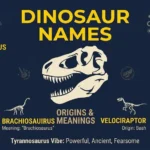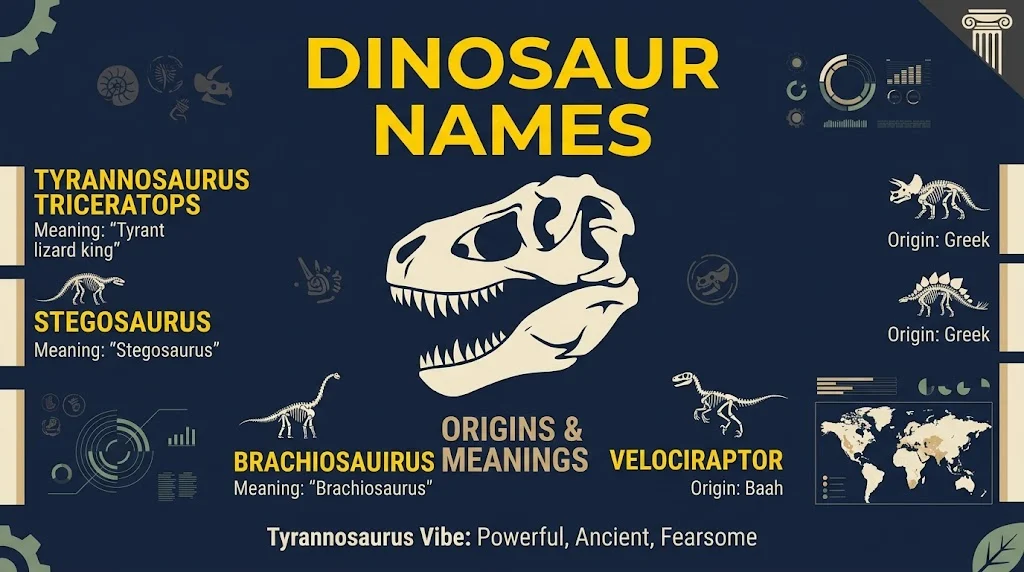
Dinosaur names are scientific labels given to extinct reptiles from the Mesozoic Era. Most use Greek or Latin roots describing features, locations, or people. Examples include Tyrannosaurus rex (tyrant lizard king) and Triceratops (three-horned face).
Query Fan-Out
1. What does the word dinosaur mean?
Dinosaur comes from the Greek words deinos, meaning terrible, and sauros, meaning lizard. English anatomist Richard Owen coined the term in 1842 to describe the fossil reptiles he was studying .
2. Why do most dinosaur names end in saurus?
Saurus comes from the Greek word for lizard. Early naturalists used it as a default ending for large fossil reptiles. Other common endings include -raptor (thief), -ceratops (horned face), and -don (tooth) .
3. How do scientists name a new dinosaur?
The paleontologist who describes a new species chooses the name, usually from Greek or Latin roots describing a feature, location, or person being honored. The name becomes official after publication in a peer-reviewed journal following zoological nomenclature rules .
4. What is the most famous dinosaur name?
Tyrannosaurus rex is the most widely recognized dinosaur name. It appears at the top of most popularity lists and has been the franchise mascot of Jurassic Park since 1993 .
5. What does Tyrannosaurus rex mean?
Tyrannosaurus rex translates to tyrant lizard king. Tyranno means tyrant, saurus means lizard, and rex means king in Latin .
6. What does Triceratops mean?
Triceratops means three-horned face. Tri means three, cerat means horn, and ops means face in Greek. The name refers to the dinosaur’s three facial horns and bony frill .
7. Are dinosaur names italicized?
Yes. Scientific names are always italicized, with the genus capitalized and the species lowercase. Tyrannosaurus rex is correct; tyrannosaurus Rex is not .
8. What are some dinosaur names for kids to learn?
Easy dinosaur names for children include T. rex, Triceratops, Stegosaurus, Velociraptor, Brachiosaurus, Ankylosaurus, and Spinosaurus. These are the most recognizable and frequently featured in books and films .
Introduction
Every child learns the name Tyrannosaurus rex before they can spell it. The name itself sounds like what it describes: something massive, ancient, and terrifying. But behind every dinosaur name is a story, usually written in Greek or Latin, often describing a single feature that caught a scientist’s attention millions of years after the animal died.
Dinosaur names are more than labels. They are tiny windows into how paleontologists think and what they value. A name might honor a location, a colleague, a benefactor, or a child who found the first fossil. It might describe a horn, a crest, a tooth, or a claw. Some names are elegant. Some are strange. A few are quietly funny.
This guide explores how dinosaur names work, what the most famous ones actually mean, and why some names stick in popular culture while others fade into scientific footnotes. Whether you are helping a child with a school project or satisfying your own curiosity, the names tell a story worth reading.
Main Content
How Do Dinosaurs Get Their Names?
Dinosaur naming follows strict international rules. The International Code of Zoological Nomenclature governs how every new species is named, and paleontologists must follow those rules for a name to be valid . A scientific name has two parts: the genus (capitalized) and the species (lowercase). Both are italicized. Tyrannosaurus rex is the classic example. The genus is Tyrannosaurus, the species is rex .
Scientists name dinosaurs using three main approaches. They may reference the location where the fossil was found, honor a person connected to the discovery, or describe a distinctive body part or behavior . Most dinosaur names combine Greek or Latin roots. The American Museum of Natural History lists common components: saur or saurus means lizard, raptor means robber, rex means king, tri means three, and cerat means horned . Understanding these roots makes even the longest dinosaur names readable.
The Most Popular Dinosaur Names and What They Mean
1. Tyrannosaurus rex
Meaning: Tyrant lizard king
Origin: Greek tyranno (tyrant) + Greek sauros (lizard) + Latin rex (king)
Style: Apex predator, iconic, intimidating
Best for: Anyone learning dinosaur names for the first time
Tyrannosaurus rex is the most famous dinosaur name in the world. It sits at the top of virtually every popularity list, from fan polls to quiz data . The name itself is a masterclass in branding: three words that sound as fearsome as the animal was. Tyranno captures the creature’s dominance. Saurus grounds it as a reptile. Rex adds a regal finality.
The name has been inseparable from Jurassic Park since 1993, when the film’s T. rex became a cinematic icon. Fans affectionately call the franchise’s Tyrannosaurus “Rexy” . The species lived in western North America during the Late Cretaceous, roughly 68 to 66 million years ago .
Similar names: Tarbosaurus, Albertosaurus, Daspletosaurus, Gorgosaurus
Why it works today: The name is simple enough for a child to remember and dramatic enough to carry a multi-billion-dollar film franchise. Few scientific names achieve that balance.
2. Triceratops
Meaning: Three-horned face
Origin: Greek tri (three) + Greek cerat (horn) + Greek ops (face)
Style: Defensive, recognizable, gentle giant
Best for: Kids who love the “tank” dinosaurs
Triceratops is the most recognizable herbivorous dinosaur, known for its three facial horns and large bony frill. The name is purely descriptive: three horns on a face . It appears near the top of every major dinosaur popularity ranking .
In Jurassic Park, Triceratops appeared as a sick, gentle animal receiving medical care, reinforcing its reputation as a peaceful counterpart to the predators . The dinosaur lived alongside Tyrannosaurus in western North America during the Late Cretaceous. Fossil evidence suggests it could defend itself against predators, making it one of the few herbivores capable of challenging a healthy adult T. rex .
Similar names: Torosaurus, Styracosaurus, Pachyrhinosaurus, Centrosaurus
Why it works today: The name is easy to say and easy to visualize. Three horns. One face. No ambiguity.
3. Velociraptor
Meaning: Speedy thief
Origin: Latin veloci (speed) + Latin raptor (thief or robber)
Style: Cunning, agile, cinematic
Best for: Fans of intelligent predators and Jurassic Park lore
Velociraptor means speedy thief, a name that perfectly captures the animal’s presumed hunting style . The name entered public consciousness through Jurassic Park, where the film’s raptors were portrayed as intelligent, coordinated pack hunters. The real Velociraptor was much smaller than its cinematic counterpart; the film’s raptors were actually modeled on a related dinosaur, Deinonychus .
Despite the size discrepancy, the name stuck. Velociraptor ranks among the top three most popular dinosaur names in fan polls and quiz data . The name’s brevity and aggressive sound make it memorable. It also lends itself to nicknames; “raptor” has become shorthand for an entire group of bird-like dinosaurs.
Similar names: Deinonychus, Utahraptor, Dromaeosaurus, Microraptor
Why it works today: Velociraptor sounds fast. Four syllables, sharp consonants, and a meaning that promises action. It is the rare scientific name that works as an action-movie title.
4. Stegosaurus
Meaning: Roofed lizard
Origin: Greek stego (roof or covered) + Greek sauros (lizard)
Style: Distinctive, peaceful, prehistoric
Best for: Dinosaur fans who love unusual anatomy
Stegosaurus means roofed lizard, referring to the row of large bony plates along its back. Early paleontologists thought the plates lay flat like shingles on a roof, hence the name . The dinosaur also had a spiked tail, informally called a thagomizer, a term coined by cartoonist Gary Larson and later adopted by paleontologists .
Stegosaurus is one of the most visually distinctive dinosaurs, appearing in countless books, toys, and films. It ranks consistently in the top five of popularity polls . The name is easy to pronounce and easy to remember, making it a childhood favorite.
Similar names: Kentrosaurus, Tuojiangosaurus, Huayangosaurus, Miragaia
Why it works today: Stegosaurus looks like no other animal. The name matches the silhouette. Children recognize it before they know what the word means.
5. Brachiosaurus
Meaning: Arm lizard
Origin: Greek brachion (arm) + Greek sauros (lizard)
Style: Gentle giant, awe-inspiring, majestic
Best for: Fans of long-necked sauropods
Brachiosaurus means arm lizard, named for its unusually long front legs, which were longer than its hind legs . This gave the dinosaur a giraffe-like posture, allowing it to reach high vegetation. The name is fitting for one of the tallest dinosaurs, with some estimates placing its height at over 40 feet.
Brachiosaurus gained iconic status through the first Jurassic Park film, where its first appearance introduced audiences to the wonder of CGI dinosaurs . The scene remains one of the most memorable in the franchise. In fan discussions, Brachiosaurus is often cited as the definitive sauropod, alongside Brontosaurus .
Similar names: Giraffatitan, Sauroposeidon, Brachytrachelopan, Europasaurus
Why it works today: The name sounds graceful and grand. Arm lizard is a strange phrase, but it captures the dinosaur’s most distinctive feature in two simple words.
6. Spinosaurus
Meaning: Spine lizard
Origin: Latin spina (spine) + Greek sauros (lizard)
Style: Mysterious, semi-aquatic, controversial
Best for: Fans of unusual predators and scientific debate
Spinosaurus means spine lizard, referring to the tall neural spines that formed a sail-like structure on its back . The dinosaur has become one of the most debated in paleontology, with recent research suggesting it was semi-aquatic and had a crocodile-like snout for catching fish. This scientific controversy has fueled public interest.
Spinosaurus achieved infamy through Jurassic Park III, where it was depicted defeating a Tyrannosaurus in combat, a scene that sparked endless fan arguments . The dinosaur’s popularity has grown in the 2020s, helped by new research and its appearance in documentaries and games .
Similar names: Suchomimus, Baryonyx, Irritator, Ichthyovenator
Why it works today: Spinosaurus is a dinosaur that keeps changing. Each new study revises what we thought we knew. The name remains constant while the science evolves.
7. Ankylosaurus
Meaning: Fused lizard
Origin: Greek ankylo (fused or joined) + Greek sauros (lizard)
Style: Defensive, armored, tank-like
Best for: Fans of heavily armored herbivores
Ankylosaurus means fused lizard, named for the way its armor plates fused together to form a solid protective shell . The dinosaur’s back was covered in bony osteoderms, and its tail ended in a heavy club capable of breaking bone. It was the largest of the ankylosaur family, reaching up to 26 feet in length .
Ankylosaurus appears consistently in top-ten dinosaur lists and has been featured in Jurassic Park films . The name is less intuitive than some, but the image it conjures, a living tank with a wrecking ball tail, is unforgettable.
Similar names: Euoplocephalus, Nodosaurus, Sauropelta, Edmontonia
Why it works today: Ankylosaurus is the dinosaur equivalent of a fortress. The name sounds technical, but the animal it describes is pure defensive design.
8. Allosaurus
Meaning: Different lizard
Origin: Greek allo (different or strange) + Greek sauros (lizard)
Style: Classic predator, underrated, Jurassic icon
Best for: Fans of the Jurassic Period’s apex predator
Allosaurus means different lizard, named for its distinctive vertebrae, which differed from those of other dinosaurs known at the time . It was the dominant predator of Late Jurassic North America, often called the “lion of the Jurassic” . Despite its importance in paleontology, Allosaurus has never reached the pop-culture heights of T. rex or Velociraptor.
Allosaurus ranks in the top ten of most popularity lists and has appeared in numerous documentaries and films . It is well-known among paleontology enthusiasts but less familiar to the general public. The name is straightforward and easy to remember.
Similar names: Saurophaganax, Torvosaurus, Ceratosaurus, Megalosaurus
Why it works today: Allosaurus is a dinosaur for people who know dinosaurs. The name signals expertise without being obscure.
9. Dilophosaurus
Meaning: Two-crested lizard
Origin: Greek di (two) + Greek lophos (crest) + Greek sauros (lizard)
Style: Misunderstood, cinematic, memorable
Best for: Fans of Jurassic Park’s most creative liberty
Dilophosaurus means two-crested lizard, referring to the pair of rounded crests on its skull . The real Dilophosaurus was a medium-sized predator, roughly 20 feet long. The Jurassic Park version, however, was much smaller, capable of spitting venom, and equipped with a frill, none of which have any fossil evidence .
Despite the inaccuracies, the Dilophosaurus scene in Jurassic Park, where it kills Dennis Nedry, remains one of the film’s most memorable moments. The name has become synonymous with the movie’s creative liberties, and the dinosaur retains a cult following .
Similar names: Cryolophosaurus, Monolophosaurus, Sinosaurus, Coelophysis
Why it works today: Dilophosaurus is a reminder that dinosaur names belong to science, but dinosaur stories belong to everyone.
10. Parasaurolophus
Meaning: Near crested lizard
Origin: Greek para (near) + Greek sauros (lizard) + Greek lophos (crest)
Style: Elegant, musical, distinctive
Best for: Fans of duck-billed dinosaurs and unusual crests
Parasaurolophus means near crested lizard, named for its long, backward-curving skull crest. Scientists believe the crest may have been used for communication, possibly producing resonant sounds . The name is a bit of a mouthful, but the dinosaur is one of the most recognizable hadrosaurs, or duck-billed dinosaurs.
Parasaurolophus appears in Jurassic Park herd scenes and has a devoted following among dinosaur enthusiasts who appreciate its unusual appearance . The name is less intuitive than T. rex or Triceratops, but the animal’s trumpet-like crest makes it memorable.
Similar names: Corythosaurus, Lambeosaurus, Hypacrosaurus, Olorotitan
Why it works today: Parasaurolophus sounds like what it might have sounded like. The name is awkward, but the dinosaur is beautiful.
Quick Comparison Table
| Dinosaur Name | Meaning | Origin Roots | Best For | Vibe |
|---|---|---|---|---|
| Tyrannosaurus rex | Tyrant lizard king | Greek + Latin | Beginners | Iconic |
| Triceratops | Three-horned face | Greek | Kids | Defensive |
| Velociraptor | Speedy thief | Latin | Action fans | Cunning |
| Stegosaurus | Roofed lizard | Greek | Visual learners | Distinctive |
| Brachiosaurus | Arm lizard | Greek | Sauropod fans | Majestic |
| Spinosaurus | Spine lizard | Latin + Greek | Debate lovers | Mysterious |
| Ankylosaurus | Fused lizard | Greek | Armor fans | Tank-like |
| Allosaurus | Different lizard | Greek | Enthusiasts | Classic |
| Dilophosaurus | Two-crested lizard | Greek | Movie fans | Misunderstood |
| Parasaurolophus | Near crested lizard | Greek | Crest fans | Elegant |
How to Choose a Dinosaur Name to Learn or Use
Whether you are helping a child learn dinosaur names, choosing a name for a pet or character, or simply expanding your knowledge, these practical tips will help:
Start with the meaning: Knowing what a name means makes it easier to remember. Tyrannosaurus rex is easier to recall when you know it means tyrant lizard king.
Learn the roots: Greek and Latin components repeat across dozens of names. Once you know saurus means lizard and raptor means thief, Velociraptor becomes obvious .
Match the name to the feature: Many dinosaur names describe exactly what the animal looked like. Triceratops has three horns. Stegosaurus has a roofed back. The name is a description.
Check pronunciation: Some names are harder to say than others. Parasaurolophus is a mouthful. T. rex is not. Choose names that fit your comfort level.
Consider the context: If you are naming a pet, short and punchy works best. If you are creating a character, a longer, more dramatic name might fit. If you are learning for school, focus on the most famous names first.
Verify the science: Popular culture takes liberties with dinosaurs. Dilophosaurus did not spit venom. Velociraptor was not human-sized. Learning the real science behind the name adds depth .
Classic and Lesser-Known Dinosaur Names
Beyond the famous ten, hundreds of dinosaur names exist. Some are elegant. Some are strange. A few are quietly humorous.
- Brontosaurus: Thunder lizard. Once folded into Apatosaurus, restored as a valid genus in 2015 .
- Diplodocus: Double beam. Named for its double-beamed tail bones.
- Ceratosaurus: Horned lizard. A predator with a prominent nose horn.
- Compsognathus: Pretty jaw. One of the smallest known dinosaurs.
- Maiasaura: Good mother lizard. Named for fossil evidence of nesting and parental care .
- Oviraptor: Egg thief. Named for a specimen found near eggs, later shown to be its own nest .
- Anzu: Named after a bird-like demon in Mesopotamian mythology .
- Irritator: Named because the paleontologist who described it was irritated by the specimen’s condition.
These names show the range of dinosaur naming, from descriptive to mythological to personal.
Modern Dinosaur Name Trends
New dinosaur discoveries continue at a steady pace, and naming trends reflect the scientists behind them. Recent names often honor Indigenous cultures, local communities, or the researchers’ families. Some names reference modern pop culture. Others are chosen specifically to be pronounceable for children.
The internet has also influenced which dinosaur names become famous. Species featured in games, documentaries, and social media posts can surge in public awareness. Spinosaurus is a prime example, its popularity rising alongside new scientific research and online discussion .
However, not every new name enters popular culture. Most dinosaur names remain within scientific literature, known only to specialists. The names that break through tend to be either unusually descriptive, tied to a major film, or associated with a dramatic scientific discovery.
Query Fan-Out
1. What does the word dinosaur mean?
Dinosaur comes from the Greek words deinos, meaning terrible, and sauros, meaning lizard. English anatomist Richard Owen coined the term in 1842 to describe the fossil reptiles he was studying .
2. Why do most dinosaur names end in saurus?
Saurus comes from the Greek word for lizard. Early naturalists used it as a default ending for large fossil reptiles. Other common endings include -raptor (thief), -ceratops (horned face), and -don (tooth) .
3. How do scientists name a new dinosaur?
The paleontologist who describes a new species chooses the name, usually from Greek or Latin roots describing a feature, location, or person being honored. The name becomes official after publication in a peer-reviewed journal following zoological nomenclature rules .
4. What is the most famous dinosaur name?
Tyrannosaurus rex is the most widely recognized dinosaur name. It appears at the top of most popularity lists and has been the franchise mascot of Jurassic Park since 1993 .
5. What does Tyrannosaurus rex mean?
Tyrannosaurus rex translates to tyrant lizard king. Tyranno means tyrant, saurus means lizard, and rex means king in Latin .
6. What does Triceratops mean?
Triceratops means three-horned face. Tri means three, cerat means horn, and ops means face in Greek. The name refers to the dinosaur’s three facial horns and bony frill .
7. Are dinosaur names italicized?
Yes. Scientific names are always italicized, with the genus capitalized and the species lowercase. Tyrannosaurus rex is correct; tyrannosaurus Rex is not .
8. What are some dinosaur names for kids to learn?
Easy dinosaur names for children include T. rex, Triceratops, Stegosaurus, Velociraptor, Brachiosaurus, Ankylosaurus, and Spinosaurus. These are the most recognizable and frequently featured in books and films .
FAQ
1. What is the most famous dinosaur name?
Tyrannosaurus rex is the most widely recognized dinosaur name. It tops most popularity lists and has been the franchise mascot of Jurassic Park since 1993. Its name, meaning tyrant lizard king, is as iconic as the animal itself .
2. What does dinosaur mean?
Dinosaur comes from the Greek words deinos (terrible) and sauros (lizard). English anatomist Richard Owen coined the term in 1842. The full translation is terrible lizard .
3. Why do dinosaur names end in saurus?
Saurus is Greek for lizard. Early naturalists used it as a standard ending for large fossil reptiles. Many dinosaur names still follow this convention, though other endings like -raptor (thief) and -ceratops (horned face) are also common .
4. How do scientists name a new dinosaur?
The paleontologist who describes a new species chooses the name, usually from Greek or Latin roots describing a feature, location, or person being honored. The name becomes official after publication in a peer-reviewed journal. Rules are set by the International Code of Zoological Nomenclature .
5. What does Triceratops mean?
Triceratops means three-horned face. Tri means three, cerat means horn, and ops means face in Greek. The name refers to the dinosaur’s three facial horns and bony frill .
6. Are dinosaur names italicized?
Yes. Scientific names are always italicized. The genus is capitalized and the species is lowercase. Tyrannosaurus rex is correct. You may also see the genus abbreviated after first mention, as in T. rex .
7. What are good dinosaur names for kids to learn?
Start with the most recognizable: T. rex, Triceratops, Stegosaurus, Velociraptor, Brachiosaurus, Ankylosaurus, and Spinosaurus. These appear most often in books, films, and toys, making them easy for children to remember .
8. What dinosaur names are actually not dinosaurs?
Pteranodon and Quetzalcoatlus are pterosaurs, flying reptiles. Mosasaurus and Plesiosaurus are marine reptiles. Dimetrodon is a synapsid that lived before dinosaurs existed. None of these are dinosaurs, though they often appear alongside them in popular media .
Conclusion
Dinosaur names are more than scientific labels. They are stories written in Greek and Latin, describing horns and crests and teeth and the people who found them. From the tyrant lizard king to the three-horned face, every name carries a piece of the animal’s identity and the scientist’s curiosity.
This guide has explored how dinosaur names work, what the most famous ones mean, and why some names endure while others remain in the footnotes. Whether you are learning for school, naming a pet, or simply satisfying a childhood fascination, the names offer a way into the deep past.
Which dinosaur name is your favorite? Share it in the comments and pass this guide along to someone who still knows the joy of saying Tyrannosaurus rex out loud.

Benjamin Clarke is a writer and nickname enthusiast at NicknameCorner.com, where he helps readers discover creative, meaningful, funny and unique nicknames for people, pets, usernames and special occasions. His content focuses on practical ideas, clear explanations and nickname inspiration that makes choosing the perfect name easier.