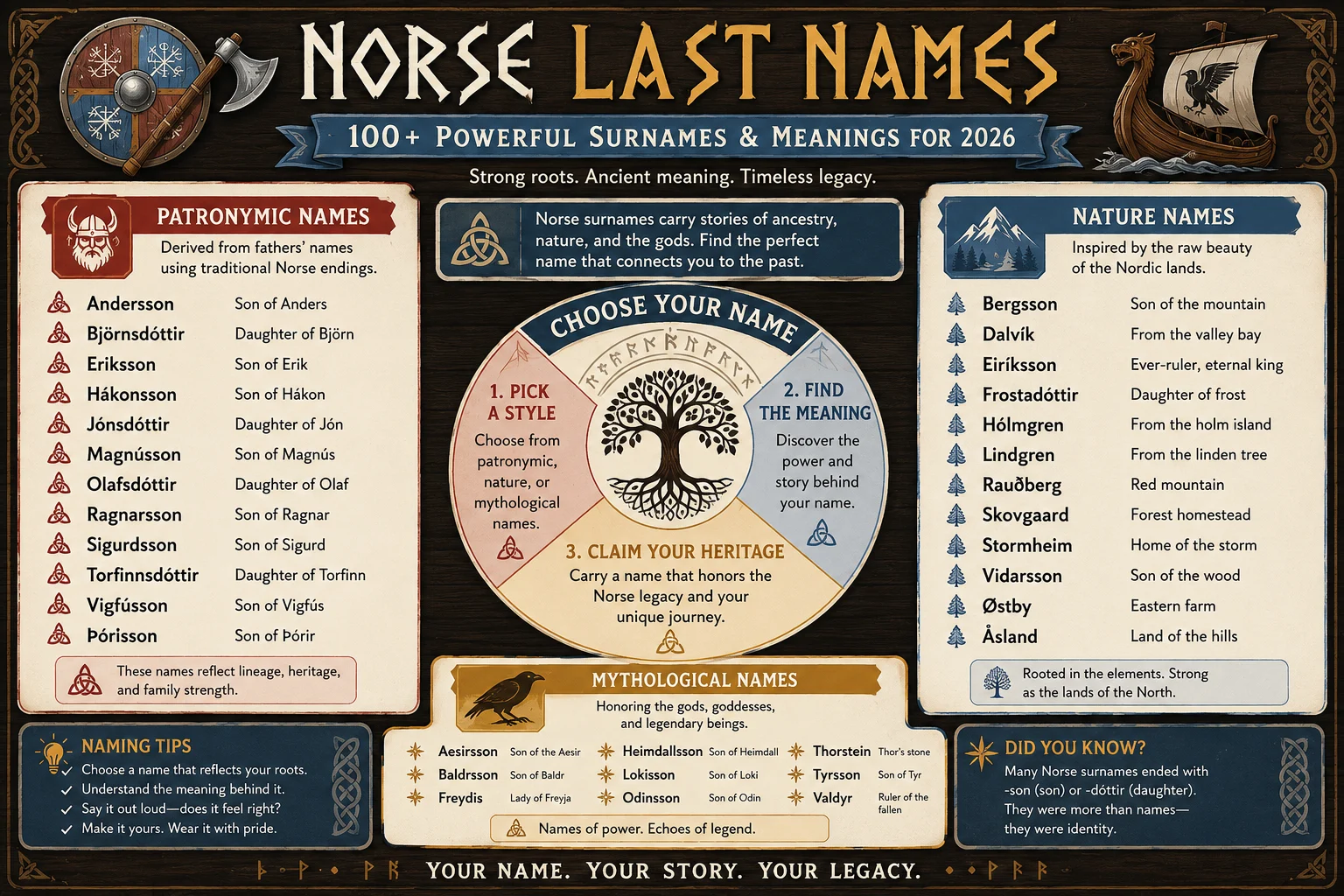
There’s something undeniably powerful about a Norse last name. They carry the weight of Vikings, the mystery of ancient runes, and the strength of old gods. Whether you’re looking for a surname for a character, researching your own heritage, or simply fascinated by Nordic culture, Norse last names tell stories of warriors, nature, and family.
Norse last names are unique because they don’t follow the same patterns as most Western surnames. Instead of being passed down unchanged through generations, they traditionally reflected a person’s father, their occupation, or the landscape around them.
In this comprehensive guide, we’ll explore everything you need to know about Norse last names. You’ll discover their meanings, origins, and the fascinating stories behind them. Whether you want a name that sounds like a Viking chief or something more subtle and modern, you’ll find plenty of inspiration here.
Let’s journey into the world of Norse surnames and uncover the power of a name.
Patronymic Origins
Traditionally, Scandinavians didn’t use family surnames. Instead, they used patronymics—names based on the father’s first name. A son of Erik would be Eriksson (Erik’s son), while a daughter would be Eriksdottir (Erik’s daughter).
This system means Norse last names reveal family connections. Even today, many Scandinavian surnames follow this pattern.
Connection to Nature and Mythology
Many Norse last names come from the natural world. Words like bjørn (bear), ulf (wolf), and fjell (mountain) appear in countless surnames. Others reference Norse gods and mythology.
Occupational Names
Some Norse last names came from professions. Names like Smed (smith) or Fisker (fisherman) described what a person did for a living.
Geographic Influences
Where you lived mattered. Norse last names often included references to farms, villages, or geographic features like rivers, valleys, and hills.
The Three Main Categories of Norse Last Names
Norse last names typically fall into three categories:
| CategoryDescriptionExample Names | ||
|---|---|---|
| Patronymic | Based on the father’s name with -son or -dottir endings | Eriksson, Olafsdottir, Jonsson |
| Nature-Based | Connected to animals, plants, or landscapes | Bjørnson, Lindberg, Fjell |
| Occupational | Based on a person’s profession or trade | Smed, Fisker, Skomaker |
100+ Norse Last Names and Their Meanings
Here’s a curated list of Norse last names organized by category.
Patronymic Norse Last Names
| Surname | Meaning |
|---|---|
| Eriksson | Son of Erik |
| Olafsdottir | Daughter of Olaf |
| Jonsson | Son of Jon |
| Magnusson | Son of Magnus |
| Svensson | Son of Sven |
| Gunnarsson | Son of Gunnar |
| Ragnarsson | Son of Ragnar |
| Ingvarsson | Son of Ingvar |
| Leifsson | Son of Leif |
| Håkansson | Son of Håkan |
| Nilsen | Son of Nils |
| Andersen | Son of Anders |
| Pedersen | Son of Peder |
| Jensen | Son of Jens |
| Larsen | Son of Lars |
Nature-Inspired Norse Last Names
| Surname | Meaning |
|---|---|
| Bjørnson | Son of Bjørn (bear) |
| Lindberg | Linden tree mountain |
| Fjell | Mountain |
| Skog | Forest |
| Dahl | Valley |
| Berg | Mountain or hill |
| Eik | Oak tree |
| Ulv | Wolf |
| Hauk | Hawk |
| Falk | Falcon |
| Kjell | Kettle (or protective helmet) |
| Strom | Stream or river |
| Vang | Field or meadow |
| Lund | Grove or small forest |
| Haugen | Hill |
Occupational Norse Last Names
| Surname | Meaning |
|---|---|
| Smed | Smith |
| Fisker | Fisherman |
| Skomaker | Shoemaker |
| Møller | Miller |
| Bonde | Farmer (peasant) |
| Jeger | Hunter |
| Skald | Poet or bard |
| Kriger | Warrior |
| Handler | Trader or merchant |
| Båtmann | Boatman |
| Sverd | Sword |
| Skjold | Shield |
Mythological and Warrior Norse Last Names
| Surname | Meaning |
|---|---|
| Thorsson | Son of Thor |
| Odinsson | Son of Odin |
| Freysson | Son of Freyr |
| Iverson | Son of Ivar (archer) |
| Haraldsson | Son of Harald (army ruler) |
| Vidarsson | Son of Vidar (forest warrior) |
| Sigurdsson | Son of Sigurd (victory guard) |
| Einarsson | Son of Einar (lone warrior) |
| Grimsson | Son of Grim (masked one) |
| Hrolfsson | Son of Hrolf (famous wolf) |
| Sturluson | Son of Sturla (turbulent one) |
| Tryggvason | Son of Tryggve (trusty) |
| Hákonarson | Son of Hákon (noble son) |
| Valdemarsson | Son of Valdemar (famous ruler) |
| Knutsson | Son of Knut (knot) |
Compound Norse Last Names
| Surname | Meaning |
|---|---|
| Stormberg | Storm mountain |
| Vindheim | Wind home |
| Havstrøm | Ocean stream |
| Nordfjell | Northern mountain |
| Sølvang | Silver field |
| Gullberg | Golden mountain |
| Rødhagen | Red hill |
| Kaldvind | Cold wind |
| Blåberg | Blue mountain |
| Swartfjell | Black mountain |
| Hvitlund | White grove |
| Steinstrom | Stone stream |
| Jernberg | Iron mountain |
| Vannskog | Water forest |
| Fjellvang | Mountain field |
Modern Norwegian and Swedish Surnames
| Surname | Meaning |
|---|---|
| Hansen | Son of Hans |
| Johansson | Son of Johan |
| Karlsson | Son of Karl |
| Nilsson | Son of Nils |
| Söderberg | Southern mountain |
| Lindström | Linden tree stream |
| Engström | Meadow stream |
| Holm | Island or small hill |
| Ek | Oak tree |
| Kjellberg | Kettle mountain |
| Löfgren | Leaf branch |
| Lundgren | Grove branch |
| Sandberg | Sand mountain |
| Sjöberg | Sea mountain |
| Ahlström | Eel stream |
How to Choose the Perfect Norse Last Name
Choosing a Norse last name is about more than picking something that sounds cool. Here’s how to find the right one:
1. Consider Your Purpose
- For a character: Think about their personality, background, and story.
- For yourself: Consider your heritage and what resonates with you.
- For a story: Think about the setting and time period.
2. Think About Meaning
The most meaningful Norse last names have stories behind them. Choose a name that reflects who you are or who your character is.
- Bjørnson (bear’s son) for someone strong and fierce.
- Fjell (mountain) for someone steady and unshakeable.
- Ulv (wolf) for someone loyal and wild.
- Skald (poet) for a creative soul.
- Thorsson for someone with a powerful presence.
3. Consider the Sound
Some Norse last names sound harsh and guttural. Others are softer and more melodic. Think about how the name sounds when spoken aloud.
- Hard sounds: K, G, R, J
- Soft sounds: L, V, M, N
- Longer names: Ragnarsson, Eriksdottir
- Shorter names: Fjell, Berg, Dahl
4. Match the Time Period
- Viking Age (8th-11th century): Patronymic names like Ragnarsson or Olafsdottir.
- Medieval: Names like Skald, Smed, or Fisker.
- Modern: Names like Johansson, Lindberg, or Engström.
5. Think About the Character’s Personality
- Warrior: Thorsson, Haraldsson, Hrolfsson
- Sage or poet: Skald, Grimsson, Sigurdsson
- Survivor: Tryggvason, Ulv, Bjørnson
- Leader: Valdemarsson, Ragnarsson, Häkonarson
- Lone wolf: Einarsson, Vidarsson, Iverson
Quick Comparison Table
| Surname | Meaning | Style | Best For |
|---|---|---|---|
| Eriksson | Son of Erik | Classic, Timeless | Warriors, Leaders |
| Bjørnson | Son of Bear | Strong, Bold | Fierce Characters |
| Skog | Forest | Natural, Wild | Druids, Rangers |
| Smed | Smith | Crafty, Hardworking | Artisans, Creators |
| Thorsson | Son of Thor | Mythical, Powerful | Heroes, Protectors |
| Fjell | Mountain | Steady, Stable | Anchored Characters |
| Ulv | Wolf | Fierce, Loyal | Survivors, Outcasts |
| Skald | Poet | Creative, Wise | Bards, Storytellers |
| Stormberg | Storm Mountain | Dramatic, Intense | Adventurers, Wanders |
| Nordfjell | Northern Mountain | Mysterious, Cool | Northern Characters |
Most Popular Norse Last Names Today
Based on modern usage, these are some of the most popular Norse last names:
| Name | Why It’s Popular |
|---|---|
| Hansen | Common and classic |
| Johansson | Modern and widely used |
| Karlsson | Clean and strong |
| Nilsson | Simple and traditional |
| Eriksson | Historical and powerful |
| Bjørnson | Bold and memorable |
| Thorsson | Mythologically significant |
| Lindberg | Beautiful and nature-inspired |
| Söderberg | Geographic and classic |
| Berg | Short and strong |
Vintage Norse Last Names Making a Comeback
Some traditional Norse last names are seeing renewed interest:
| Vintage Name | Why It’s Coming Back |
|---|---|
| Hrolfsson | Historical and unique |
| Sturluson | Connected to Icelandic sagas |
| Tryggvason | Distinctive and meaningful |
| Grimsson | Dark and mysterious |
| Einarsson | Strong and dignified |
Modern Norse Naming Trends
Recent trends in Norse last names include:
1. Nature Names
Names like Fjell (mountain), Ulv (wolf), and Skog (forest) are increasingly popular.
2. Shortened Surnames
Names like Berg, Dahl, and Holm are popular in their short forms.
3. Compound Names
Names combining two words, like Stormberg or Kaldvind, are gaining traction.
4. Mythological Names
Names like Thorsson or Odinsson appeal to fans of Norse mythology.
Frequently Asked Questions
What are Norse last names?
Norse last names are surnames originating from Scandinavia. They traditionally followed a patronymic system, where a person’s last name indicated their father’s first name (e.g., Eriksson means “son of Erik”).
Why do Norse last names end in -son or -dottir?
These endings mean “son of” and “daughter of,” respectively. This patronymic system was the traditional way Scandinavians identified themselves and their family connections.
Are Norse last names still used in Scandinavia?
Yes, many Norse last names are still common in Norway, Sweden, Denmark, and Iceland. Iceland continues to use the traditional patronymic system today.
What does Bjørnson mean?
Bjørnson means “son of Bjørn.” Bjørn itself means “bear” in Old Norse, so the name carries a strong, fierce connotation.
Can I use a Norse last name for my character?
Absolutely. Norse last names are perfect for characters in fantasy, historical fiction, or modern stories. They add depth, history, and personality.
How do I choose the right Norse last name?
Consider your character’s personality, background, and story. Think about the meaning of the name and how it sounds aloud.
Conclusion
Norse last names are more than just words. They’re stories of warriors, poets, and farmers. They’re echoes of a world where names connected you to your family, your land, and your gods.
Whether you choose a name like Eriksson to honor a legendary explorer or Ulv to embrace the wild spirit within, your Norse surname will carry power and meaning.
Take your time exploring the possibilities. Listen to how each name sounds. Consider what it means. Then, choose the name that resonates with your soul.
And remember: a name isn’t just what you’re called. It’s who you are.

Benjamin Clarke is a writer and nickname enthusiast at NicknameCorner.com, where he helps readers discover creative, meaningful, funny and unique nicknames for people, pets, usernames and special occasions. His content focuses on practical ideas, clear explanations and nickname inspiration that makes choosing the perfect name easier.