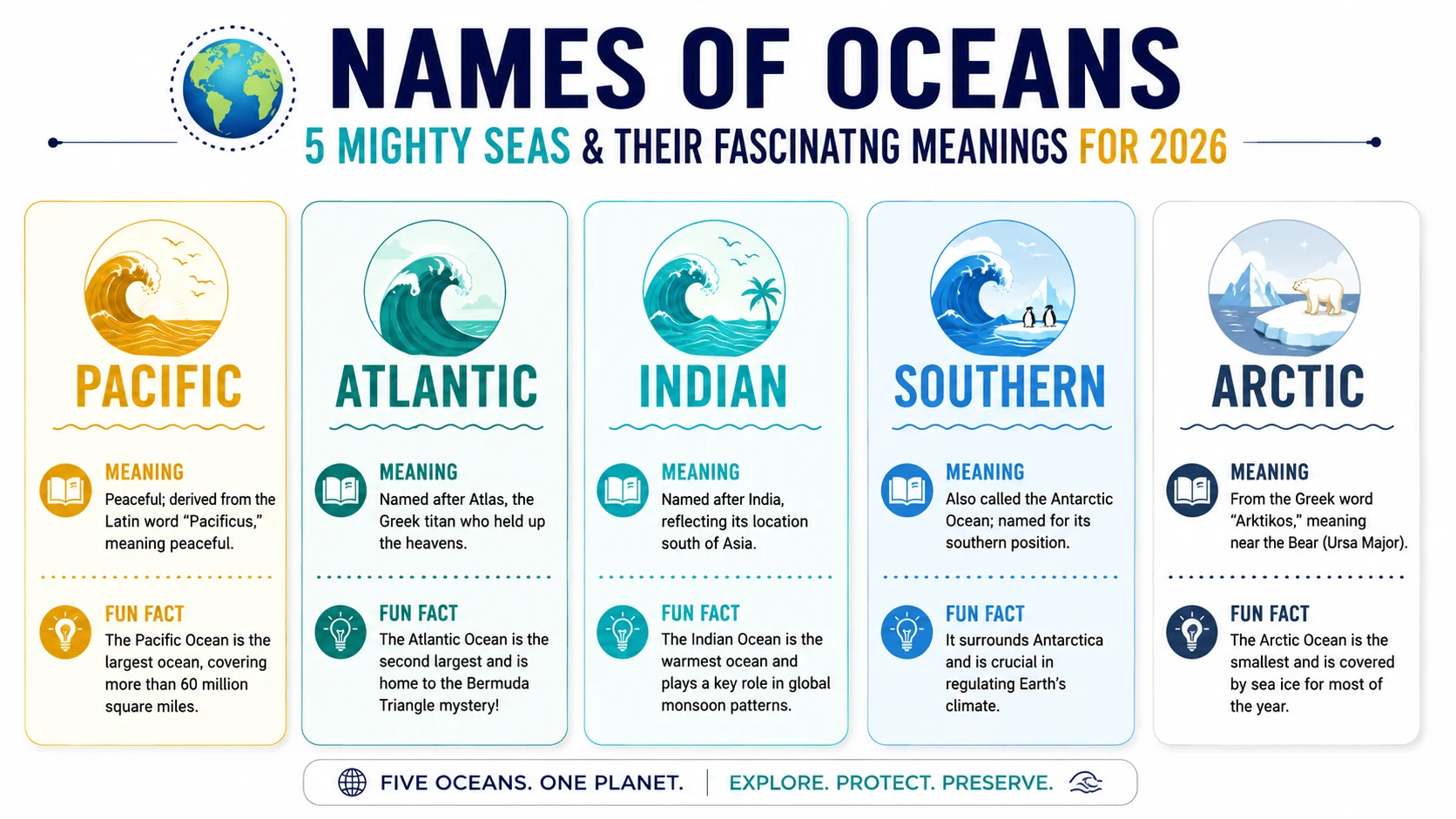
The names of oceans are Pacific, Atlantic, Indian, Southern, and Arctic. The Pacific is the largest, the Arctic is the smallest, and the Southern Ocean was officially recognized in 2000.
The world’s oceans cover most of our planet and play a vital role in climate, weather, marine life, and human life. But can you name the ocean that is the largest, deepest, or warmest? If you are looking for ocean names, you may already know the basics, but there is much more to discover. This guide explains the ocean names in English in a simple and reliable way. You will learn the names of oceans, their locations, key features, and why each one matters. Whether you are a student, teacher, traveler, or simply curious, this guide makes oceans names in English easy to understand. We also explain each ocean name in English with useful facts, so you can confidently name an ocean when needed. If you are also searching for a sea name, you will learn how seas and oceans differ.
Why the Names of Oceans Matter
They connect us to history. Many ocean names come from explorers, myths, and ancient civilizations. Learning about them helps us understand how people viewed the world.
They define our planet. The names of oceans help us distinguish between the massive bodies of water that cover Earth’s surface.
They inspire wonder. There’s something magical about saying “Pacific Ocean” or “Atlantic Ocean.” These names carry the romance of exploration and discovery.
The Five Oceans: Names and Meanings
1. Pacific Ocean
Meaning: “Peaceful Sea”
Origin: Named by Portuguese explorer Ferdinand Magellan in 1520. After sailing through the treacherous Strait of Magellan, he found the ocean remarkably calm and peaceful .
Style: Majestic, Mighty, Expansive
2. Atlantic Ocean
Meaning: “Sea of Atlas”
Origin: Named after the Greek Titan Atlas, who was said to hold up the sky. In Greek mythology, the “Sea of Atlas” was the ocean beyond the Pillars of Hercules (the Strait of Gibraltar) .
Size: The second-largest ocean, covering about 41 million square miles.
Personality: The Atlantic is the highway of the world historically the most traveled ocean for trade and exploration. It’s dynamic, powerful, and full of history.
Style: Historic, Powerful, Connected
Best For: A nickname for someone who connects people and places.
Fun Fact: The Atlantic Ocean is the saltiest of the five oceans .
3. Indian Ocean
Meaning: “Ocean of India”
Origin: Named after the country of India, which has a long coastline along this ocean. It was known as the “Indian Ocean” in ancient times by Greek and Roman geographers .
Size: The third-largest ocean, covering about 27 million square miles.
Personality: The Indian Ocean is warm, culturally rich, and historically significant for trade routes between Africa, Asia, and the Middle East.
Style: Warm, Historic, Culturally Rich
Best For: A nickname for someone who brings different cultures together.
Fun Fact: The Indian Ocean is the warmest of all the oceans .
4. Southern Ocean
Meaning: “Ocean of the South”
Origin: Named for its location at the southernmost part of the Earth. It was officially recognized as the fifth ocean by the International Hydrographic Organization in 2000 .
Size: The second-smallest ocean, covering about 7.8 million square miles. It surrounds Antarctica.
Personality: The Southern Ocean is cold, wild, and mysterious. It’s the most recently recognized ocean and is home to unique wildlife like penguins and seals.
Style: Cold, Wild, Mysterious
Best For: A nickname for someone who’s adventurous and loves the cold.
Fun Fact: The Southern Ocean is the only ocean that completely encircles the globe without being interrupted by land !
5. Arctic Ocean
Meaning: “Ocean of the Arctic” (from the Greek “Arktos,” meaning “bear,” referring to the constellation Ursa Major, the Great Bear)
Size: The smallest ocean, covering about 5.4 million square miles.
Personality: The Arctic Ocean is icy, remote, and fragile. It’s the most vulnerable to climate change and is covered by sea ice for much of the year.
Style: Icy, Remote, Fragile
Fun Fact: The Arctic Ocean is the smallest and shallowest of the five oceans .
Quick Comparison Table: Names of Oceans
| Ocean Name | Meaning | Size | Key Feature |
|---|---|---|---|
| Pacific | “Peaceful Sea” | Largest (60M sq mi) | Ring of Fire, deepest point (Mariana Trench) |
| Atlantic | “Sea of Atlas” | Second-largest (41M sq mi) | Saltiest ocean, major trade route |
| Indian | “Ocean of India” | Third-largest (27M sq mi) | Warmest ocean, rich trade history |
| Southern | “Ocean of the South” | Second-smallest (7.8M sq mi) | Newest recognized ocean, surrounds Antarctica |
| Arctic | “Ocean of the Bear” | Smallest (5.4M sq mi) | Icy, shallow, most fragile |
The History Behind the Names of Oceans
The names of oceans have fascinating origin stories that reflect human exploration and cultural history.
Pacific Ocean
Atlantic Ocean
The name comes from Greek mythology. Atlas, the Titan who held up the sky, was associated with the ocean beyond the Pillars of Hercules (the Strait of Gibraltar). The “Sea of Atlas” became the Atlantic Ocean .
Indian Ocean
- Southern Ocean
The Southern Ocean was officially named as a distinct body of water in 2000. It’s the youngest of the names of oceans and surrounds Antarctica .
Arctic Ocean
Oceanic Nicknames and Cool Facts
Each ocean has its own personality and some fascinating nicknames:
| Ocean | Nickname/ Fun Fact |
|---|---|
| Pacific | The “Peaceful Sea” (despite being anything but peaceful at times!) |
| Atlantic | The “Highway of the World” |
| Indian | The “Warmest Ocean” |
| Southern | The “Wild Ocean” |
| Arctic | The “Frozen Ocean” |
Most Popular Ocean Names Today
Based on searches and cultural references, these are the most popular names of oceans :
- Pacific Ocean – The largest and most famous
- Atlantic Ocean – The most historically significant
- Indian Ocean – The warmest and most culturally rich
- Southern Ocean – The newly recognized ocean
- Arctic Ocean – The smallest and most fragile
Frequently Asked Questions
How many oceans are there in the world?
There are five oceans in the world: the Pacific, Atlantic, Indian, Southern, and Arctic Oceans .
What are the 5 ocean names?
The five names of oceans are Pacific, Atlantic, Indian, Southern, and Arctic .
Which ocean is the largest?
The Pacific Ocean is the largest ocean, covering more than 60 million square miles .Which ocean is the smallest?
The Arctic Ocean is the smallest ocean, covering about 5.4 million square miles .
The Southern Ocean was officially recognized as the fifth ocean by the International Hydrographic Organization in 2000 .
Why is the Pacific Ocean called the “Peaceful Sea”?
Portuguese explorer Ferdinand Magellan named it "Mar Pacifico" (Peaceful Sea) in 1520 because he found its waters calm after his voyage through the Strait of Magellan .Conclusion
The names of oceans Pacific, Atlantic, Indian, Southern, and Arctic are more than just geographical labels. They're stories of exploration, mythology, and the incredible power of our planet's waters.From the mighty Pacific to the fragile Arctic, each ocean has its own personality and significance. They connect continents, support life, and remind us of the vastness of our world.
The next time you look at a map or stand by the sea, remember the names of the oceans and the histories they carry. They’re a reminder of our planet’s beauty and the importance of protecting it.
Which ocean name is your favorite? Share it in the comments below, and don’t forget to share this guide with other geography lovers!

Scarlett Howard is a writer and name enthusiast at NicknameCorner. She creates creative and helpful guides on nicknames, names, usernames and naming ideas, helping readers find meaningful, memorable and unique names for every occasion.