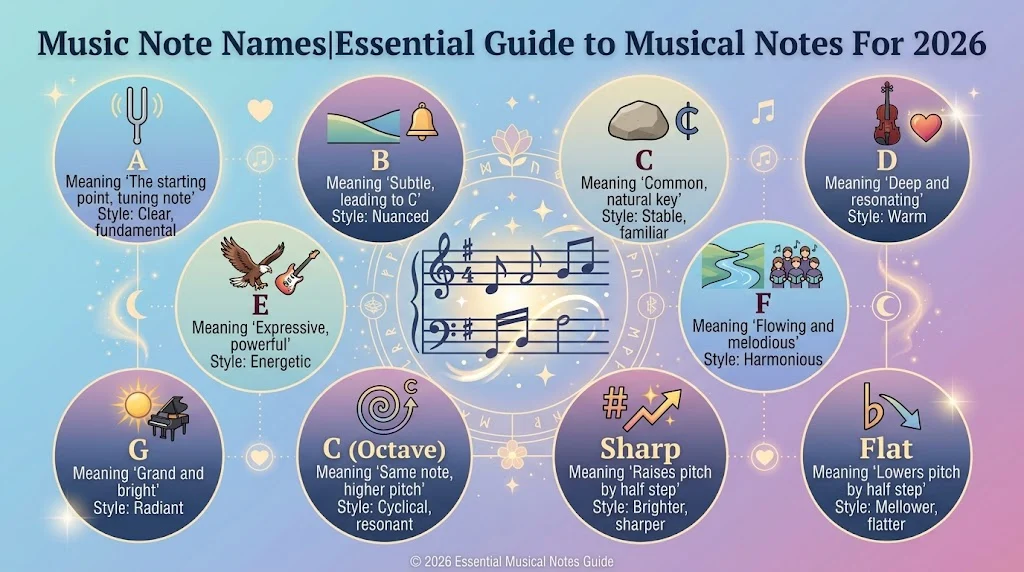
What are the music note names? The seven basic music note names are A, B, C, D, E, F, and G. These notes repeat in a cycle called an octave. Notes can be raised with sharps (♯) or lowered with flats (♭). Together, all twelve notes form the chromatic scale.
Every musician remembers the moment they first learned to read music. It’s like learning a secret code. Suddenly, those black dots on a page make sense. They become sounds. They become songs. And at the heart of that code are the music note names.
There are only seven basic note names in Western music: A, B, C, D, E, F, and G. But those seven notes can create infinite melodies. They can be raised, lowered, combined, and arranged in countless ways. Understanding these music note names is the key to unlocking your musical potential.
This guide explores the ten essential concepts behind music note names. You’ll learn what each note means, where it comes from, and how it fits into the grand tapestry of music. Whether you’re a beginner or just curious, this is your starting point.
10 Essential Music Note Names and Concepts
1. The Note A
Meaning: The first note in the musical alphabet, but not the lowest in pitch.
Origin: From the Latin hymn “Ut queant laxis,” where each line began with a syllable that became a note name. “A” corresponds to “A” in the modern system.
Personality: A is the confident, clear, and stable note. It’s often used as a tuning reference the “A” above middle C vibrates at 440 Hz, the standard concert pitch. A note A is bold, resonant, and full of presence.
Style: Fundamental, Clear, Strong.
Best For: Tuning instruments, starting scales, and establishing a key.
Popularity: Universal used in every musical tradition that uses Western notation.
Emotional Appeal: This note feels reliable, steady, and confident.
Pop Culture Reference: The tuning note for orchestras worldwide.
Similar Notes: G, B, A♯, A♭.
Why It Still Works Today: A is the anchor of Western music, the note everyone tunes to.
2. The Note B
Meaning: The second note in the musical alphabet.
Origin: From the Latin hymn sequence, corresponding to the syllable “B.”
Personality: B is the bright, energetic, and slightly restless note. It has a natural tendency to resolve upward to C. In many scales, B plays a supporting role, adding color and movement.
Style: Bright, Restless, Supportive.
Best For: Creating tension that resolves to C, adding color to chords.
Popularity: Universal in Western music.
Emotional Appeal: This note feels energetic, youthful, and full of potential.
Pop Culture Reference: The B string on a guitar is famous for being the only string tuned differently than the others.
Similar Notes: A, C, B♯, B♭.
Why It Still Works Today: B is essential for creating the leading tone that pulls melodies toward resolution.
3. The Note C
Meaning: The third note in the musical alphabet, but the starting point for most beginners.
Origin: From the Latin hymn, corresponding to the syllable “C.”
Personality: C is the grounded, stable, and welcoming note. Middle C is the central note on the piano, the divide between treble and bass clefs. A note C feels like home calm, clear, and peaceful.
Style: Stable, Warm, Foundational.
Best For: Beginners learning to read music, pianists finding their way on the keyboard.
Popularity: Universal Middle C is the most famous note in music education.
Emotional Appeal: This note feels warm, familiar, and comforting.
Pop Culture Reference: Middle C is the first note most piano students learn.
Similar Notes: B, D, C♯, C♭.
Why It Still Works Today: C major is the simplest key in music, and C is the note that everyone starts with.
4. The Note D
Meaning: The fourth note in the musical alphabet.
Origin: From the Latin hymn sequence, corresponding to the syllable “D.”
Personality: D is the warm, rich, and expressive note. It has a fullness that makes it a favorite for melodies. In the key of D major, the note feels triumphant and joyful. D is often used in folk and classical music.
Style: Warm, Rich, Expressive.
Best For: Melodies, folk tunes, and classical compositions.
Popularity: Universal in Western music.
Emotional Appeal: This note feels warm, full, and emotionally expressive.
Pop Culture Reference: The D string on a violin is often the starting point for beginners.
Similar Notes: C, E, D♯, D♭.
Why It Still Works Today: D is the key of triumph, used in many famous pieces from Beethoven to folk songs.
5. The Note E
Meaning: The fifth note in the musical alphabet.
Origin: From the Latin hymn, corresponding to the syllable “E.”
Personality: E is the bright, brilliant, and clear note. It has a sparkling quality that cuts through an ensemble. In the key of E major, the note feels joyful and celebratory. E is often used for bright, uplifting melodies.
Style: Bright, Brilliant, Clear.
Best For: Bright melodies, happy tunes, and triumphant fanfares.
Popularity: Universal in Western music.
Emotional Appeal: This note feels bright, joyful, and full of life.
Pop Culture Reference: The highest string on a standard guitar is tuned to E.
Similar Notes: D, F, E♯, E♭.
Why It Still Works Today: E is a versatile note that works in countless musical contexts.
6. The Note F
Meaning: The sixth note in the musical alphabet.
Origin: From the Latin hymn sequence, corresponding to the syllable “F.”
Personality: F is the warm, gentle, and slightly melancholic note. It has a softness that makes it perfect for tender melodies. In the key of F major, the note feels peaceful and reflective. F is often used in lullabies and romantic music.
Style: Warm, Gentle, Reflective.
Best For: Soft melodies, lullabies, and romantic pieces.
Popularity: Universal in Western music.
Emotional Appeal: This note feels warm, gentle, and full of tenderness.
Pop Culture Reference: F is a common key for love songs and ballads.
Similar Notes: E, G, F♯, F♭.
Why It Still Works Today: F is a versatile note that adds warmth and depth to any composition.
7. The Note G
Meaning: The seventh and final note in the musical alphabet.
Origin: From the Latin hymn, corresponding to the syllable “G.”
Personality: G is the strong, clear, and commanding note. It has a powerful presence that anchors harmonies. In the key of G major, the note feels bright and optimistic. G is often used in anthems and powerful pieces.
Style: Strong, Clear, Powerful.
Best For: Anthems, powerful melodies, and strong harmonies.
Popularity: Universal in Western music.
Emotional Appeal: This note feels strong, clear, and full of authority.
Pop Culture Reference: The G string on a violin is its lowest string.
Similar Notes: F, A, G♯, G♭.
Why It Still Works Today: G is a foundational note in music, used in countless famous pieces.
8. The Note C (The Octave)
Meaning: The return to the starting note, but higher or lower in pitch.
Origin: From the Latin hymn, “C” is the first note of the scale.
Personality: C is the grounded, stable, and welcoming note. When you go up an octave from Middle C to High C, you’ve completed a full cycle of the musical alphabet. The two notes share a name but sound different in pitch.
Style: Stable, Warm, Foundational.
Best For: Completing scales, marking the end of an octave.
Popularity: Universal the octave is a fundamental concept in music.
Emotional Appeal: This note feels like a homecoming, a return to the beginning.
Pop Culture Reference: “Somewhere Over the Rainbow” famously jumps a full octave.
Similar Notes: B, D, C♯, C♭.
Why It Still Works Today: Understanding the octave is essential for reading music and playing by ear.
9. The Note Sharp (♯)
Meaning: A symbol that raises a note by one semitone (half step).
Origin: From the Latin “diesis,” meaning “difference.”
Personality: Sharp is the note that adds tension, brightness, and edge. When you play a sharp, you’re raising the pitch, adding energy to the music.
Style: Bright, Tense, Energetic.
Best For: Adding tension, modulating to new keys, creating excitement.
Popularity: Universal in Western music.
Emotional Appeal: This note feels energetic, bright, and full of tension.
Pop Culture Reference: The song “Sharp Dressed Man” by ZZ Top.
Similar Notes: A♯, C♯, D♯, F♯, G♯.
Why It Still Works Today: Sharps are essential for creating tension and modulating between keys.
10. The Note Flat (♭)
Meaning: A symbol that lowers a note by one semitone (half step).
Origin: From the Latin “mollis,” meaning “soft.”
Personality: Flat is the note that adds warmth, softness, and relaxation. When you play a flat, you’re lowering the pitch, softening the sound and adding a touch of melancholy.
Style: Warm, Soft, Melancholic.
Best For: Creating warmth, softening melodies, adding emotion.
Popularity: Universal in Western music.
Emotional Appeal: This note feels warm, soft, and slightly sad.
Pop Culture Reference: The song “Flat on the Floor” by Carrie Underwood.
Similar Notes: A♭, B♭, D♭, E♭, G♭.
Why It Still Works Today: Flats are essential for creating warmth and emotional depth in music.
Quick Comparison Table
| Note Name | Meaning | Style | Best For |
|---|---|---|---|
| A | First note in the alphabet | Clear, Strong | Tuning, establishing keys |
| B | Second note | Bright, Restless | Creating tension, resolving to C |
| C | Third note, Middle C | Stable, Warm | Beginners, piano players |
| D | Fourth note | Warm, Expressive | Melodies, folk tunes |
| E | Fifth note | Bright, Brilliant | Uplifting melodies, fanfares |
| F | Sixth note | Gentle, Reflective | Lullabies, romantic music |
| G | Seventh note | Strong, Powerful | Anthems, harmonies |
| C (Octave) | Return to the start | Stable, Foundational | Completing scales |
| Sharp (♯) | Raises pitch | Bright, Tense | Adding tension, modulation |
| Flat (♭) | Lowers pitch | Warm, Soft | Adding warmth, emotion |
How Music Note Names Work
Music note names follow a simple pattern. There are only seven letters used: A, B, C, D, E, F, and G. After G, the pattern repeats, starting again at A. This repeating pattern is called an octave.
Here’s how it works:
- The Musical Alphabet: A, B, C, D, E, F, G. Then it repeats.
- Sharps and Flats: Between most notes, there’s an “in-between” note. You can raise a note with a sharp (♯) or lower it with a flat (♭).
- The Chromatic Scale: When you include all the sharps and flats, you get twelve notes in an octave. This is called the chromatic scale.
- Solfege: In some musical traditions, notes are also named with syllables: Do, Re, Mi, Fa, Sol, La, Ti. These correspond to C, D, E, F, G, A, B.
Understanding these basics is the first step to reading music, playing by ear, and composing your own songs.
How to Choose the Right Note for Your Melody
Choosing the right note is about more than just pitch. It’s about emotion, context, and expression. Here are some tips to help you choose the right note for your melody.
- Consider the Mood: Want a bright, happy sound? Go for E or G. Want something warm and gentle? Try F or D. Let the emotion guide you.
- Think About the Key: Every key has a home note. In C major, that’s C. In G major, that’s G. The home note feels stable and resolved.
- Use Tension and Release: Sharps create tension. Flats add warmth. Use them to create interest in your melody.
- Trust Your Ear: At the end of the day, the best note is the one that sounds right to you. Trust your instincts and let your ear guide you.
Most Popular Music Notes Today
Some of the most commonly used notes in Western music include:
- C: The starting note for beginners.
- G: A foundational note in many keys.
- D: The key of triumph and joy.
- A: The tuning note for orchestras.
- E: The bright, brilliant note.
These notes are popular because they are versatile and easy to work with.
Vintage Music Note Names Making a Comeback
Some traditional note naming systems are being rediscovered:
- Solfege (Do, Re, Mi): Used in many music education systems.
- Ut, Re, Mi: The original Latin hymn names.
- Tonic Sol-fa: A system popular in the 19th century.
- Numbered Notation: Used in some folk and traditional music.
- Shape Notes: A system used in American shape-note singing.
These systems offer alternative ways to understand and teach music.
Modern Music Note Name Trends
Today’s trends in music note names reflect broader changes in music education:
- Digital Notation: Apps and software make learning note names easier than ever.
- Global Influence: Musicians are exploring note names from non-Western traditions.
- Simplified Learning: Teachers are using color-coded and mnemonic devices to help beginners.
- Accessibility: Online resources make music theory available to everyone.
Frequently Asked Questions
What are the music note names?
The seven basic music note names are A, B, C, D, E, F, and G. These notes repeat in a cycle called an octave, and they can be raised with sharps (♯) or lowered with flats (♭).
How many music notes are there?
There are seven basic note names in Western music: A, B, C, D, E, F, and G. When you include sharps and flats, there are twelve notes in an octave.
What is the difference between sharp and flat notes?
A sharp (♯) raises a note by one semitone (half step). A flat (♭) lowers a note by one semitone. For example, C♯ is one semitone higher than C, and C♭ is one semitone lower.
What is an octave?
An octave is the interval between one musical pitch and another with double its frequency. The notes at either end of an octave share the same name. For example, Middle C and High C are one octave apart.
What is Middle C?
Middle C is the C note near the center of a piano keyboard. It’s called “middle” because it’s roughly in the middle of the range of pitches used in music. It’s the first note most beginners learn.
What is the chromatic scale?
The chromatic scale is a musical scale with twelve pitches, each a semitone apart. It includes all the notes in an octave, including sharps and flats.
What is solfege?
Solfege is a system of naming notes using syllables: Do, Re, Mi, Fa, Sol, La, Ti. It’s used in many music education systems around the world.
Why do notes have different names in different countries?
Different musical traditions use different naming systems. For example, in some countries, notes are named using solfege syllables (Do, Re, Mi) instead of letters (C, D, E).
Conclusion
Understanding music note names is the first step to unlocking the world of music. Whether you’re learning to play an instrument, writing your own songs, or just appreciating the music you love, knowing the names of the notes gives you a deeper connection to the art form.
The music note names we’ve explored A, B, C, D, E, F, G, plus sharps, flats, and the octave are the building blocks of everything musical. We hope this guide has helped you understand these essential concepts. Share this article with someone who might be learning music, and let us know in the comments which note is your favorite!

Scarlett Howard is a writer and name enthusiast at NicknameCorner. She creates creative and helpful guides on nicknames, names, usernames and naming ideas, helping readers find meaningful, memorable and unique names for every occasion.