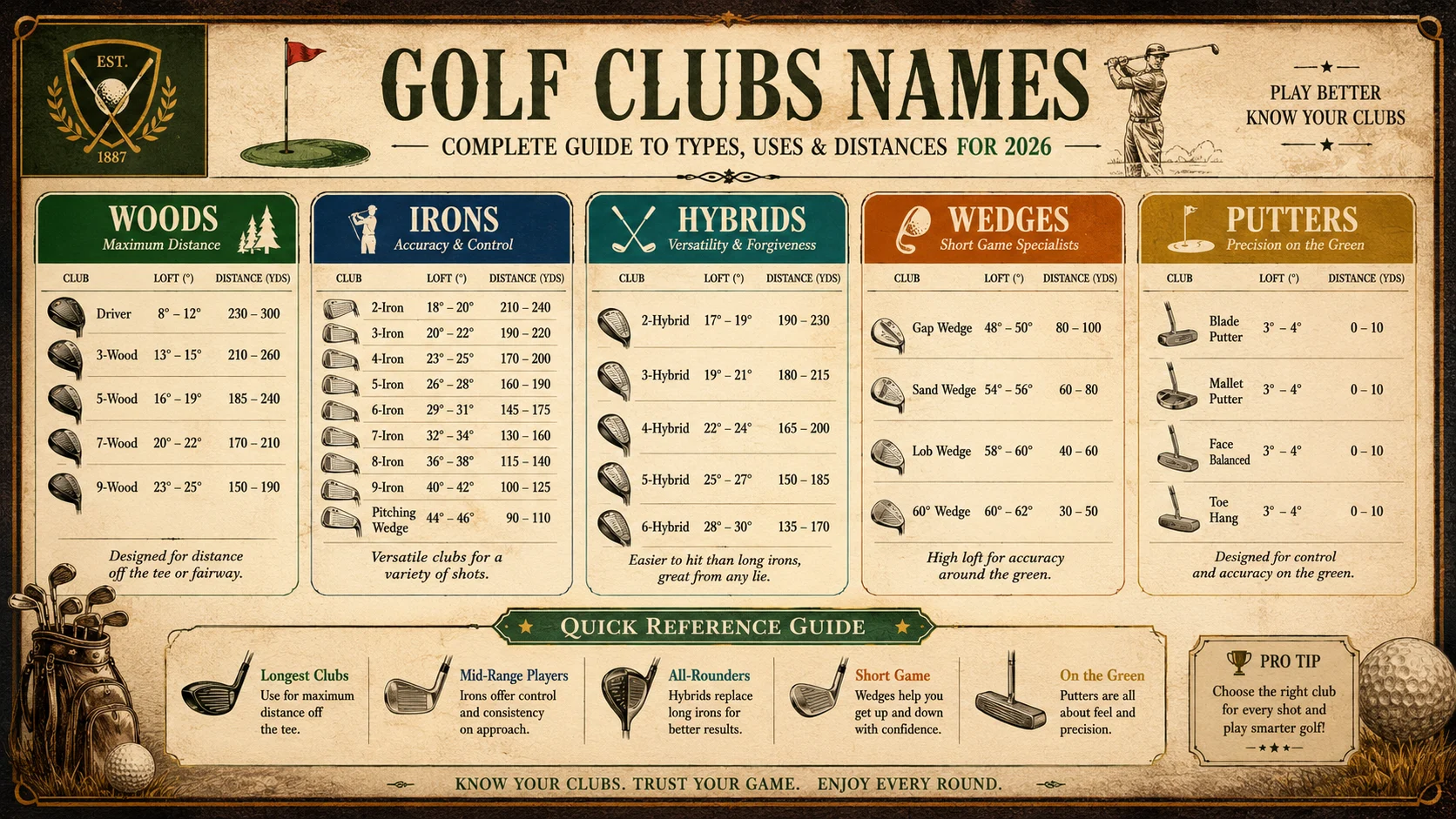
Golf clubs names include the driver (longest shots), fairway woods (3-wood, 5-wood), irons (3-iron through 9-iron), hybrids (easier than long irons), wedges (pitching, gap, sand, lob), and putter (on the green). Each club serves a unique purpose.
Whether you’re standing on the first tee or browsing the pro shop, knowing your golf clubs names is essential. From the powerful driver to the precise putter, each club in your bag has a specific purpose.
In this comprehensive guide, we’ll explore every golf clubs name you need to know. You’ll discover the meaning behind each club, its history, and exactly when to use it. We’ll cover woods, irons, hybrids, wedges, and putters everything from the driver to the lob wedge.
So grab your favorite club, and let’s dive in!
What Are the Different Types of Golf Clubs
Before we explore specific golf clubs names, it’s helpful to understand the main categories. Every golfer is allowed to carry up to 14 clubs in their bag, and each one serves a unique purpose.
| Category | Purpose | Examples |
|---|---|---|
| Woods | Long-distance shots from tee or fairway | Driver, 3-wood, 5-wood |
| Irons | Versatile clubs for various distances | 3-iron through 9-iron |
| Hybrids | Cross between woods and irons | 3-hybrid, 4-hybrid, 5-hybrid |
| Wedges | Short approach shots and bunker play | Pitching wedge, sand wedge, lob wedge |
| Putters | Rolling the ball on the green | Blade, mallet, center-shafted |
The Complete List of Golf Clubs Names
Here’s a comprehensive breakdown of every golf clubs name you’ll encounter:
1. Driver
Meaning
The club used to hit the longest shots off the tee.
Origin
Originally called a “brassie” in the 1800s when clubs were made of wood with brass soles. The term “driver” became common in the early 1900s.
Personality
The driver is bold, powerful, and confident. It’s the club that announces your presence on the first tee.
Style
Modern, Powerful, Aggressive
Best For
Tee shots on par-4 and par-5 holes where maximum distance is needed.
Popularity
The driver is the most iconic and recognizable golf clubs name. It’s the club every golfer wants to hit well.
Emotional Appeal
There’s nothing quite like the feeling of a well-struck drive. It’s pure power and precision.
Similar Names
1-wood, Big Dog, The Big Stick
Why It Still Works Today
The driver represents power and confidence. Every golfer dreams of crushing one down the middle.
2. Fairway Wood (3-Wood, 5-Wood, 7-Wood)
Meaning
Woods designed to be hit from the fairway (or occasionally off the tee).
Origin
The numbers (3, 5, 7) represent the loft angle. Lower numbers have less loft and travel further.
Personality
Fairway woods are reliable, versatile, and forgiving. They’re the workhorses of the long game.
Style
Classic, Versatile, Dependable
Best For
Long approach shots into greens, or tight tee shots where the driver is too much.
Popularity
The 3-wood is the second most commonly used golf clubs name after the driver.
Emotional Appeal
A well-struck fairway wood is both powerful and graceful.
Similar Names
3-metal, Spoon (an old name for the 3-wood)
Why It Still Works Today
Fairway woods offer the perfect balance of distance and control.
3. Irons (3-Iron through 9-Iron)
Meaning
Clubs with angled faces used for approach shots and from the fairway or rough.
Origin
“Iron” comes from the metal used to make the clubhead. The numbering system (3 through 9) indicates decreasing loft and increasing distance.
Personality
Irons are precise, demanding, and rewarding. They separate good golfers from great ones.
Style
Classic, Technical, Precise
Best For
Approach shots to the green, shots from the rough, and punch shots.
Popularity
Irons are the most numerous clubs in the bag, making them essential golf clubs names to know.
Emotional Appeal
A pure iron shot is one of the most satisfying feelings in golf.
Similar Names
Long irons (3-4), Mid irons (5-7), Short irons (8-9)
Why It Still Works Today
Irons offer precision and control that no other clubs can match.
4. Hybrid (3-Hybrid, 4-Hybrid, 5-Hybrid)
Meaning
A cross between a wood and an iron, designed to be more forgiving than long irons.
Origin
First introduced in the early 2000s, hybrids have become increasingly popular as an alternative to traditional long irons.
Personality
The hybrid is forgiving, versatile, and easy to hit. It’s a modern solution to a classic problem.
Style
Modern, Versatile, Forgiving
Best For
Replacing long irons (3-iron, 4-iron, 5-iron) for higher launch and easier hitting.
Popularity
Hybrids are one of the most popular golf clubs names among amateur golfers.
Emotional Appeal
Hybrids take the fear out of long approach shots.
Similar Names
Rescue club, Utility club, Driving iron
Why It Still Works Today
Hybrids make the game easier and more enjoyable for golfers of all skill levels.
5. Pitching Wedge (PW)
Meaning
A wedge designed for short approach shots with moderate loft (usually 44-48°).
Origin
“Pitching” refers to the type of shot a high, short shot that stops quickly on the green.
Personality
The pitching wedge is reliable, versatile, and the most used wedge in the bag.
Style
Classic, Versatile, Dependable
Best For
Approach shots from 100-130 yards, chip shots around the green.
Popularity
The pitching wedge is the most common wedge golf clubs name and is usually included in every iron set.
Emotional Appeal
The pitching wedge is the go-to club for getting close to the pin.
Similar Names
PW, Gap wedge (sometimes replaces a pitching wedge)
Why It Still Works Today
The pitching wedge is essential for every golfer from beginners to pros.
6. Sand Wedge (SW)
Meaning
A wedge designed for escaping bunkers, with a wide flange and heavy bounce (usually 54-56°).
Origin
Designed specifically to help golfers escape sand traps. The wide sole helps the club glide through sand.
Personality
The sand wedge is the rescuer. It gets you out of trouble when nothing else will.
Style
Specialized, Forgiving, Reliable
Best For
Bunker shots, short approach shots, and chips from thick rough.
Popularity
The sand wedge is one of the most important golf clubs names for any golfer.
Emotional Appeal
The sand wedge turns a potential disaster into an opportunity.
Similar Names
SW, Sandy
Why It Still Works Today
Every course has bunkers, and the sand wedge is the best tool for the job.
7. Lob Wedge (LW)
Meaning
A high-lofted wedge (usually 58-64°) used for short, high shots that stop quickly.
Origin
“Lob” describes the type of shot a very high, short pitch that lands softly.
Personality
The lob wedge is the finesse club. It’s all about touch and precision.
Style
Specialized, Precision, Touch
Best For
Short approach shots, flop shots over bunkers, and delicate chips.
Popularity
The lob wedge is a favorite golf clubs name among skilled players who want to attack pins.
Emotional Appeal
The lob wedge allows you to be creative around the greens.
Similar Names
LW, 60-degree, Flop wedge
Why It Still Works Today
The lob wedge gives skilled players the ability to attack tight pins.
8. Gap Wedge (GW) or Approach Wedge (AW)
Meaning
A wedge with loft between the pitching wedge and sand wedge (usually 50-52°).
Origin
“Gap” refers to the distance gap between the pitching wedge and sand wedge.
Personality
The gap wedge fills the void. It’s the unsung hero of the short game.
Style
Specialized, Versatile, Precise
Best For
Full approach shots from 90-110 yards, and longer chip shots.
Popularity
The gap wedge is an increasingly popular golf clubs name among better players.
Emotional Appeal
The gap wedge takes the guesswork out of those in-between distances.
Similar Names
AW (Approach Wedge), GW, Utility wedge
Why It Still Works Today
The gap wedge solves the distance gap problem for modern golfers.
9. Putter
Meaning
The club used on the green to roll the ball into the hole.
Origin
“Putting” comes from the Scottish word “putt,” meaning to strike or push.
Personality
The putter is the most personal club in the bag. It’s all about feel, touch, and confidence.
Style
Specialized, Personal, Precise
Best For
Putting on the green. The putter is the most used club in the bag.
Popularity
The putter is the most important golf clubs name it’s the club that saves strokes.
Emotional Appeal
The putter is where the game is won or lost. It’s the club that makes champions.
Similar Names
Flatstick, Putter, Blade, Mallet
Why It Still Works Today
Every golfer knows that “drive for show, putt for dough.”
10. Bump and Run (Specialty Wedge)
Meaning
A low-lofted wedge used for low-running chip shots.
Origin
“Bump and run” describes the shot type a low chip that runs toward the hole.
Personality
The bump and run wedge is practical, reliable, and low-risk.
Style
Practical, Reliable, Low-Risk
Best For
Chip shots from around the green where there’s lots of green to work with.
Popularity
This is a less common but useful golf clubs name for short-game specialists.
Emotional Appeal
The bump and run takes the pressure off short chips.
Similar Names
Chipper, Chip wedge, Run-up wedge
Why It Still Works Today
The bump and run is a simple, effective way to get close to the pin.
Quick Comparison Table
| Club Name | Loft (Approx.) | Best Use | Skill Level |
|---|---|---|---|
| Driver | 8-12° | Off the tee | All levels |
| 3-Wood | 13-17° | Fairway/tee | All levels |
| 5-Wood | 18-22° | Fairway/tee | All levels |
| 3-Iron | 18-21° | Fairway | Advanced |
| 4-Iron | 21-24° | Fairway | Advanced/Intermediate |
| 5-Iron | 24-27° | Fairway | Intermediate |
| 6-Iron | 27-30° | Fairway | Intermediate |
| 7-Iron | 30-33° | Fairway | All levels |
| 8-Iron | 33-36° | Approach | All levels |
| 9-Iron | 36-40° | Approach | All levels |
| Pitching Wedge | 44-48° | Approach | All levels |
| Gap Wedge | 50-52° | Approach | Intermediate/Advanced |
| Sand Wedge | 54-56° | Bunker/approach | All levels |
| Lob Wedge | 58-64° | Short approach | Intermediate/Advanced |
| Putter | 3-4° | Putting | All levels |
How to Choose the Right Golf Clubs
Choosing the right golf clubs names can be overwhelming. Here’s a simple guide:
1. Consider Your Skill Level
- Beginners: Start with a driver, fairway woods (3 & 5), hybrids (4 & 5), irons (6-9), pitching wedge, sand wedge, and putter.
- Intermediate: Add a gap wedge and lob wedge for more options around the green.
- Advanced: You may prefer specific combinations and specialty clubs.
2. Think About Your Game
- If you struggle with long irons, consider more hybrids.
- If you’re confident with wedges, add a lob wedge.
- If you’re a longer hitter, you may need more wedge options.
3. Get Fitted
Club fitting can dramatically improve your game. Professional fitters will help you find the right shafts, lie angles, and lengths.
4. Test Before You Buy
Always test clubs before purchasing. What works for one player may not work for another.
Frequently Asked Questions
What are the basic golf clubs names?
The basic golf clubs names are driver, fairway woods (3-wood, 5-wood), irons (3-iron through 9-iron), wedges (pitching, gap, sand, lob), and putter.
How many clubs can you carry?
You can carry up to 14 clubs in your bag under official rules.
What is the difference between a wood and an iron?
Woods have larger clubheads and lower lofts for longer distance. Irons have smaller heads and higher lofts for precision and control.
What is a hybrid club?
A hybrid combines features of a wood and an iron. It’s easier to hit than a long iron and more versatile than a fairway wood.
Which club should I use from the tee?
The driver is the most common choice for tee shots on par-4 and par-5 holes. For shorter or tighter holes, use a 3-wood or hybrid.
What is the most important club?
The putter is the most used club and where the most strokes are saved. However, every club serves an important purpose.
Conclusion
Understanding golf clubs names is the foundation of learning the game. From the powerful driver to the precise putter, each club has a name, a purpose, and a personality.
Whether you’re a beginner learning the basics or a seasoned player refining your game, knowing your clubs will help you make better decisions on the course. Remember, it’s not just about hitting the ball it’s about choosing the right tool for the job.
So next time someone asks you about golf clubs names, you’ll be ready with the answer. And who knows you might even impress your playing partners with your knowledge.
Which club is your favorite? Share it in the comments below, and don’t forget to share this guide with your golf buddies!

Benjamin Clarke is a writer and nickname enthusiast at NicknameCorner.com, where he helps readers discover creative, meaningful, funny and unique nicknames for people, pets, usernames and special occasions. His content focuses on practical ideas, clear explanations and nickname inspiration that makes choosing the perfect name easier.