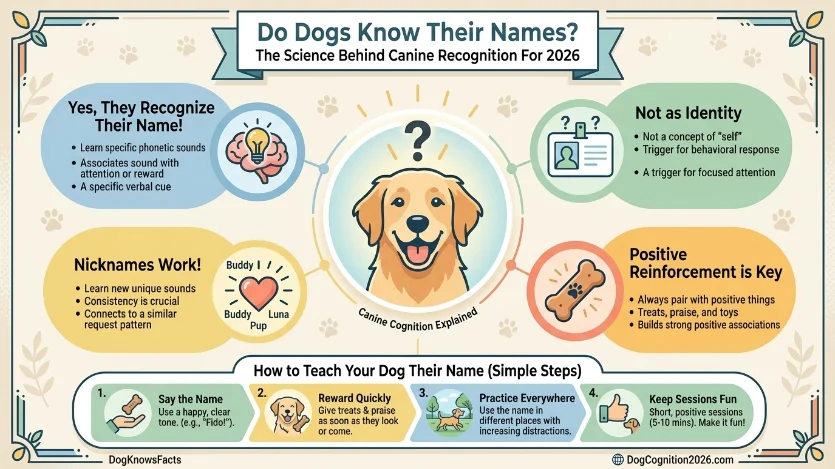
Do dogs know their names? Yes, most dogs can learn and recognize their name as a meaningful word, especially when consistently paired with positive attention and rewards . However, unlike humans, they don’t understand it as a label of self-identity they recognize it as a sound cue that signals something rewarding is about to happen .
Every dog owner has experienced that magical moment. You call your dog’s name, and they respond with a perky head tilt, a wagging tail, or come running from across the room. It feels like proof that your dog knows their name and understands they’re being addressed.
But what’s really going on in your dog’s mind? This question has puzzled pet owners and researchers alike. Do dogs know their names in the way we understand our own names as a label for our identity? Or is it something more basic, like a learned cue that means “pay attention because something good is coming”?
Science has some fascinating answers. Research shows that most dogs living in human homes likely understand around 70-80 words, with some super dogs learning up to 250 . Their mental ability is often compared to that of a 2-year-old child . But understanding words and understanding identity are two different things.
In this article, we’ll explore what science reveals about whether dogs know their names, how they learn them, and what it means for how you communicate with your furry friend.
10 Things Every Dog Owner Should Know About Canine Name Recognition
1. Yes, Dogs Recognize Their Names
The short answer to the question “do dogs know their names” is yes. Dogs can learn and recognize their name as a meaningful word, especially when it’s consistently paired with positive attention and rewards . According to a study from the University of Lincoln, dogs can identify their own name even when it’s buried in a sentence and delivered in a monotone voice .
Dr. Holly Root-Gutteridge, a Postdoctoral Research Fellow at the University of Lincoln, explained that dogs “could absolutely find their name when presented in a monotone way and buried in a stream of irrelevant speech.” She added that this ability recognizing a specific word among others is “a prerequisite for comprehending language and shows how good they are at listening to us” .
The study found that dogs understand the sound pattern of their name, not just the happy tone we often use when saying it. They can pick out their name from other words, even without the emotional cues we typically provide .
Style: Scientific, Informative
Popularity: A widely supported finding from peer-reviewed research
Why It Matters: This confirms that dogs have a genuine ability to recognize their name as a distinct word, not just a sound.
2. Dogs Learn Their Names Through Association
So how do dogs learn their names? Through a process called classical conditioning. Initially, your dog’s name is just another sound. But over time, through consistent repetition, they learn to associate that specific sound with positive outcome streats, attention, walks, or affection .
Animal behaviorist Petrina Firth explains that dogs “know that if they pay attention to you when you say that word, it’s going to be rewarding for them” . This is why reinforcing the name with positivity is so important for building a strong association.
Initially, your dog’s name is just another word. But through repetition and rewards, they come to associate it with positive responses from you .
Style: Scientific, Practical
Popularity: A well-established concept in canine training
Why It Matters: Understanding how dogs learn helps you train them more effectively.
3. Dogs Don’t Understand Names as Identity
Here’s where things get interesting. While dogs clearly recognize their names, researchers believe they don’t understand them as a label of self-identity the way humans do .
Sian Lawley-Rudd, an ethical dog trainer, explains: “We know our name is our name and refers to ourselves, whereas dogs do not know themselves they don’t identify with a name in the same way we do” .
Classic experiments like the mirror test have shown that dogs don’t recognize their own reflection as themselves they often react to it as if it’s another dog . This suggests they lack the same level of self-awareness that humans possess. However, another study found dogs do recognize themselves by smell .
Style: Thoughtful, Science-Based
Popularity: Supported by behavioral research
Why It Matters: Understanding this distinction helps set realistic expectations for your dog’s cognitive abilities.
4. Dogs Can Learn the Names of Other People and Objects
Dogs are pattern-driven creatures, and their learning ability goes far beyond just their own name. “I do it with my own dog and she knows Nanny and Grandad by name we have taught her because those two people appear when those words are said,” says Sian Lawley-Rudd .
If you mention the names of other family members or beloved dog friends, your dog may show excitement or anticipation. This demonstrates that dogs can learn the meaning of many different words through consistent association.
One famous study documented a Border Collie named Chaser who had learned the proper-noun names of 1,022 different objects . This shows just how powerful canine associative learning can be.
Style: Awe-Inspiring, Evidence-Based
Popularity: Supported by well-known scientific studies
Why It Matters: Your dog’s ability to learn vocabulary is more impressive than you might realize.
5. Dogs Respond to Nicknames Too
If you call your dog by a shortened version of their name or a silly nickname, you’re not alone. The good news is that dogs can learn and respond to nicknames as well .
According to a 2020 study, dogs process speech differently based on how familiar the word sounds. When you use a nonsense word that sounds completely different from known words, a dog’s brain processes it quickly as something new. However, words that sound similar to familiar commands are often interpreted as the known word .
“Most pet parents call their dogs all sorts of nicknames that they will respond to,” notes one expert . This is because nicknames often share similar sound patterns with their actual name, helping the dog recognize them as a cue.
Style: Encouraging, Practical
Popularity: A common observation among dog owners
Why It Matters: You don’t have to feel guilty about using those adorable pet names!
6. Positive Reinforcement Is Key
The most effective way to teach your dog their name and any words is through positive reinforcement. When you consistently say your dog’s name and reward them with attention, treats, or affection, you’re building a strong positive association .
Petrina Firth advises: “When a dog pays attention after you say its name, you should reward the dog with a treat every time” . This approach ensures your dog remains eager to respond when called.
Style: Action-Oriented, Helpful
Popularity: A foundational principle in modern dog training
Why It Matters: The right training approach makes all the difference.
7. Avoid Poisoning the Recall
One of the most common mistakes dog owners make is using their dog’s name in frustration or as a reprimand. This can “poison” the name association and make your dog less likely to respond .
A lot of dogs will end up thinking their name is ‘No,'” warns Petrina Firth. If you say their name in frustration, they might start anticipating punishment and avoiding you even more. We call this poisoning the recall” .
The advice from both behavior experts is consistent: don’t use your dog’s name as a cue to come. Instead, use it to get your dog’s attention and indicate they should await further instruction .
Style: Cautionary, Practical
Popularity: An important warning from animal behaviorists
Why It Matters: Protecting your dog’s positive association with their name is crucial for good communication.
8. Dogs Listen for Their Name in Sentences
You might have noticed your dog perking up when they hear their name mentioned in a conversation, even when you’re not directly talking to them. This isn’t your imagination.
A groundbreaking study from the University of Lincoln and the University of Sussex found that dogs actually “listen in” when we are speaking, even if the speech is not directed at them . The researchers discovered that dogs “possess the neurological capacity to passively sift through information and commands relevant to them when humans are talking” .
This means your dog is quietly paying attention to your words all the time, looking for familiar sounds that matter to theme specially their name.
Style: Fascinating, Research-Based
Popularity: A recent scientific discovery from 2025
Why It Matters: It reveals just how attentive dogs are to human speech.
9. Dogs Process Tone as Well as Words
Dogs are experts at reading our emotions, and the way we say words is just as important to them as the words themselves. They pay closer attention when we use what researchers call “dog-directed speech” the happy, high-pitched tone often called “baby talk” for dogs .
The Lincoln study found that while dogs can recognize their name even in a monotone, they pay “more attention if you give them both cues,” meaning their name combined with an eager, happy tone. So, “Sheba, come on then” gets more attention from your dog if you sound excited to see them .
Style: Engaging, Science-Backed
Popularity: A key finding from recent canine cognition research
Why It Matters: Using a warm, excited tone when calling your dog can make them much more responsive.
10. Dogs Know More Words Than You Think
According to the American Psychological Association, most dogs can understand more than 150 words, and their mental ability is close to that of a 2-year-old child . The smartest dogs, also called “super dogs,” can learn up to 250 words .
Studies have shown that dogs can learn names and other words within one week . This means your dog is likely understanding far more of what you say than you might realize especially when it comes to their name and other familiar, important words.
Style: Encouraging, Informative
Popularity: Supported by the American Psychological Association
Why It Matters: Recognizing your dog’s intelligence can deepen your bond and improve your communication.
Quick Comparison Table
| Aspect | What Dogs Can Do | What They Can’t Do |
|---|---|---|
| Name Recognition | Recognize name as a distinct sound cue | Understand name as a label of self-identity |
| Learning Method | Learn names through repetition and association | Understand the origin or meaning of words |
| Language Processing | Recognize up to 150-250 words | Comprehend complex grammar or sentence structure |
| Self-Awareness | Understand that a name signals attention | Recognize their name refers to “me” as an individual |
| Response | React to name in different contexts and tones | Respond to name as a “come” command without training |
How to Tell If Your Dog Knows Their Name
Wondering if your dog truly knows their name? Here are some signs to look for:
- Head Perking Up: When you say their name, your dog lifts their head and points it in your direction .
- Wagging Tail: Tail wags are a clear sign of excitement and recognition .
- Coming When Called: They come running, even when they’re not already looking at you .
- Ears Alert: Your dog’s ears perk up at the sound of their name .
- Differentiating from Other Words: They show a stronger response to their name than to other similar-sounding words .
How to Teach a Dog Their Name
Whether you’re working with a new puppy or an adopted dog, here’s how to teach name recognition effectively:
- Use Positive Reinforcement: “When a dog pays attention after you say its name, you should reward the dog with a treat every time,” advises Petrina Firth . Over time, you can adjust the reward pattern.
- Practice in Different Settings: Say their name in various scenarios with consistent rewards so they learn to respond anywhere .
- Avoid Negative Associations: “Be sure to keep in mind that reinforcement can also become negative, especially when your pup’s name is said with frustration,” warns Firth .
- Don’t Use Their Name to Mean “Come”: Use their name as an attention-getter, not a recall cue. “Your dog’s name should be just that their name, and a cue to pay attention for what’s next” .
Frequently Asked Questions
Do dogs actually know their names?
Yes, dogs can learn and recognize their name as a meaningful word, especially when consistently paired with positive attention and rewards . However, unlike humans, they don’t understand it as a label of self-identity they recognize it as a sound cue that signals attention or a reward is coming .
How do dogs learn their names?
Dogs learn their names through a process called classical conditioning. When you say their name and give them a treat, attention, or praise, they associate the sound with that positive outcome . Research shows dogs can learn names within one week with consistent practice .
Do dogs recognize nicknames?
Yes, most dogs can recognize nicknames . Since nicknames often share similar sound patterns with their actual name, dogs can learn to respond to them. “Most pet parents call their dogs all sorts of nicknames that they will respond to” .
Do dogs think their name is a command?
Dogs don’t inherently understand their name as a command, but they can learn to interpret it that way through training. The name is best used as a cue for attention, not as a stand-alone recall command . Using the name in frustration can poison the association, making dogs less responsive .
Can dogs hear their name in sentences?
Yes. A 2025 study from the University of Lincoln found that dogs “could absolutely find their name when presented in a monotone way and buried in a stream of irrelevant speech” . They’re constantly listening for familiar and important words.
How many words can a dog understand?
According to the American Psychological Association, most dogs can understand more than 150 words, and their mental ability is comparable to a 2-year-old child . The smartest dogs can learn up to 250 words .
Why does my dog ignore me when I call their name?
There are a few reasons this might happen: your dog may not have had enough reinforcement, may have learned to associate their name with something negative, or may be distracted. Consistent positive reinforcement and avoiding “poisoning the recall” can help .
Do all dogs know their names?
Not all dogs know their names automatically. Dogs who enter shelters as strays usually don’t recognize the name the shelter gives them, as it’s not repeated enough . Dogs in homes with consistent use of their name are more likely to know it .
Conclusion
So, do dogs know their names? The answer is a qualified yes. Dogs clearly recognize their names as meaningful sounds that signal attention, engagement, and often something positive. They can pick their name out of a sentence, respond to nicknames, and understand far more words than we might realize .
However, the way dogs understand their names is different from how humans do. They don’t grasp the concept of identity or selfhood your dog doesn’t think of their name as “me” in the way you think of your own name. Instead, it’s a sound cue that means “you’re being addressed, and something good might happen next” .
Understanding this distinction can transform how you communicate with your dog. By using their name as an attention-grabber, reinforcing it with positivity, and avoiding frustration, you can build a stronger bond and better communication with your furry best friend.
What name does your dog respond to? Share your experience in the comments below!

Scarlett Howard is a writer and name enthusiast at NicknameCorner. She creates creative and helpful guides on nicknames, names, usernames and naming ideas, helping readers find meaningful, memorable and unique names for every occasion.