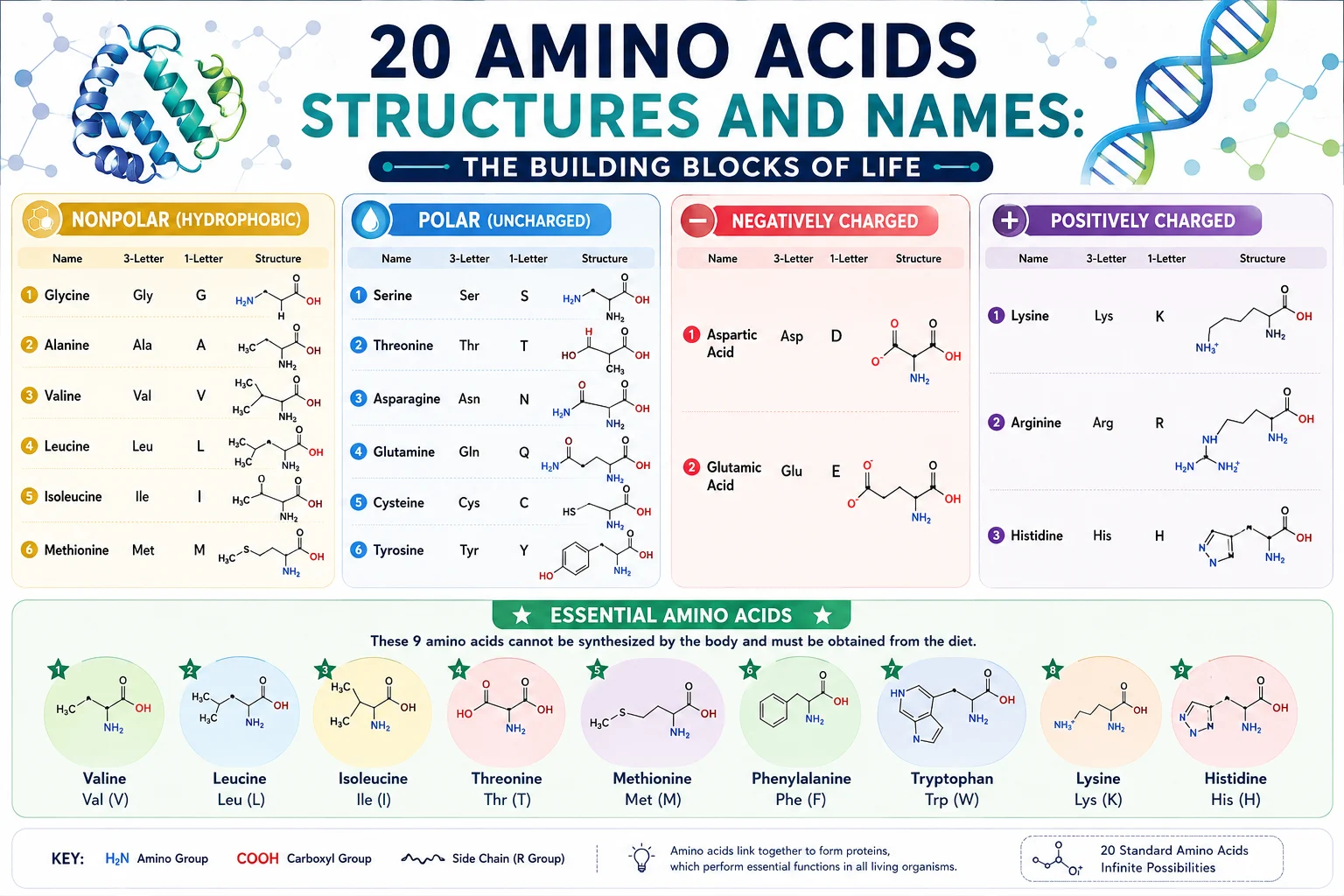
The 20 amino acids structures and names include Alanine, Arginine, Asparagine, Aspartic Acid, Cysteine, Glutamic Acid, Glutamine, Glycine, Histidine, Isoleucine, Leucine, Lysine, Methionine, Phenylalanine, Proline, Serine, Threonine, Tryptophan, Tyrosine, and Valine. Each has a three-letter code and one-letter code .
What Are Amino Acids?
What if 20 tiny molecules could explain how your body builds proteins, supports tissues, and carries out countless biological processes? That is exactly why 20 amino acids are so important in biology and biochemistry.
Before exploring the 20 amino acids and their structures, it helps to understand what an amino acid actually is. An amino acid is a small organic molecule built around a central carbon atom, known as the alpha carbon. It typically has four key components: an amino group (-NH₂), a carboxyl group (-COOH), a hydrogen atom (-H), and a variable side chain called the R-group.
The general structure is R-CH(NH₂)-COOH. The R-group acts like a molecular fingerprint, giving each amino acid its unique properties, shape, and biological role.
In this guide, you will find amino acid names, a complete amino acids list, the structures of 20 amino acids, and an easy-to-reference 20 amino acid chart. We will also provide a clear 20 amino acids table, making it easier to compare and understand all 20 amino acids at a glance.
How Are Amino Acids Classified?
To make sense of the 20 amino acids structures and names, scientists group them into categories based on their side chains. Here are the main groups :
1. Non-Polar (Hydrophobic) Amino Acids
These amino acids are water-fearing. They tend to hide inside proteins, away from water. They’re like the introverts of the amino acid world.
2. Polar (Hydrophilic) Amino Acids
These are water-loving. They interact well with water and are often found on protein surfaces, interacting with the watery environment inside and outside cells.
3. Charged Amino Acids
These amino acids carry a positive or negative electrical charge. They’re important for protein function and interactions .
4. Essential vs. Non-Essential
Some amino acids cannot be made by your body and must come from your diet (essential amino acids). The others can be synthesized by your body .
The 20 Amino Acids
Now let’s explore each of the 20 amino acids structures and names in detail. We’ll cover their three-letter abbreviations, one-letter codes, molecular formulas, and unique properties.
1. Alanine (Ala, A)
Molecular Formula: C₃H₇NO₂
Classification: Non-polar, aliphatic
Fun Fact: Alanine is one of the simplest amino acids, second only to glycine. It’s found in many proteins and is important for glucose metabolism.
Structure: CH₃-CH(NH₂)-COOH
2. Arginine (Arg, R)
Molecular Formula: C₆H₁₄N₄O₂
Classification: Basic, positively charged
Fun Fact: Arginine has a unique guanidine group that gives it a positive charge. It’s important for the urea cycle and immune function.
Structure: HN=C(NH₂)-NH-(CH₂)₃-CH(NH₂)-COOH
3. Asparagine (Asn, N)
Molecular Formula: C₄H₈N₂O₃
Classification: Polar, uncharged
Fun Fact: Asparagine is the first amino acid to be discovered, isolated from asparagus in 1806. It’s important for protein synthesis and neurological function.
Structure: H₂N-CO-CH₂-CH(NH₂)-COOH
4. Aspartic Acid (Asp, D)
Molecular Formula: C₄H₇NO₄
Classification: Acidic, negatively charged
Fun Fact: This amino acid is involved in many metabolic pathways. It’s a neurotransmitter and plays a role in the urea cycle.
Structure: HOOC-CH₂-CH(NH₂)-COOH
5. Cysteine (Cys, C)
Molecular Formula: C₃H₇NO₂S
Classification: Polar, uncharged
Fun Fact: Cysteine contains sulfur in its side chain, allowing it to form disulfide bonds that stabilize protein structures . It’s crucial for hair, skin, and nail formation.
Structure: HS-CH₂-CH(NH₂)-COOH
6. Glutamic Acid (Glu, E)
Molecular Formula: C₅H₉NO₄
Classification: Acidic, negatively charged
Fun Fact: Glutamic acid is one of the most abundant amino acids in the brain and serves as a neurotransmitter. It also enhances food flavor as MSG.
Structure: HOOC-(CH₂)₂-CH(NH₂)-COOH
7. Glutamine (Gln, Q)
Molecular Formula: C₅H₁₀N₂O₃
Classification: Polar, uncharged
Fun Fact: Glutamine is the most abundant free amino acid in the body. It’s crucial for immune function and gut health.
Structure: H₂N-CO-(CH₂)₂-CH(NH₂)-COOH
8. Glycine (Gly, G)
Molecular Formula: C₂H₅NO₂
Classification: Non-polar, aliphatic
Fun Fact: Glycine is the simplest amino acid, with just a hydrogen atom as its side chain. This small size allows it to fit into tight spaces in proteins.
Structure: NH₂-CH₂-COOH
9. Histidine (His, H)
Molecular Formula: C₆H₉N₃O₂
Classification: Basic, positively charged
Fun Fact: Histidine has an imidazole ring in its side chain, which allows it to act as a buffer at physiological pH. It’s essential for growth and tissue repair.
Structure: NH-CH=N-CH=C-CH₂-CH(NH₂)-COOH
10. Isoleucine (Ile, I)
Molecular Formula: C₆H₁₃NO₂
Classification: Non-polar, aliphatic
Fun Fact: This is an essential amino acid that must be obtained from food. It’s important for muscle metabolism and immune function.
Structure: CH₃-CH₂-CH(CH₃)-CH(NH₂)-COOH
11. Leucine (Leu, L)
Molecular Formula: C₆H₁₃NO₂
Classification: Non-polar, aliphatic
Fun Fact: Leucine is a branched-chain amino acid that stimulates muscle protein synthesis. It’s a popular supplement among athletes.
Structure: (CH₃)₂-CH-CH₂-CH(NH₂)-COOH
12. Lysine (Lys, K)
Molecular Formula: C₆H₁₄N₂O₂
Classification: Basic, positively charged
Fun Fact: Lysine is an essential amino acid involved in protein synthesis, hormone production, and calcium absorption. It’s often deficient in grain-based diets.
Structure: H₂N-(CH₂)₄-CH(NH₂)-COOH
13. Methionine (Met, M)
Molecular Formula: C₅H₁₁NO₂S
Classification: Non-polar, aliphatic
Fun Fact: Methionine is an essential amino acid that contains sulfur. It’s the starting amino acid for protein synthesis and is important for methylation reactions.
Structure: CH₃-S-(CH₂)₂-CH(NH₂)-COOH
14. Phenylalanine (Phe, F)
Molecular Formula: C₉H₁₁NO₂
Classification: Non-polar, aromatic
Fun Fact: This essential amino acid has a phenyl group that absorbs UV light. It’s a precursor to tyrosine, dopamine, and norepinephrine.
Structure: Ph-CH₂-CH(NH₂)-COOH
15. Proline (Pro, P)
Molecular Formula: C₅H₉NO₂
Classification: Non-polar, cyclic
Fun Fact: Proline is unique because its side chain connects back to the amino group, forming a ring. This rigid structure causes kinks in protein chains.
Structure: NH-(CH₂)₃-CH-COOH
16. Serine (Ser, S)
Molecular Formula: C₃H₇NO₃
Classification: Polar, uncharged
Fun Fact: Serine contains a hydroxyl group that is often phosphorylated to regulate protein function. It’s important for cell signaling and metabolism.
Structure: HO-CH₂-CH(NH₂)-COOH
17. Threonine (Thr, T)
Molecular Formula: C₄H₉NO₃
Classification: Polar, uncharged
Fun Fact: Threonine is an essential amino acid with a hydroxyl group. It’s important for protein synthesis, immune function, and fat metabolism.
Structure: CH₃-CH(OH)-CH(NH₂)-COOH
18. Tryptophan (Trp, W)
Molecular Formula: C₁₁H₁₂N₂O₂
Classification: Non-polar, aromatic
Fun Fact: Tryptophan is the largest amino acid and has an indole ring. It’s the precursor to serotonin and melatonin, affecting mood and sleep.
Structure: Ph-NH-CH=C-CH₂-CH(NH₂)-COOH
19. Tyrosine (Tyr, Y)
Molecular Formula: C₉H₁₁NO₃
Classification: Polar, uncharged
Fun Fact: Tyrosine is the precursor to important neurotransmitters like dopamine, norepinephrine, and epinephrine. It also contributes to thyroid hormones.
Structure: HO-Ph-CH₂-CH(NH₂)-COOH
20. Valine (Val, V)
Molecular Formula: C₅H₁₁NO₂
Classification: Non-polar, aliphatic
Fun Fact: Valine is an essential branched-chain amino acid important for muscle metabolism, energy production, and tissue repair.
Structure: (CH₃)₂-CH-CH(NH₂)-COOH
Quick Reference Table
| Amino Acid | 3-Letter Code | 1-Letter Code | Classification | Essential? |
|---|---|---|---|---|
| Alanine | Ala | A | Non-polar | No |
| Arginine | Arg | R | Basic | No (conditionally) |
| Asparagine | Asn | N | Polar | No |
| Aspartic Acid | Asp | D | Acidic | No |
| Cysteine | Cys | C | Polar | No |
| Glutamic Acid | Glu | E | Acidic | No |
| Glutamine | Gln | Q | Polar | No |
| Glycine | Gly | G | Non-polar | No |
| Histidine | His | H | Basic | Yes (children) |
| Isoleucine | Ile | I | Non-polar | Yes |
| Leucine | Leu | L | Non-polar | Yes |
| Lysine | Lys | K | Basic | Yes |
| Methionine | Met | M | Non-polar | Yes |
| Phenylalanine | Phe | F | Non-polar | Yes |
| Proline | Pro | P | Non-polar | No |
| Serine | Ser | S | Polar | No |
| Threonine | Thr | T | Polar | Yes |
| Tryptophan | Trp | W | Non-polar | Yes |
| Tyrosine | Tyr | Y | Polar | No (conditionally) |
| Valine | Val | V | Non-polar | Yes |
Why Amino Acids Matter
Amino acids are the building blocks of proteins, which are involved in virtually every function in your body. They help build muscle, repair tissue, produce enzymes and hormones, and support immune function . Understanding the 20 amino acids structures and names is the foundation for grasping biochemistry, nutrition, and molecular biology.
Frequently Asked Questions
What are the 20 amino acids and their structures?
The 20 standard amino acids include Alanine, Arginine, Asparagine, Aspartic Acid, Cysteine, Glutamic Acid, Glutamine, Glycine, Histidine, Isoleucine, Leucine, Lysine, Methionine, Phenylalanine, Proline, Serine, Threonine, Tryptophan, Tyrosine, and Valine . Each has a unique side chain attached to a central carbon with an amino group, carboxyl group, and hydrogen atom.
How are amino acids named?
Amino acids have three-letter abbreviations (like Ala for Alanine) and one-letter codes (like A) for convenience. Their full names come from their chemical structure, sources where discovered, or properties of their side chains .
What is the difference between polar and non-polar amino acids?
Polar amino acids have hydrophilic side chains that interact well with water, while non-polar amino acids have hydrophobic side chains that avoid water . This difference determines how amino acids arrange themselves in protein structures.
Which amino acids are essential?
Essential amino acids cannot be synthesized by the body and must come from food. They include Isoleucine, Leucine, Lysine, Methionine, Phenylalanine, Threonine, Tryptophan, and Valine . Histidine is also essential for children.
Why are amino acids important?
Amino acids are essential for building proteins, synthesizing hormones and neurotransmitters, supporting immune function, repairing tissues, and countless other bodily functions . Without them, life wouldn’t exist.
Conclusion
Understanding the 20 amino acids structures and names is like learning the alphabet of life. These 20 simple molecules combine in countless ways to create every protein in your body from the hemoglobin that carries oxygen to the collagen that gives your skin structure.
Whether you’re a student studying for a biochemistry exam, a health professional refreshing your knowledge, or someone simply curious about how your body works, mastering these amino acids is a crucial step. Each amino acid has its own personality, structure, and role to play in the complex symphony of life.
Remember: your body needs all 20 amino acids some made internally, some from food. The next time you eat a protein-rich meal, think about the incredible molecular story happening inside your body. Those amino acids are literally building the cells that make you who you are.

Scarlett Howard is a writer and name enthusiast at NicknameCorner. She creates creative and helpful guides on nicknames, names, usernames and naming ideas, helping readers find meaningful, memorable and unique names for every occasion.