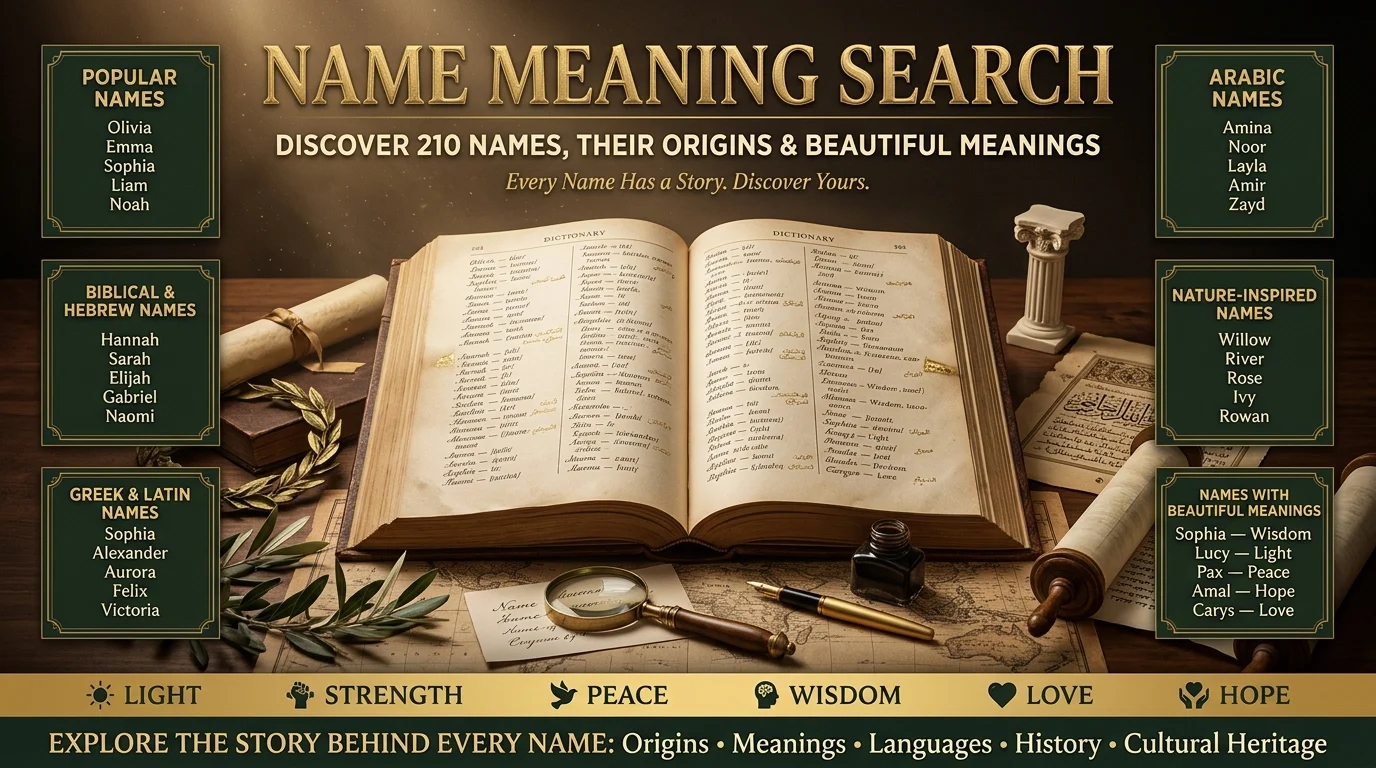
A name meaning search helps you explore a name’s meaning, language, origin, and cultural background. This guide includes 210 names grouped by style, origin, and meaning, making it easier to discover options and compare their associations.
Name Meaning Search: Popular Girl Names
These familiar choices have established histories and appealing meanings. They offer a starting point if you want a recognizable name with a meaningful background.
- Olivia — Latin; associated with the olive tree.
- Emma — Germanic; whole or universal.
- Amelia — Germanic; linked to work and effort.
- Sophia — Greek; wisdom.
- Isabella — Hebrew through Spanish and Italian; pledged to God.
- Mia — Used in several languages; often associated with “mine.”
- Charlotte — French feminine form of Charles; free person.
- Evelyn — English; historically linked to the name Aveline.
- Ava — Multiple possible origins; meaning depends on the tradition.
- Luna — Latin; moon.
- Grace — Latin; favor or blessing.
- Chloe — Greek; green shoot or young growth.
- Lucy — Latin; light.
- Nora — Often a short form of Honora or Eleanor.
- Zoe — Greek; life.
Popular Boy Names
This selection includes traditional and modern favorites with recognizable roots. Meanings range from strength and protection to peace, kindness, and family.
- Liam — Irish short form of William; resolute protector.
- Noah — Hebrew; rest or comfort.
- Oliver — Old French and Germanic associations; linked to the olive tree.
- James — English form of Jacob; traditionally “supplanter.”
- Elijah — Hebrew; my God is Yahweh.
- Theodore — Greek; gift of God.
- Henry — Germanic; ruler of the home.
- Lucas — Latin form related to Lucius; associated with light.
- Benjamin — Hebrew; son of the right hand.
- Alexander — Greek; defender of people.
- Daniel — Hebrew; God is my judge.
- Samuel — Hebrew; traditionally understood as heard by God.
- Jack — Medieval English form of John; God is gracious.
- Leo — Latin; lion.
- Arthur — Celtic origin is debated; traditionally associated with a bear.
Biblical Girl Names
Biblical names connect personal naming with stories, traditions, and religious history. Some have clear linguistic roots, while others have debated or uncertain etymologies.
- Hannah — Hebrew; grace or favor.
- Sarah — Hebrew; princess or noblewoman.
- Rebecca — Hebrew; traditionally linked to joining or binding.
- Rachel — Hebrew; ewe.
- Leah — Hebrew; meaning is uncertain.
- Esther — Possibly Persian; often associated with a star.
- Naomi — Hebrew; pleasantness.
- Ruth — Hebrew; commonly interpreted as friend or companion.
- Miriam — Hebrew; meaning is debated.
- Abigail — Hebrew; my father is joy.
- Elizabeth — Hebrew through Greek; my God is an oath.
- Martha — Aramaic; lady or mistress.
- Eve — Hebrew; life or living.
- Deborah — Hebrew; bee.
- Priscilla — Latin; ancient or venerable.
Biblical Boy Names
These names come from biblical figures and traditions. Their meanings can reflect Hebrew vocabulary, ancient naming customs, and religious interpretations.
- Adam — Hebrew; man or humankind.
- Abraham — Hebrew; traditionally “father of many.”
- Isaac — Hebrew; he will laugh.
- Jacob — Hebrew; traditionally associated with supplanting.
- Joseph — Hebrew; may he add.
- Moses — Traditionally connected with drawing out.
- Joshua — Hebrew; Yahweh is salvation.
- Caleb — Hebrew; commonly interpreted as whole-hearted or faithful.
- Nathan — Hebrew; he gave.
- Ethan — Hebrew; strong or enduring.
- Aaron — Hebrew or Egyptian origin proposed; meaning uncertain.
- Ezra — Hebrew; help.
- Micah — Hebrew; who is like God?
- Jonah — Hebrew; dove.
- Gabriel — Hebrew; God is my strength.
Hebrew Girl Names
Hebrew names often draw on words, phrases, and religious traditions. The following examples include names with meanings connected to nature, beauty, joy, and faith.
- Adina — Hebrew; delicate or gentle.
- Talia — Hebrew; dew from God.
- Shira — Hebrew; song or singing.
- Yael — Hebrew; ibex or mountain goat.
- Aviva — Hebrew; springtime.
- Dalia — Hebrew; branch or bough.
- Noa — Hebrew; movement or motion.
- Liora — Hebrew; my light.
- Maya — Has several origins; Hebrew associations include water.
- Eliana — Hebrew; my God has answered.
- Aliza — Hebrew; joyful.
- Tova — Hebrew; good.
- Ziva — Hebrew; radiance or brightness.
- Hadas — Hebrew; myrtle.
- Keren — Hebrew; horn or ray of light.
Hebrew Boy Names
These Hebrew-origin names have meanings associated with strength, kindness, nature, and devotion. Some are also widely used internationally in adapted spellings.
- Ariel — Hebrew; lion of God.
- Asher — Hebrew; happy or blessed.
- Eli — Hebrew; my God or high.
- Eitan — Hebrew form of Ethan; strong or enduring.
- Boaz — Hebrew; strength is in him.
- Gideon — Hebrew; meaning is debated, often linked to cutting down.
- Ilan — Hebrew; tree.
- Lior — Hebrew; I have light.
- Oren — Hebrew; pine or ash tree.
- Rafael — Hebrew form of Raphael; God has healed.
- Shai — Hebrew; gift.
- Tal — Hebrew; dew.
- Uri — Hebrew; my light.
- Zev — Hebrew; wolf.
- Amos — Hebrew; traditionally associated with carrying or burden-bearing.
Greek Girl Names
Greek names are found in mythology, literature, and ancient history. Many have meanings tied to virtues, natural imagery, or ideas that shaped classical culture.
- Alexandra — Greek; defender of people.
- Calliope — Greek; beautiful voice.
- Daphne — Greek; laurel tree.
- Irene — Greek; peace.
- Iris — Greek; rainbow.
- Penelope — Greek; etymology uncertain.
- Phoebe — Greek; bright or radiant.
- Theodora — Greek; gift of God.
- Xanthe — Greek; golden or yellow.
- Eudora — Greek; good gift.
- Melina — Greek; associated with honey.
- Agatha — Greek; good.
- Anastasia — Greek; resurrection.
- Cassandra — Greek; etymology uncertain.
- Clio — Greek; glory or fame.
Greek Boy Names
Greek-origin boy names include classical choices and names that have traveled through many languages. Their meanings often relate to leadership, courage, victory, or divine gifts.
- Andreas — Greek; manly or brave.
- Nicholas — Greek; victory of the people.
- Philip — Greek; lover of horses.
- George — Greek; farmer or earth-worker.
- Stephen — Greek; crown or wreath.
- Dimitri — Greek form of Demetrius; devoted to Demeter.
- Basil — Greek; royal or kingly.
- Evander — Greek; good man.
- Leander — Greek; lion-man.
- Orion — Greek mythological name; etymology uncertain.
- Theron — Greek; hunter.
- Timothy — Greek; honoring God.
- Xander — Short form of Alexander; defender of people.
- Achilles — Greek mythological name; meaning uncertain.
- Atlas — Greek mythology; bearer or enduring figure.
Latin Girl Names
Latin names often have roots in ancient Roman vocabulary, family names, and words that describe qualities or natural objects. These options have a classic, international feel.
- Clara — Latin; clear or bright.
- Flora — Latin; flower.
- Victoria — Latin; victory.
- Stella — Latin; star.
- Valentina — Latin; strong or healthy.
- Aurora — Latin; dawn.
- Felicia — Latin; fortunate or happy.
- Marina — Latin; of the sea.
- Serena — Latin; calm or serene.
- Vita — Latin; life.
- Camilla — Latin; ancient Roman name of uncertain origin.
- Livia — Ancient Roman family name; etymology uncertain.
- Aurelia — Latin; golden.
- Octavia — Latin; eighth.
- Cecilia — Latin; traditionally linked to the Roman family name Caecilius.
Latin Boy Names
Roman and Latin names have shaped naming traditions across Europe and beyond. This category includes names associated with light, honor, strength, and ancient Roman identity.
- Augustus — Latin; majestic or venerable.
- Felix — Latin; fortunate or happy.
- Maximus — Latin; greatest.
- Julius — Roman family name; origin uncertain.
- Marcus — Roman name traditionally associated with Mars.
- Victor — Latin; conqueror.
- Lucian — Latin; associated with light.
- Dominic — Latin; belonging to the Lord.
- Silas — Traditionally linked to Silvanus; association with forests.
- Cassian — Roman family name; etymology uncertain.
- Florian — Latin; flowering.
- Valerian — Latin; strong or healthy.
- Adrian — Latin; from Hadria.
- Titus — Ancient Roman name; meaning uncertain.
- Remus — Roman legendary name; etymology uncertain.
Arabic Girl Names
Arabic names can reflect qualities, nature, beauty, and spiritual values. Spellings and transliterations may differ between regions, so check the preferred pronunciation and written form.
- Amina — Arabic; trustworthy or faithful.
- Amal — Arabic; hope.
- Noor — Arabic; light.
- Layla — Arabic; night.
- Salma — Arabic; safe or peaceful.
- Jasmine — Persian-derived through Arabic usage; jasmine flower.
- Farah — Arabic; joy or happiness.
- Huda — Arabic; guidance.
- Mariam — Arabic form of Maryam; traditional meaning is debated.
- Rania — Arabic; often interpreted as gazing or looking.
- Samira — Arabic; evening companion in conversation.
- Yasmin — Persian-origin word used in Arabic; jasmine.
- Zahra — Arabic; radiant or blossoming.
- Nadia — Used across languages; Arabic association with caller or announcer.
- Dina — Used in several traditions; Arabic meaning depends on derivation.
Arabic Boy Names
Arabic boy names often express positive character traits, faith, or natural imagery. Some are shared across many countries and have several accepted English spellings.
- Amir — Arabic; prince or commander.
- Omar — Arabic; flourishing or long-lived.
- Zayd — Arabic; growth or increase.
- Karim — Arabic; generous or noble.
- Hassan — Arabic; handsome or good.
- Malik — Arabic; king or owner.
- Rayan — Arabic; often associated with luxuriance or well-watered growth.
- Samir — Arabic; evening companion in conversation.
- Tariq — Arabic; night visitor or morning star.
- Faris — Arabic; horseman or knight.
- Jamal — Arabic; beauty.
- Nabil — Arabic; noble.
- Salim — Arabic; safe or sound.
- Anas — Arabic; friendliness or affection.
- Bilal — Arabic; moisture or water; also a historic Islamic name.
Nature-Inspired Names
Nature names draw inspiration from plants, animals, landscapes, weather, and the sky. They can feel gentle, adventurous, or distinctive without relying on invented meanings.
- Willow — English; willow tree.
- River — English word name; flowing watercourse.
- Rose — English; rose flower.
- Jasper — Persian origin; traditionally associated with a precious stone.
- Lily — English; lily flower.
- Rowan — Irish and Scottish usage; rowan tree.
- Ivy — English; evergreen climbing plant.
- Hazel — English; hazel tree.
- Cedar — English; cedar tree.
- Sage — English; herb, also wisdom.
- Raven — English; black bird.
- Daisy — English; daisy flower.
- Heath — English; open land with low shrubs.
- Sky — English; the sky.
- Fern — English; leafy plant.
Names That Reflect Positive Qualities
Some parents prefer a name that expresses a value or personal hope. These choices are associated with ideas such as peace, courage, kindness, joy, and wisdom.
- Amity — Latin-derived English word; friendship.
- Constance — Latin; steadfastness.
- Verity — Latin; truth.
- Felicity — Latin; happiness or good fortune.
- Clement — Latin; merciful or gentle.
- Blythe — Old English; cheerful or carefree.
- Edmund — Old English; prosperous protector.
- Everett — Germanic; associated with strength and bravery.
- Imogen — Literary name of uncertain origin; associated with innocence.
- Mira — Multiple origins; meanings include peace or wonderful.
- Pax — Latin; peace.
- Asha — Sanskrit; hope or wish.
- Esme — French; esteemed or loved.
- Carys — Welsh; love.
- Valor — English word name; courage or bravery.
Frequently Asked Questions
1. How do I search for the meaning of a name?
Start with the exact spelling, then look for the name’s language of origin, historical forms, pronunciation, and documented meaning. Compare more than one reliable reference, especially if websites give different explanations.
2. Why can one name have several meanings?
Names can develop across languages, cultures, and centuries. A modern spelling may come from an older name, while similar spellings can have unrelated roots. Some traditional meanings are also debated by linguists.
3. What is the difference between a name’s meaning and its origin?
A name’s origin identifies the language or historical tradition from which it developed. Its meaning describes the sense associated with its original word or root. Neither necessarily tells you where everyone with that name comes from.
4. Are name meanings always historically accurate?
No. Some meanings are well supported by dictionaries and historical records, while others come from later traditions or popular interpretations. Ancient names can be especially difficult to explain because their original forms may have changed or disappeared.
5. Can I search for names by meaning instead of spelling?
Yes. Many name dictionaries allow searches by concepts such as “light,” “peace,” “strength,” or “hope.” You can also use this guide to explore names grouped by language, nature, and positive qualities.
6. Do different spellings change a name’s meaning?
Sometimes. A spelling may represent a regional pronunciation or a transliteration from another alphabet. Other times, similar-looking names have separate origins. Check the language and historical form rather than assuming two spellings are interchangeable.
7. How can I choose a meaningful name?
Consider its pronunciation, spelling, cultural background, and personal significance. Check whether the meaning is well supported and whether the name works naturally in the languages your family uses. A name should feel right to the people who will use it.
Conclusion
A useful name meaning search goes beyond finding a short definition. It helps you understand a name’s language, history, pronunciation, and cultural associations. This collection of 210 names offers a starting point, from familiar favorites and biblical choices to Arabic, Hebrew, Greek, Latin, and nature-inspired names. Before making a final choice, compare reliable references and check the spelling used in the relevant language. Remember that some name meanings are debated, and personal significance can be just as important as a dictionary definition.

Benjamin Clarke is a writer and nickname enthusiast at NicknameCorner.com, where he helps readers discover creative, meaningful, funny and unique nicknames for people, pets, usernames and special occasions. His content focuses on practical ideas, clear explanations and nickname inspiration that makes choosing the perfect name easier.









19 thoughts on “Name Meaning Search| 210 Names, Origins & Meanings”